
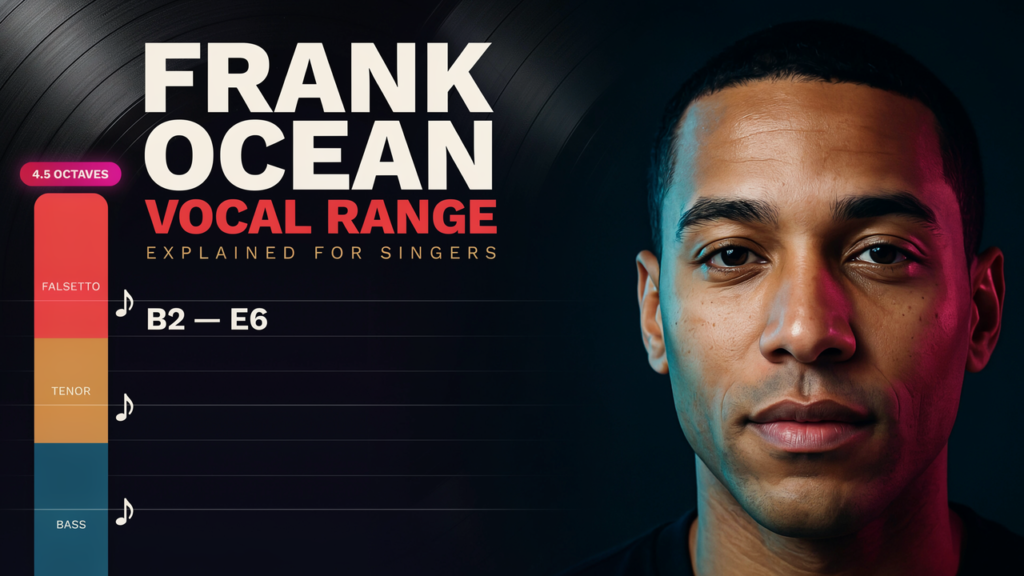
Frank Ocean’s vocal range is best understood as a baritone-colored R&B voice with a strong falsetto extension. Some online sources claim very wide ranges for him, especially across Blonde, but those claims often include falsetto, layered vocals, studio effects, and brief pitch peaks. A more useful answer is that Frank Ocean’s practical lead voice sits in a smooth lower-to-mid male range, while his falsetto gives many songs their floating, vulnerable high-register sound.
That difference matters because Frank Ocean is not a traditional power singer. His voice works through intimacy, tone, phrasing, restraint, and emotional detail. He can move upward with ease, but his biggest strength is how he makes a line feel private, unfinished, and deeply personal.
Frank Ocean’s Vocal Range at a Glance
Frank Ocean is often described as a baritone or baritone-leaning R&B singer, but that label does not capture the full picture. His lower voice has warmth and conversational weight, while his upper register often shifts into falsetto or heady coordination.
| Category | Best Description |
|---|---|
| Likely voice type | Baritone-colored R&B voice with tenor/falsetto extension |
| Common range discussion | Wide, but source-dependent |
| Strong song evidence | “Lost” is listed with vocals from C4 to G5 |
| Signature upper register | Light falsetto and head voice |
| Strongest vocal area | Intimate middle voice and emotional falsetto |
| Main styles | Alternative R&B, soul, pop, neo-soul |
For readers comparing him with standard categories, what is a baritone helps explain why a warm lower-middle voice can still use high falsetto notes. Frank’s range is not just about low-to-high distance; it is about how he changes vocal color between registers.
Evidence for His Lowest and Highest Notes
Frank Ocean’s exact full vocal range is not officially published in a simple lowest-note-to-highest-note format. Many range claims come from fan vocal-analysis videos, pitch databases, or album-level breakdowns. These can be useful, but they need context.
| Note/Range | Song or Context | Register/Production | Evidence Status |
|---|---|---|---|
| C4–G5 | “Lost” | Lead vocal song range | Strong song-level reference |
| Falsetto sections | “Thinkin Bout You” | Light upper register | Strongly associated with the song |
| D2–C6 / B1–C6 claims | Blonde vocal-analysis videos | May include effects, layers, or brief peaks | Source-dependent |
| Lower-middle voice | “Self Control,” “Nights,” “Ivy” | Modal/conversational voice | Strong listening pattern |
The song page for “Lost” lists Ocean’s vocal span as C4 to G5, which gives a clearer song-specific example than broad album-range claims. Meanwhile, “Thinkin Bout You” is frequently discussed for Ocean’s falsetto, and that falsetto is central to why the song feels so delicate.
The very wide Blonde claims should be treated carefully. On that album, Frank often uses layering, vocal manipulation, soft delivery, and altered textures. A high sound on a recording is not always the same thing as a clean, sustained, natural lead vocal note.
Is Frank Ocean a Tenor or Baritone?
Frank Ocean is usually best described as a baritone-colored singer rather than a straightforward tenor. His speaking-like delivery, warm lower-middle tone, and relaxed phrasing point toward baritone qualities. However, his falsetto and lighter upper register let him reach areas listeners often associate with tenor singing.
This is where pop and R&B voice labels become flexible. A strict classical tenor voice is judged by tessitura, timbre, passaggio, and repertoire. Frank Ocean’s music is built around microphones, studio atmosphere, and register shifts, so a classical label can only go so far.
The better description is practical: Frank has a lower-centered R&B voice with a beautiful upper extension. He does not need to belt constantly because his music often values vulnerability over volume.
Why Frank Ocean’s Falsetto Stands Out
Frank Ocean’s falsetto stands out because it feels emotional rather than decorative. In “Thinkin Bout You,” the falsetto does not simply show that he can sing high. It changes the emotional temperature of the song. The voice becomes lighter, more exposed, and more fragile.
Many R&B singers use falsetto, but Frank’s version often sounds less polished and more intimate. He lets small imperfections, soft attacks, and airy textures stay in the recording. That makes his high notes feel human instead of overly controlled.
This is also why comparing him with The Weeknd’s vocal range is useful. The Weeknd often uses falsetto as a glossy, dramatic signature. Frank Ocean’s falsetto usually feels more understated, closer to confession than performance.
Songs That Show Frank Ocean’s Vocal Range
“Thinkin Bout You” is the clearest example of Frank Ocean’s falsetto identity. The verses are smooth and restrained, while the upper-register moments create the song’s emotional lift.
“Lost” is useful because it has a listed C4–G5 song range. It shows a brighter, more rhythmic side of his voice, with the melody sitting higher than some of his more intimate tracks.
“Nights” shows Frank’s flexibility as a vocalist and writer. The song moves between rhythmic phrasing, melodic fragments, and softer sung sections, making range feel like part of the production rather than a separate display.
“Self Control” and “Ivy” show the emotional core of his voice. These songs are not about huge belted climaxes. They rely on tone, tension, layered vocals, and the feeling that the singer is half-speaking something too personal to fully explain.
How Frank Ocean Compares With Other R&B Singers
Compared with John Legend’s vocal range, Frank Ocean sounds lighter, less gospel-driven, and more atmospheric. Legend’s voice often feels fuller and more resonant, while Frank’s voice often feels closer, quieter, and more interior.
Compared with Usher’s vocal range, Frank is less about polished runs and dance-R&B smoothness. Usher often uses agility and clean control as a major feature. Frank uses tone, space, and lyrical mood.
A comparison with Justin Timberlake’s vocal range also makes sense because both use falsetto, but in different ways. Timberlake’s falsetto often feels crisp and pop-focused. Frank’s feels softer, moodier, and more fragile.
For a wider historical comparison, Prince’s vocal range shows how falsetto can become a core part of an artist’s identity. Frank Ocean is not a Prince-style virtuoso, but he similarly uses upper-register color as part of his emotional language.
If you want to compare your own notes with Frank Ocean songs, use a vocal range calculator first. Then check whether the main melody, not just the highest falsetto moment, sits comfortably in your voice.
Frequently Asked Questions
What is Frank Ocean’s vocal range?
Frank Ocean’s exact full vocal range is not officially fixed. Some sources claim very wide ranges, but a safer description is that he has a baritone-colored R&B voice with strong falsetto extension.
Is Frank Ocean a tenor or baritone?
Frank Ocean is best described as baritone-leaning or baritone-colored, with upper-register extension through falsetto and heady singing. His voice type should not be judged by falsetto notes alone.
What is Frank Ocean’s highest note?
Some fan and video analyses report very high notes for Frank Ocean, especially on Blonde, but those claims may include falsetto, layers, or studio effects. Song-level examples like “Lost” show him reaching G5.
Does Frank Ocean use falsetto?
Yes. Falsetto is one of Frank Ocean’s most recognizable vocal tools, especially in songs like “Thinkin Bout You.” He uses it for vulnerability, lift, and emotional contrast.
Why is Frank Ocean’s voice so recognizable?
Frank Ocean’s voice is recognizable because of his intimate tone, relaxed phrasing, soft falsetto, and unusual emotional delivery. His singing often feels conversational rather than showy.

Harlow is a vocal analysis and singing tools writer at Voice Range Test. She focuses on vocal range testing, voice type analysis, pitch recognition, and singing education tools for singers, musicians, choir performers, and beginners.