
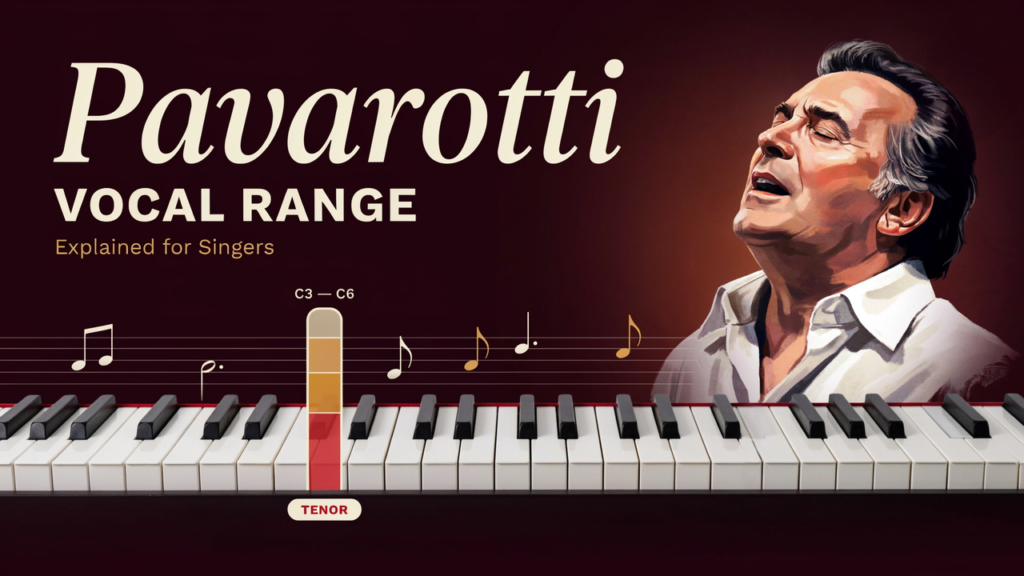
Luciano Pavarotti was an operatic tenor with well-documented performances of the tenor high C, C5. The Metropolitan Opera archive records his 1972 appearance in “La Fille du Régiment” and preserves a contemporary review discussing the aria’s nine high Cs. That is stronger evidence than an unsourced career-range chart.
C3–C5 is a familiar two-octave tenor reference, but this article does not certify it as Pavarotti’s complete personal range. Nor does it establish the circulating C-sharp3–F5 estimate as verified career boundaries.
Pavarotti’s Range: What Is Documented?
The most useful distinction is between a demonstrated stage note and an absolute maximum. Evidence that Pavarotti repeatedly performed high Cs establishes the former; it does not prove that he never sang above C5.
Likewise, a general tenor chart does not verify his lowest recorded note. A complete range study would need identifiable performances at both endpoints and consistent rules about which sounds count.
C3–C5 spans 24 semitones. C-sharp3–F5 would span 28 semitones, or two octaves plus four semitones. These calculations describe proposed intervals, not the quality or completeness of the supporting evidence.
The guide to tenor voices provides the broader classification context without turning conventional chart boundaries into personal limits.
The Nine High Cs at the Metropolitan Opera
The Metropolitan Opera archive for February 17, 1972 lists Pavarotti as Tonio in Donizetti’s “La Fille du Régiment,” alongside Joan Sutherland as Marie.
The archived contemporary review specifically discusses the nine high Cs and describes Pavarotti in the lyric tenor repertoire. This supports both the performance context and the high-C evidence.
The record should be cited with its actual date rather than borrowing a different date from a retelling. A performance listing and its accompanying review are more informative than a compilation title that simply announces a maximum note.
What Is a Tenor High C?
In scientific pitch notation, a tenor high C is C5, one octave above middle C, C4. It should not be confused with soprano high C, C6, which is another octave higher.
This octave distinction matters when comparing singers. The same letter name can refer to substantially different pitches, and a score may use an octave convention for a vocal part.
Repeated stage high notes also present a different task from producing an isolated pitch in a test. The singer must coordinate the approach, text, tuning, and subsequent phrase within the demands of the whole role.
Was Pavarotti a Lyric Tenor?
Lyric tenor is supported by the contemporary assessment preserved in the Met record. Unlike a pop label inferred only from a recording’s tone, it sits within his actual operatic performance context.
A classification still does not tell us every note a singer can produce. It concerns the voice’s musical function, tonal character, and suitable repertoire, alongside range.
The comparison of tenor and baritone explains why shared notes do not erase differences between voice types. Two singers can reach the same pitch while finding very different repertoire comfortable.
Does the F5 Claim Establish His Highest Note?
No verified F5 maximum is established by the evidence reviewed here. Before accepting such a claim, identify the original recording, timestamp, pitch, and vocal context.
Do not assume how the note was produced merely because it lies above C5. Falsetto, a brief effect, an altered recording, or a transcription error are possibilities to investigate, not facts that follow from the pitch label.
A clearly attributable performance could expand the documented range. Until it is examined, the claim should remain separate from the securely sourced high-Cs discussion.
Range Is Different from Tessitura
A role’s tessitura describes where its music spends much of its time. A singer may reach a high note briefly yet find repeated phrases below it demanding.
An octave count leaves out duration, diction, dynamic control, and recovery between phrases. It also does not measure how the voice carries in an operatic setting.
This is why comparisons with Dimash should identify the registers and performance conditions being compared. An isolated extreme and a sustained operatic phrase are different achievements.
What Singers Can Learn from the High-C Example
Study the musical phrase around a difficult note rather than treating the peak as a standalone target. Learn the rhythm and text, identify the approach interval, and choose material suited to your present voice.
Do not make C5 a compulsory goal because a famous tenor performed it. A teacher familiar with your repertoire can help assess readiness and choose an appropriate key or exercise.
Comparisons with Josh Groban can also clarify why classical crossover and opera should not be assessed solely through matching endpoints. Repertoire and performance conditions matter.
Frequently Asked Questions
How many octaves could Pavarotti sing?
C3–C5 is a two-octave reference often associated with tenor singing. This review does not establish it as his complete measured career range.
Was C5 his highest possible note?
The archive supports C5 as a demonstrated stage note. It does not establish an absolute ceiling.
Did he sing nine high Cs?
The Met’s February 17, 1972 archive and preserved review document the performance context and nine-high-C achievement.
Does F5 prove a wider operatic range?
Only after the specific recording and vocal sound are verified. A number alone does not establish a sustained operatic capability.

Harlow is a vocal analysis and singing tools writer at Voice Range Test. She focuses on vocal range testing, voice type analysis, pitch recognition, and singing education tools for singers, musicians, choir performers, and beginners.