
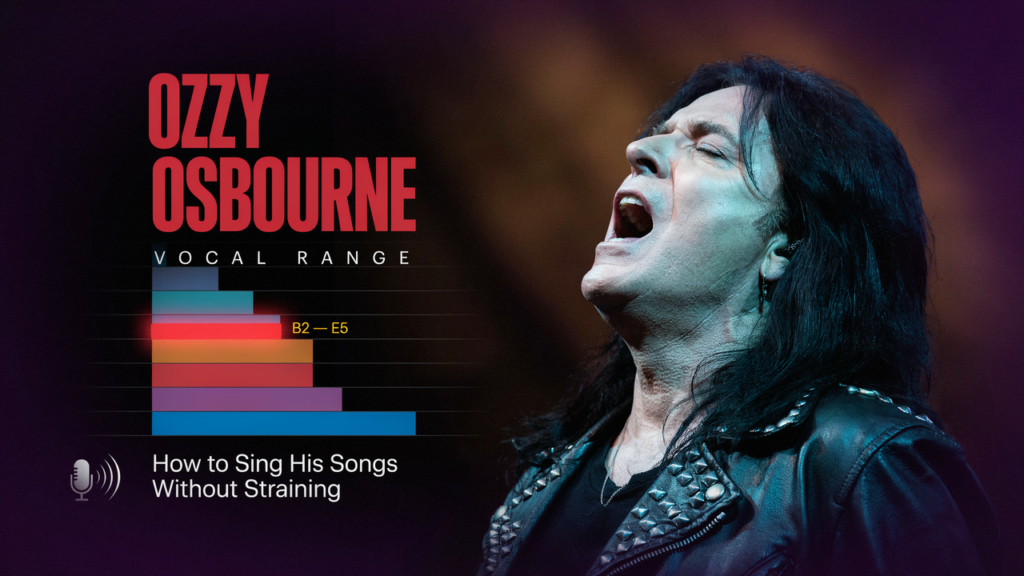
Ozzy Osbourne’s complete recorded vocal range is not verified by the sources reviewed here. A1–D-sharp5 is a circulating estimate, not an established set of career boundaries. It spans three and a half octaves mathematically, but both endpoint attributions still require direct evidence.
His songs should be assessed through the lead melody, its repeated tessitura, and the particular recording or arrangement. A database maximum can include material that says little about the demands of singing a complete song.
What Does the A1–D-sharp5 Claim Mean?
A1 to A4 covers 36 semitones; A4 to D-sharp5 adds six. The total is 42 semitones, or three octaves plus a tritone.
That calculation does not confirm an A1 in “Trap Door” or a D-sharp5 in “Miracle Man.” Those attributions need exact versions, timestamps, and clear identification of the lead voice. A low effect and a sustained melodic note are different forms of evidence.
Nor should an unusually low number be dismissed merely because it seems surprising. It should be checked, with the same standards used for a high-note claim. Plausibility is not measurement.
A “Crazy Train” Score—and an Octave Caution
The Musicnotes “Crazy Train” piano/vocal/guitar edition, product MN0080962, lists G-sharp4–A5 for the voice part in F-sharp minor.
This is a publisher’s written range for one arrangement. It must not be used by itself to claim that Osbourne’s recorded lead vocal sounds in that octave. Check the staff convention and the performance before making that conversion.
The interval is 13 semitones: one octave plus a semitone. Performing a line an octave below its written placement changes every pitch by 12 semitones while preserving its width and pitch classes. Transposing into a different key is a separate operation.
The example shows why copying sheet-music metadata directly into an artist’s range table can create misleading extremes.
Tenor, Baritone, and Rock Vocal Labels
This review does not establish a formal classical classification for Osbourne. A bright or cutting sound is not sufficient evidence for tenor, just as a low sound does not prove baritone or bass.
In amplified rock, labels are often used descriptively. They do not automatically imply the projection, repertoire, or registration expectations associated with operatic voice categories.
The concept of tessitura is more helpful for a cover singer: where does the song keep asking your voice to work, and can you sustain that placement comfortably?
Comparisons with Rob Halford should distinguish clearly sung phrases from screams and other effects before comparing octave totals.
Learning a Riff-Based Vocal Line
Start by identifying the lead melody independently of the guitar. A repeated instrumental riff can be a useful cue, but following the guitar’s pitches instead of the vocal line can introduce errors.
Speak the words in rhythm, then sing a short phrase at a comfortable volume. Check the entrance and final note before adding stylistic intensity. Repetition should improve accuracy rather than simply make the sound louder.
When the phrase works alone, add the backing track at a level that lets you hear yourself. If you begin pushing to compete with the instruments, change the monitoring balance instead.
Why a High-Sounding Voice Is Not a Range Measurement
Brightness can make a voice seem penetrating even when the melody is not at an extreme pitch. Conversely, a dark sound may contain a higher fundamental than a listener expects.
Describe the audible quality separately from the measured note. Avoid inferring exact vocal-fold compression, breath pressure, or anatomical behavior from a finished mix.
A comparison with Robert Plant can examine phrase placement and sound, while Bruce Dickinson provides another context for discussing sustained rock repertoire. Similar genre labels do not make the vocal demands identical.
Studio and Live Versions Need Separate Records
Keep the release, date, key, and vocal attribution with any claimed endpoint. A live arrangement may change a melody, and a commercial track may contain doubled vocals or harmonies. Neither situation should be assumed to explain a specific note without inspection.
Do not infer a medical cause for a change heard between performances. Different musical choices and recording conditions can affect the result, and a clip does not provide a clinical assessment.
The same source discipline applies when reading about Corey Taylor’s range, particularly where melodic singing and rougher effects are discussed together.
Choosing a Workable Cover Key
Test the repeated chorus and the lower verse before settling on a key. Moving the song down may ease the top but make the verse too low. A good key supports the complete performance.
Practice cleanly before attempting a rough texture. Pain, new hoarseness, or loss of comfortable notes are reasons to stop; imitating a recording is not a reason to continue through symptoms.
Frequently Asked Questions
Did Ozzy Osbourne have three and a half octaves?
A1–D-sharp5 has that width, but this review does not certify its endpoints as verified career limits.
Does the “Crazy Train” score prove A5 was his sung maximum?
No. The cited listing is arrangement metadata. Written octave placement and the recorded vocal must be checked separately.
Was he definitely a tenor?
No formal classical classification is established here. Popular voice descriptions should not be treated as standardized assessments.
Does a wider range make a better rock singer?
No. Accurate phrasing, rhythm, expression, and repeatability are separate musical abilities.

Harlow is a vocal analysis and singing tools writer at Voice Range Test. She focuses on vocal range testing, voice type analysis, pitch recognition, and singing education tools for singers, musicians, choir performers, and beginners.