
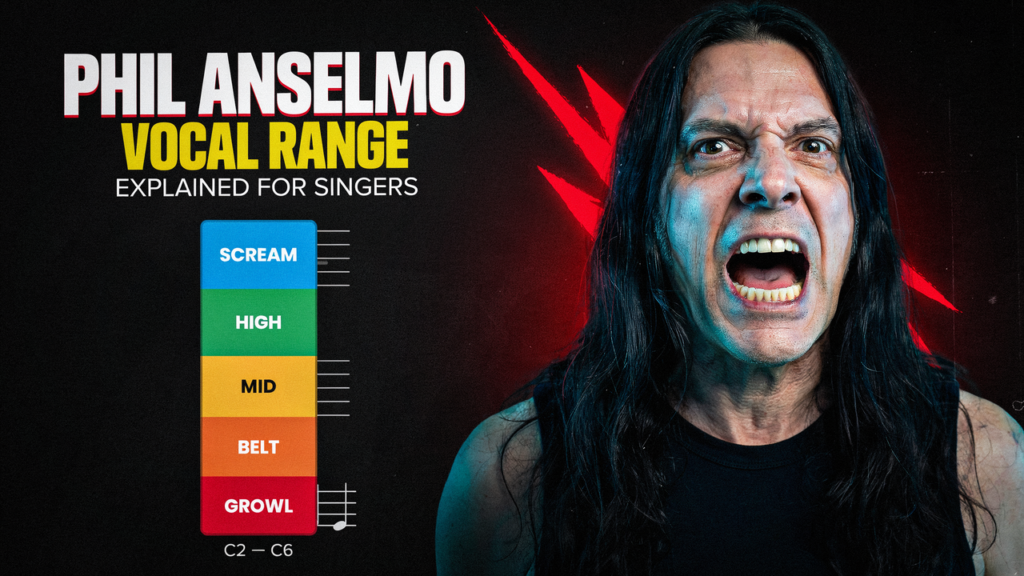
Phil Anselmo’s vocal range is commonly reported as approximately E1 to B♭5, spanning four octaves and six semitones. Some fan-led analyses extend his lower boundary to C♯1, while other estimates place his highest pitched sound near C6 or F6.
Those headline figures require qualification. Anselmo’s recordings contain clean singing, high metal vocals, falsetto-like production, vocal fry, growls, screams, and heavily distorted sounds. They cannot all be treated as equally clear or sustainable sung notes. His clean, identifiable range is narrower than the widest measurement of every sound he has produced.
What Is Phil Anselmo’s Vocal Range?
Phil Anselmo’s reported E1–B♭5 range combines conventional singing with extreme vocal production. The span is impressive, but the first-octave lows likely involve fry, growling, or distortion rather than full, sustained baritone notes.
His early Pantera recordings provide the strongest evidence of his upper singing. On Cowboys from Hell, Anselmo frequently used bright, high metal vocals that contrasted sharply with the lower, rougher sound he adopted on later albums.
A practical profile looks like this:
| Vocal category | Approximate area | Evidence assessment |
|---|---|---|
| Widely reported total range | E1–B♭5 | Includes extreme or distorted production |
| Wider fan estimate | C♯1–B♭5 | Strongly dependent on fry and growl classification |
| Conservative clean lower area | Around G2 and above | More representative of recognizable singing |
| High pitched singing | Fifth octave | Clearly demonstrated in early Pantera material |
| Reported sixth-octave sounds | Up to C6 or F6 | May involve screams, harmonies, or octave-identification issues |
| Likely voice type | Baritone with a high extension | Contemporary description, not a formal classical Fach |
The most defensible approach is to describe Anselmo’s clean tonal range and harsh-vocal production separately.
Phil Anselmo’s Lowest and Highest Reported Notes
The lowest note commonly assigned to Anselmo is E1, although C♯1 also appears in some fan analyses. Both pitches fall unusually low for conventional baritone singing.
These sounds may be measurable as pitches, but that does not mean they have the resonance, stability, or repeatability of ordinary clean notes. Fry-based production can create very low frequencies with little resemblance to the singer’s normal tessitura.
At the upper end, B♭5 is a more conservative reported boundary. Claims reaching C6 or F6 require additional caution. Very high metal screams contain strong overtones, and different pitch-analysis methods may identify an overtone instead of the fundamental frequency.
| Note or range | Song or context | Vocal production | Evidence status |
|---|---|---|---|
| C♯1–E1 | Reported extreme lows | Fry, growl, or heavy distortion | Source-dependent |
| Around G2 | Lower clean singing | Dark baritone production | More practical clean boundary |
| B♭3–G5 | “The Art of Shredding” | High pitched metal singing | Song-specific estimate |
| Fifth-octave highs | “Cemetery Gates,” “Shattered,” “Medicine Man” | Clean-to-distorted high singing | Strongly demonstrated |
| B♭5 | Reported upper boundary | High metal coordination | Commonly reported |
| C6–F6 | “Psycho Holiday” and other extreme attributions | Scream, harmony, or possible octave ambiguity | Disputed |
A clean isolated recording can be examined with a frequency finder, but distorted vocals are difficult to measure accurately because their overtone structure can dominate the detected pitch.
How Many Octaves Could Phil Anselmo Sing?
Using the commonly reported E1–B♭5 boundaries, Anselmo’s total production range spans 54 semitones, or four octaves and six semitones.
The wider C♯1–B♭5 estimate covers 57 semitones, equal to four octaves and nine semitones. Neither figure represents a clean, repeatable singing range from bottom to top.
A proposed G2–C6 clean or pitched range would cover three octaves and five semitones, but the C6 boundary still depends on how the high sound is classified.
It is therefore more accurate to say that Anselmo demonstrated a broad multi-octave range across several vocal productions. Claiming one exact range without explaining what it includes gives a misleading picture of his voice.
Is Phil Anselmo a Baritone or Tenor?
Phil Anselmo is best described as a baritone with an unusually high extension, especially during his early Pantera years.
His speaking-like middle register, dark clean tone, and later heavy-vocal tessitura support the baritone description. However, songs from Cowboys from Hell show that he could reach the upper fifth octave using bright metal singing, head-dominant coordination, and varying degrees of distortion.
High notes alone do not make him a tenor. Voice type also depends on tessitura, timbre, vocal weight, and register transitions. Likewise, his fry-based first-octave sounds do not make him a bass.
The baritone voice profile explains why a singer can possess high extension without changing the central classification. Anselmo’s combination of baritone weight and aggressive metal phrasing can also be compared with James Hetfield’s vocal range.
Clean Singing Versus Harsh Vocals
Anselmo’s clean singing is clearest in songs such as “Cemetery Gates,” “Hollow,” “Planet Caravan,” “This Love,” and “Suicide Note Pt. I.” These performances reveal pitch, vibrato, phrasing, and tonal control that may be obscured in his harsher material.
His high metal singing uses a brighter setup and reduced vocal weight. Early songs frequently combine this coordination with rasp or distortion, but the underlying melody remains identifiable.
Growls and low harsh sounds behave differently. They may contain a perceived pitch, yet the noise component makes it harder to determine a single musical note. Screams can create the opposite problem: upper harmonics may sound higher than the fundamental pitch.
This is why Anselmo’s voice cannot be summarized properly by one piano-style note span. Corey Taylor’s vocal profile offers another useful example of separating clean singing from harsh production, while Chris Cornell’s range provides a contrasting model of high rock singing with controlled distortion.
Songs That Demonstrate His Vocal Range
Several Pantera songs reveal distinct parts of Anselmo’s voice:
- “Cemetery Gates” moves from melodic clean singing to increasingly intense high notes, ending with a famous exchange between Anselmo’s voice and Dimebag Darrell’s guitar.
- “Shattered” displays bright, sustained high metal vocals associated with Anselmo’s earlier style.
- “Medicine Man” contrasts heavier middle-register singing with dramatic upper extension.
- “The Sleep” combines controlled melodic lines with forceful high singing.
- “The Art of Shredding” reportedly spans approximately B♭3–G5, demonstrating an elevated tessitura.
- “Psycho Holiday” contains very high vocal moments, although the proposed F6 boundary should be treated cautiously.
- “Hollow” begins with softer, cleaner singing before shifting into rasp and aggressive vocals.
- “Planet Caravan” emphasizes a restrained, atmospheric clean tone rather than power or extreme range.
His early high-metal style invites comparison with Rob Halford’s vocal range and Bruce Dickinson’s vocal range. Anselmo later moved toward a heavier, more speech-based and distorted approach rather than continuing to center his performances on piercing upper notes.
How His Vocal Approach Changed
Anselmo’s vocal approach changed substantially across his career. Early Pantera material featured high, melodic heavy-metal singing. Later recordings increasingly emphasized chest-dominant aggression, compressed rasp, shouting, growls, and lower melodic passages.
That shift should not automatically be described as losing his entire range. Artistic direction, repertoire, vocal coordination, performance choices, and career stage can all change which notes a singer uses publicly.
It is reasonable to observe that later live performances generally do not reproduce every early high note in the same way. It would not be responsible, however, to diagnose the medical cause of that change from recordings alone.
Extreme metal vocals should never be copied by forcing the throat or singing through pain. Persistent hoarseness, loss of normally easy notes, burning, or speaking-voice changes are reasons to stop and seek qualified guidance.
Frequently Asked Questions
What is Phil Anselmo’s vocal range?
His total range is commonly reported as E1–B♭5, spanning four octaves and six semitones. This estimate includes fry, growls, distortion, and high metal vocals rather than only clean singing.
What is Phil Anselmo’s highest note?
B♭5 is a commonly reported upper boundary. Claims reaching C6 or F6 exist, but those sounds may be screams, harmonies, overtones, or octave-identification errors.
What is Phil Anselmo’s lowest note?
E1 is frequently cited, while some analyses report C♯1. These extremely low sounds are more likely fry- or growl-based than sustained conventional singing.
Is Phil Anselmo a baritone?
Yes. Baritone is the most practical classification for his central voice, although his early recordings demonstrate an unusually strong high extension.
What song best demonstrates Phil Anselmo’s range?
“Cemetery Gates” is the clearest overall showcase because it combines melodic clean singing, increasing intensity, and extreme high metal vocals.
Did Phil Anselmo use falsetto?
Some early upper notes have a light or head-dominant quality that may be described as falsetto-like. However, his high singing often combines multiple coordinations with distortion, so one label does not fit every note.

Harlow is a vocal analysis and singing tools writer at Voice Range Test. She focuses on vocal range testing, voice type analysis, pitch recognition, and singing education tools for singers, musicians, choir performers, and beginners.