
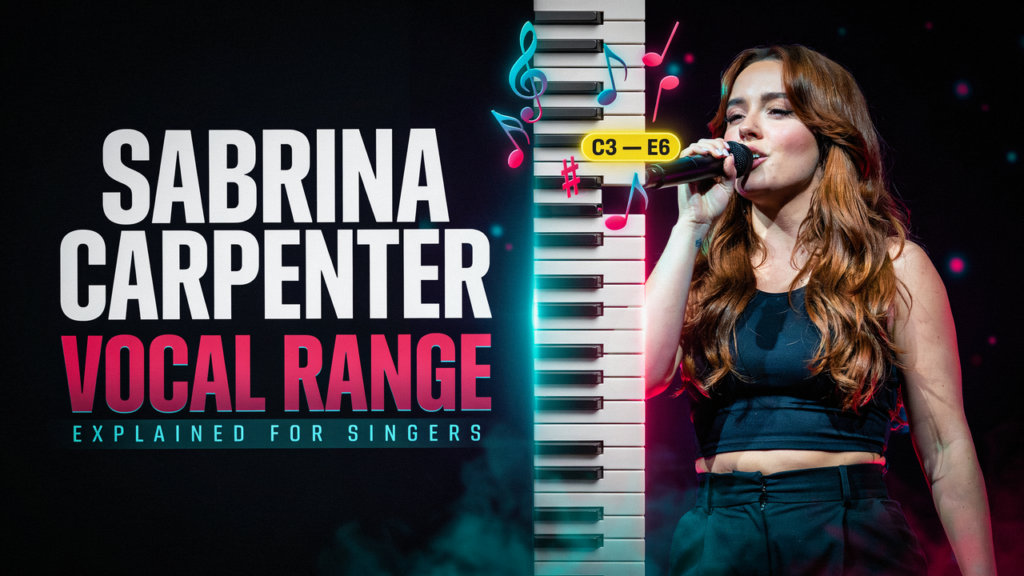
Sabrina Carpenter’s documented vocal range is commonly estimated at C3 to D6, spanning three octaves and two semitones. The lowest note is associated with “Shadows,” while the upper D6 is linked to “Alien.” However, these extremes should be treated as recording-based estimates rather than the fixed limits of her voice.
Carpenter does not build her vocal identity around extreme notes. Her strengths are a bright upper register, controlled mixed voice, agile phrasing, layered harmonies, and the ability to shift between breathy intimacy and a clearer pop belt.
Sabrina Carpenter’s vocal range C3–D6
131–1,175 Hz · 3 octaves and 2 semitones · Soprano-oriented pop voice
Documented range You
Don’t know your range? Take the voice range test.
What Is Sabrina Carpenter’s Vocal Range?
The most supportable published estimate for Sabrina Carpenter’s singing range is C3–D6.
| Range detail | Estimated note |
|---|---|
| Lowest documented note | C3 |
| Highest documented note | D6 |
| Total span | 38 semitones |
| Octave span | 3 octaves and 2 semitones |
| General voice category | Soprano-oriented pop voice |
| Strongest vocal area | Midrange through upper-middle register |
The Singing Carrots artist database connects the low C3 with “Shadows” and the high D6 with “Alien.” Its database also explains that artist ranges are estimates based on the songs it has catalogued. The numbers do not necessarily represent every note a singer can produce.
That distinction is important. A documented range includes notes found somewhere in a recording or performance, while a singer’s usable range consists of notes that can be produced consistently, clearly, and musically.
Sabrina Carpenter’s Lowest and Highest Notes
Carpenter’s reported C3 and D6 do not carry equal evidential weight in every context. Production techniques, background harmonies, layered vocals, and brief ad-libs can make an isolated pitch difficult to interpret.
| Note | Song | Context | Evidence status |
|---|---|---|---|
| C3 | “Shadows” | Low recorded phrase | Database-supported estimate |
| D6 | “Alien” | Brief upper-register production | Database-supported and context-dependent |
| G3–A4 | “Espresso” | Main song melody | Narrower, song-specific range |
| F♯3–E5 | “Feather” | Main melody and upper phrases | Representative recorded-song range |
The C3–D6 measurement should therefore be described as Carpenter’s commonly documented recorded range, not necessarily her everyday performance range.
The upper D6 also does not establish that D6 is a routinely sustained note in her repertoire. A momentary head-voice note, background layer, or studio harmony should not be treated like a repeated lead-vocal note.
How Many Octaves Can Sabrina Carpenter Sing?
A range from C3 to D6 equals 38 semitones. Since three complete octaves contain 36 semitones, Sabrina Carpenter’s documented range spans three octaves and two additional semitones.
It is reasonable to summarize this as “just over three octaves.” Calling it three and a half octaves would exaggerate the measurement.
Most individual songs use far less than her total catalogued range. “Espresso,” for example, is commonly measured at roughly G3–A4. Its challenge comes more from rhythmic precision, phrasing, articulation, and maintaining a relaxed pop tone than from covering three octaves.
Readers can compare their own lowest and highest sustainable notes using the vocal range calculator. A useful comparison should use clear, repeatable notes rather than vocal fry, strained sounds, or pitches reached only once.
Is Sabrina Carpenter a Soprano?
Sabrina Carpenter is commonly described as a soprano, but “soprano-oriented contemporary pop singer” is more defensible than assigning her a precise classical subtype.
Her voice displays several soprano-associated characteristics:
- A naturally bright and youthful tone
- Comfortable access to the upper-middle register
- Light, flexible phrasing
- Clear head-voice production
- Less emphasis on a heavy lower register
- Agility in quick melodic decorations and ad-libs
Some online descriptions call her a light lyric soprano. That label may sound plausible, but a formal classification requires more than identifying high notes. Classical voice type also considers tessitura, passaggi, vocal weight, resonance, timbre, and how the voice behaves without studio amplification.
Our guide to what a soprano is explains why range alone cannot determine voice type.
Her Comfortable Range and Tessitura
Carpenter’s total documented range is not the same as her tessitura. Tessitura refers to the part of the range where most of a song sits and where the singer can work comfortably for sustained periods.
Much of Carpenter’s pop repertoire centers on her middle and upper-middle voice. She frequently moves between a conversational lower delivery, a light mix, and head-dominant upper notes. Her songs rarely depend on maintaining the C3–D6 extremes continuously.
This differs from singers whose arrangements emphasize heavier belting. For example, Christina Aguilera’s vocal range is often demonstrated through more forceful belts and dramatic register contrasts. Carpenter generally favors lighter coordination and close-microphone detail.
How Sabrina Carpenter Uses Her Voice
Carpenter’s vocal technique is better understood through coordination and phrasing than through range alone.
Light mixed voice: She blends chest and head resonance through the upper-middle register instead of carrying a consistently heavy chest-dominant sound upward.
Breathy phrasing: Airy onsets and intimate delivery create softness, especially in verses. This is often a stylistic choice rather than evidence that the voice lacks power.
Head voice: Her upper register is typically brighter and lighter than her speaking-range production. Brief high notes can sound effortless because she avoids making every pitch a heavy belt.
Agility and articulation: Fast lyrics, clean consonants, slides, and small melodic turns are central to her style. “Espresso” relies heavily on this rhythmic accuracy.
Layered harmonies: Studio arrangements often place several vocal lines around the lead. These layers enrich the sound but must be separated from her main melody when measuring range.
Similar light contemporary coordination can be heard in parts of Tate McRae’s vocal approach, although McRae often uses a darker, huskier color. Olivia Rodrigo’s vocal style generally introduces more chest-dominant intensity and deliberate tonal roughness.
Songs That Demonstrate Her Voice
“Espresso” demonstrates Carpenter’s rhythmic control, diction, and relaxed midrange delivery. It is not the best single example of her full range, but it accurately represents her modern pop style.
“Feather” shows more upper extension, lightness, and smooth movement between vocal qualities. Its melodic writing provides a clearer example of how she approaches brighter upper notes without relying on constant heavy belting.
“Alien” is important in discussions of her highest catalogued pitch, although the D6 should be presented as an extreme, context-dependent note rather than the center of her normal singing range.
For another bright contemporary voice with a different theatrical foundation, compare Carpenter with Rachel Zegler’s vocal range. Zegler’s singing more clearly reflects musical-theatre projection, while Carpenter’s delivery is optimized for close-miked contemporary pop.
Frequently Asked Questions
What is Sabrina Carpenter’s vocal range?
Sabrina Carpenter’s commonly documented recorded range is approximately C3–D6, which equals three octaves and two semitones.
What is Sabrina Carpenter’s highest note?
Her highest commonly catalogued note is D6 in “Alien.” Because it is an extreme upper-register pitch within a produced recording, it should not be confused with her regular tessitura.
What is Sabrina Carpenter’s lowest note?
Her lowest catalogued note is C3, associated with “Shadows.” It represents an extreme in her documented range rather than the area where most of her songs sit.
Is Sabrina Carpenter a soprano or mezzo-soprano?
She is generally described as a soprano because of her bright timbre and comfortable upper register. A more specific classical subtype cannot be confirmed from range alone.
Does Sabrina Carpenter have a three-octave range?
Yes. The reported C3–D6 span covers three complete octaves plus two semitones.
Is “Espresso” difficult to sing?
“Espresso” is not exceptionally wide in range, but its rhythmic delivery, precise diction, breath management, and relaxed tone can make it deceptively challenging.

Harlow is a vocal analysis and singing tools writer at Voice Range Test. She focuses on vocal range testing, voice type analysis, pitch recognition, and singing education tools for singers, musicians, choir performers, and beginners.