
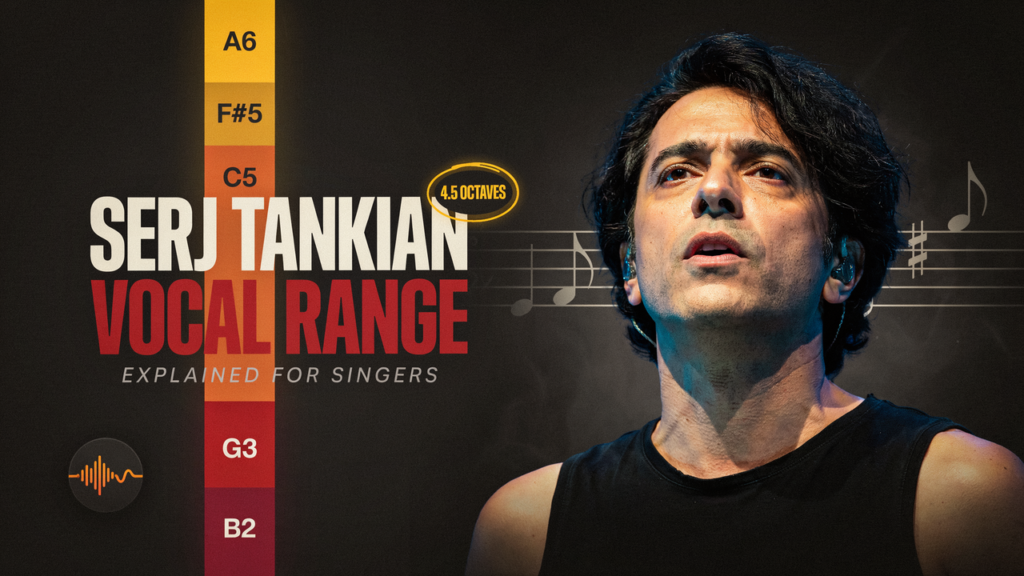
Serj Tankian’s vocal range is commonly estimated at D2 to F5 when focusing on conventional singing, giving him approximately three octaves and three semitones. Broader estimates extend his range to roughly C2–E6, but these figures include screams, distorted sounds, spoken effects and other unconventional vocalizations.
The difference matters because Serj does much more than sing clean melodies. His performances combine resonant low notes, forceful upper-register singing, theatrical character voices, aggressive distortion and high screams. Consequently, one range figure cannot accurately represent every sound he produces.
What Is Serj Tankian’s Vocal Range?
A practical summary of Serj Tankian’s range is:
| Range category | Approximate notes | Span | What it includes |
|---|---|---|---|
| Conventional singing range | D2–F5 | 3 octaves, 3 semitones | Clean and recognizably pitched singing |
| Effects-inclusive range | C2–E6 | 4 octaves, 4 semitones | Screams, distorted notes and experimental vocal effects |
| Frequently used area | Roughly G2–C5 | Varies by song | Most melodic System of a Down and solo material |
These boundaries should be treated as informed estimates rather than permanent physiological limits. Studio layering, vocal effects, live transposition and differences between clean singing and screaming can all affect range calculations.
Serj’s usable range is more important than an isolated extreme note. He regularly moves between low, speech-like phrases and intense upper notes while maintaining a distinctive vocal identity.
Serj Tankian’s Lowest Notes
Serj’s lower register has a dark, weighty quality associated with a baritone voice. His low notes are not merely occasional extensions. They contribute substantially to his dramatic and sometimes ominous delivery.
A dependable example of his lower singing can be heard in his performance of “The Rains of Castamere,” which occupies an approximately G2–C4 range. The arrangement exposes his lower register more clearly than many dense System of a Down recordings.
Notes below this area have also been attributed to him, with some range analyses placing his lowest sounds around D2 or even C2. The lowest claims require caution because quiet phonation, vocal fry and speech-like sounds can be mistaken for conventionally sung notes.
Serj Tankian’s Highest Notes
In melodic material, Serj can reach approximately F5, although his most repeatable upper singing generally lies below that point. “Toxicity” is a useful example of his ability to move through a broad melodic range, approximately C3–C5, while switching between controlled verses and a more forceful chorus.
Claims extending to G5 or E6 normally involve screams, sharp vocal effects or heavily distorted sounds. These sounds may have a recognizable pitch, but they should not be presented as equivalent to sustained clean singing.
This distinction does not make the extreme notes irrelevant. It simply explains what the figures measure. A pitched scream demonstrates coordination and extension, but it tells listeners less about a singer’s comfortable melodic range than a clean, repeatable phrase does.
Is Serj Tankian a Baritone or Tenor?
Serj Tankian is most reasonably described as a high baritone with a strong tenor extension. His lower-register resonance, vocal weight and comfortable middle range support the baritone classification. However, he can carry considerable intensity into pitches commonly associated with tenors.
The disagreement often comes from treating range and voice type as identical. They are related, but a singer’s classification also depends on:
- Tessitura, or the area where the voice functions most comfortably
- Tone and vocal weight
- Register transitions
- Resonance characteristics
- The pitches used repeatedly rather than reached once
The distinction between these classifications is explained further in this comparison of tenor and baritone voices.
Calling Serj a dramatic tenor is possible under some interpretations of his upper-register work, but high baritone is the more balanced description of his overall instrument.
Clean Singing, Distortion and Screams
One reason Serj’s range is difficult to document is the number of vocal modes he uses. A single song may contain clean singing, shouting, distortion, exaggerated diction, spoken passages and screams.
His clean voice can sound warm and resonant in the lower register before becoming brighter and more cutting as he ascends. Distortion adds aggression to the tone, while his high screams create emotional peaks that contrast sharply with quieter passages.
These sounds should be categorized separately:
- Clean notes: Clearly pitched melodic singing with limited audible distortion
- Distorted singing: Pitched singing combined with a rough or aggressive texture
- Shouts and screams: Extreme sounds that may carry pitch without functioning like conventional singing
- Spoken effects: Character voices, whispers and rhythmic speech used for dramatic impact
Producing such contrasting sounds depends on complex coordination. Understanding how the vocal cords work helps explain why two sounds at the same pitch can involve very different sensations and acoustic results.
Listeners should not assume they can safely reproduce Serj’s distorted sounds by forcing more air or tightening the throat. Unwanted strain is a warning to stop, and these techniques are best developed with qualified instruction.
Songs That Demonstrate Serj Tankian’s Range
Several recordings reveal different areas of his voice:
- “The Rains of Castamere” highlights his resonant low and middle register.
- “Toxicity” demonstrates rapid movement from controlled verses to powerful upper singing.
- “Aerials” showcases sustained melodic phrasing and tonal depth.
- “Chop Suey!” combines low phrases, urgent articulation, clean upper notes and aggressive effects.
- “Question!” displays dramatic register changes and contrasting vocal colors.
- “B.Y.O.B.” emphasizes fast transitions between character voices, shouts and melody.
Care is needed when analyzing System of a Down recordings because guitarist Daron Malakian also contributes prominent vocals. Not every harmony, background line or unusual high sound belongs to Serj.
For another example of a rock singer whose documented range includes clean and aggressive techniques, see this analysis of Corey Taylor’s vocal range.
How Serj Tankian’s Voice Has Changed
Serj’s voice has naturally changed across decades of studio recording and touring. Earlier System of a Down performances often feature especially sharp attacks, rapid register changes and frequent aggressive effects. Later performances can sound heavier, darker or more measured.
These changes do not necessarily indicate a simple loss of range. Singers adjust melodies, phrasing and distortion according to age, artistic preference, touring demands and the condition of the voice on a particular day.
Reducing unnecessary vocal tension is particularly important when singing energetic rock material. Sustainable technique depends on efficient coordination rather than attempting to duplicate the loudest possible version of every recorded note.
What Makes Serj Tankian’s Voice Distinctive?
Serj’s identity comes from more than the number of notes he can reach. His phrasing reflects rock, metal, classical, theatrical and Armenian musical influences. He frequently exaggerates consonants, changes tonal character within a phrase and moves abruptly between seriousness, satire and chaos.
His broad range supports that theatrical approach, but his articulation and contrasting vocal colors make him immediately recognizable. A singer could match the same lowest and highest pitches without sounding remotely like him.
Frequently Asked Questions
How many octaves can Serj Tankian sing?
His conventional singing range of approximately D2–F5 covers three octaves and three semitones. An effects-inclusive estimate of C2–E6 covers four octaves and four semitones.
What is Serj Tankian’s lowest note?
D2 is a reasonable lower boundary for his conventional range. Some analyses identify sounds around C2, although these may involve vocal fry or speech-like effects.
What is Serj Tankian’s highest note?
F5 is a defensible upper estimate for conventional pitched singing. Claims reaching E6 generally include screams or other extreme vocal effects.
Is Serj Tankian a tenor?
He has a strong tenor extension, but his tonal weight and lower-register qualities make high baritone a more balanced overall classification.
Can Serj Tankian’s screams be counted as part of his range?
They can be documented as an extended or effects-inclusive range. However, they should be listed separately from clean singing so readers understand what the extreme notes represent.

Harlow is a vocal analysis and singing tools writer at Voice Range Test. She focuses on vocal range testing, voice type analysis, pitch recognition, and singing education tools for singers, musicians, choir performers, and beginners.