
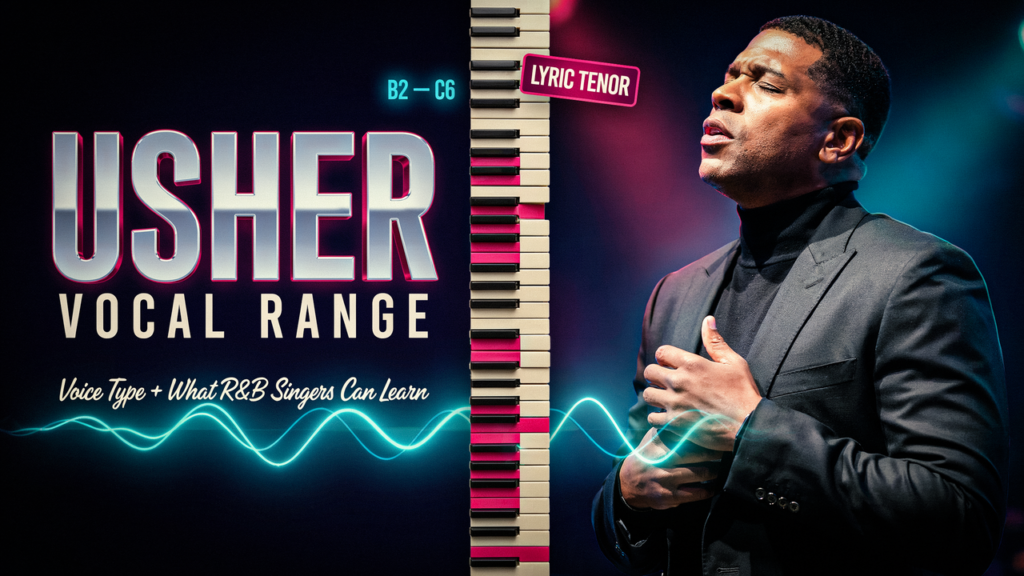
Usher’s vocal range is commonly estimated to extend from approximately D2 to B♭5, giving him a total recorded span of about three octaves and eight semitones. However, these endpoints are debated because his highest notes involve falsetto or a light upper-register coordination, while some low notes appear only briefly in recordings.
He is generally classified as a tenor, though his ability to sing occasional low notes can make his range appear broader. More important than the extremes is how Usher combines a warm middle register, agile vocal runs, controlled mixed voice, and expressive falsetto.
What Is Usher’s Vocal Range?
The most frequently reported estimate for Usher’s total recorded vocal range is:
| Vocal characteristic | Approximate result |
|---|---|
| Lowest reported note | D2 |
| Highest reported note | B♭5 |
| Total span | About 3.7 octaves |
| Voice type | Contemporary R&B tenor |
| Strongest qualities | Agility, phrasing, falsetto, register control |
This should be understood as a catalog-based estimate rather than a definitive measurement of everything Usher can sing.
Vocal-range calculations can change depending on whether they include background vocals, brief studio notes, falsetto, spoken pitches, and live improvisations. Two analysts may therefore reach different conclusions while examining the same singer.
You can learn how pitches such as D2 and B♭5 are organized by reading this guide to vocal range notes.
What Is Usher’s Lowest Note?
Usher’s lowest reported note is approximately D2. This is unusually low for a tenor, but one isolated low note does not define his voice type.
Low notes in commercial recordings can be difficult to evaluate. A pitch may occur in a quiet phrase, layered harmony, vocal fry, processed studio passage, or speech-like delivery. It may not represent a note the singer can project reliably throughout a live performance.
Usher’s fuller and more recognizable sound generally sits higher than D2. His lower register is often warm and conversational, allowing him to begin phrases gently before moving into a more intense upper register.
This illustrates the difference between an extreme note and a usable range. A singer might touch D2 without treating it as part of their comfortable performance range.
What Is Usher’s Highest Note?
Usher’s highest reported notes reach approximately B♭5, although estimates vary between vocal analyses.
The most important qualification is that this upper extreme should not be interpreted as a full chest-voice note. Usher normally reaches his highest pitches with falsetto, head-dominant production, or another light coordination.
Falsetto has a softer vocal-fold closure than a chest-dominant sound. It allows many singers to access higher pitches without carrying excessive weight upward. That does not make the notes meaningless, but it does mean that a falsetto B♭5 should not be compared directly with a powerful chest-dominant note at the same pitch.
Usher’s skill lies in making his upper register sound stylistically connected to the rest of his voice. He can move from an intimate middle register into falsetto without making the transition feel disconnected from the song.
Is Usher a Tenor?
Usher is best described as a contemporary R&B tenor. His music frequently places him in a bright, flexible upper-middle range, and his tone remains comfortable in areas commonly associated with tenor voices.
Some online vocal profiles use labels such as “lyric tenor,” “leggero tenor,” or “spinto tenor.” These terms originated in classical singing, where voice classification also considers projection, passaggio, timbre, weight, and the roles a singer can perform without amplification. Applying them precisely to an amplified R&B singer is difficult.
For that reason, “tenor” is a more defensible classification than a highly specific classical subtype.
Voice type also cannot be determined from the lowest and highest notes alone. A tenor may produce several low notes, while a baritone may develop a strong upper extension. The more useful questions concern where the voice sounds comfortable, where register transitions occur, and which pitches the singer can sustain repeatedly.
Our guide to what a tenor is explains these characteristics in greater detail. You can also review tenor vs. baritone if you are unsure how the two voice types differ.
Usher’s Total Range Versus His Usable Range
Usher’s total recorded range includes the lowest and highest identifiable notes across different performances. His usable range is the smaller area in which he can repeatedly sing with consistent pitch, tone, volume, and control.
This distinction matters because a single extreme note says little about how a singer performs an entire song. Usher’s practical strengths are most evident in his middle and upper-middle register, where he can:
- Shape phrases dynamically
- Execute fast R&B runs
- Move between vocal registers
- Use breathy and connected tones for contrast
- Maintain expression while performing choreography
His approximately 3.7-octave total estimate is impressive, but range width alone does not explain his vocal identity. His control within that range is considerably more important.
How Usher Uses Chest Voice, Mix, and Falsetto
Usher changes vocal coordination according to the emotional demands of a song.
His chest-dominant register supplies warmth and clarity to conversational verses. Instead of making every phrase powerful, he often begins with a relaxed sound that leaves room for the performance to build.
As melodies rise, he can reduce vocal weight and use a mixed coordination. This helps him preserve intensity without forcing the heavy quality of his lower register too high.
Falsetto provides another color. Usher frequently uses it to communicate vulnerability, longing, or emotional tension. His falsetto is not simply an extension used to produce impressive high notes; it is a central part of his R&B phrasing.
Smooth transitions between these coordinations make his voice sound flexible. Listeners hear an emotional progression rather than a series of technical register changes.
Songs That Showcase Usher’s Voice
Several recordings reveal different aspects of Usher’s vocal ability.
“Climax” is one of his clearest falsetto showcases. Much of its impact comes from restraint, precise dynamics, and the contrast between delicate phrases and more urgent vocal moments.
“Burn” demonstrates emotional upper-register singing. The performance combines a clear lead vocal with lighter phrases and expressive embellishments.
“There Goes My Baby” highlights the contrast between Usher’s warm tenor sound and his falsetto. It is a useful example of how register changes can support the mood of an R&B song.
“Superstar” showcases his sustained upper-register color and controlled phrasing. It also demonstrates why falsetto quality matters more than simply reaching the highest possible pitch.
“U Got It Bad” emphasizes vocal runs, gradual dynamic development, and emotional delivery. Its appeal does not depend on an enormous range; it comes from how carefully Usher shapes the melody.
What Singers Can Learn From Usher
Usher’s technique offers several practical lessons.
First, treat falsetto as a musical register rather than a shortcut to a high note. Practice it gently and work toward stable pitch, consistent airflow, and clean entrances.
Second, avoid making every phrase equally loud. Usher often uses softer sounds so that later notes feel more intense. Dynamic contrast can make a performance sound wider and more expressive without extending its actual range.
Third, practice runs slowly. R&B agility depends on accurate individual pitches, not uncontrolled movement between notes. Increase the tempo only after the pattern remains clear.
Finally, train the range you can repeat comfortably. Extreme notes may be exciting, but reliable notes are more useful for songs, rehearsals, and live performances.
Frequently Asked Questions
What is Usher’s vocal range?
Usher’s total recorded range is commonly estimated at approximately D2–B♭5. The endpoints remain debatable because different analyses count registers and studio notes differently.
How many octaves can Usher sing?
The commonly reported D2–B♭5 span equals roughly three octaves and eight semitones, or approximately 3.7 octaves.
What is Usher’s highest note?
B♭5 is frequently cited as his highest note. It is generally associated with falsetto or another light upper-register coordination rather than full chest voice.
What is Usher’s lowest note?
D2 is one of his most commonly reported low extremes, although it is not representative of where most of his singing sits.
Is Usher a tenor or a baritone?
Usher is generally considered a tenor. His tessitura, vocal color, upper-register facility, and musical repertoire support this classification more strongly than his occasional low notes support a baritone label.
Does Usher sing in falsetto?
Yes. Falsetto is one of the most recognizable parts of Usher’s singing style, particularly in songs such as “Climax,” “Burn,” and “Superstar.”
Final Takeaway
Usher’s vocal range is commonly placed at approximately D2–B♭5, but those notes should be treated as reported recorded extremes rather than fixed biological limits. His upper endpoint includes falsetto, and his lowest note does not define his everyday tessitura.
Usher stands out because he uses his range intelligently. His smooth register transitions, precise runs, expressive falsetto, dynamic phrasing, and ability to sing while performing demanding choreography are more revealing than any single high or low note.

Harlow is a vocal analysis and singing tools writer at Voice Range Test. She focuses on vocal range testing, voice type analysis, pitch recognition, and singing education tools for singers, musicians, choir performers, and beginners.