
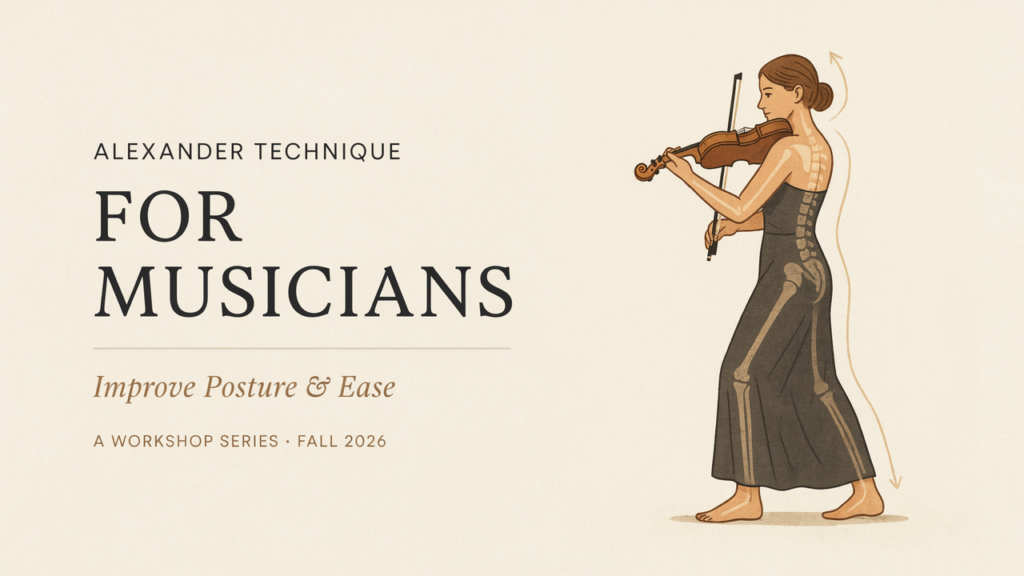
The Alexander Technique is an educational method that helps musicians notice and change habitual patterns of unnecessary tension. Instead of teaching a fixed “correct posture,” it develops awareness of how you coordinate your head, neck, back, breathing, and movement while singing or playing an instrument.
Musicians often repeat the same movements for hours. If those movements include gripping, collapsing, breath-holding, or excessive effort, repetition can make the habits feel normal. The Alexander Technique encourages you to pause before performing, recognize the habitual response, and choose a more coordinated approach.
Research suggests that Alexander Technique lessons may help some musicians manage performance anxiety. Evidence for improvements in musical performance, posture, and respiratory function remains limited or inconclusive, however. It should therefore be treated as a practical awareness skill—not a guaranteed treatment or shortcut to better musicianship.
What Is the Alexander Technique?
The technique was developed by Frederick Matthias Alexander, an actor who experienced recurring voice problems during performance. After observing himself closely, he concluded that his habitual reactions—including patterns involving his head, neck, and torso—were affecting how he spoke.
Alexander gradually developed a system for interrupting unhelpful habits and organizing movement with less interference. Today, the method is taught to musicians, actors, dancers, public speakers, and people interested in everyday movement.
Lessons typically combine verbal guidance, observation, simple activities, and gentle hands-on feedback from a trained teacher. Students may work with ordinary movements such as sitting, standing, walking, breathing, speaking, or raising an instrument.
The objective is not to become completely relaxed. Music requires muscular activity, energy, and precision. The goal is to reduce effort that does not contribute to the musical task.
Core Principles Musicians Should Understand
Several ideas form the foundation of the Alexander Technique.
Awareness
Change begins by noticing what happens before and during a musical action. A singer might lift the chin before a high note. A pianist may tighten the shoulders before a difficult passage. A violinist might grip the bow when anticipating a shift.
These reactions often begin before the challenging moment itself. Awareness helps the musician recognize the pattern without immediately trying to force it away.
Inhibition
In Alexander Technique terminology, inhibition means pausing a habitual response. It does not mean suppressing emotion or avoiding movement.
Suppose a guitarist automatically tightens the neck when approaching a fast section. Instead of launching into the passage with the same reaction, the player pauses and declines to begin in the usual way. That brief interruption creates an opportunity for a different response.
Direction
Directions are constructive mental intentions concerning coordination. Common examples involve allowing the neck to remain free, the head to balance without pulling backward, and the back to maintain length and width.
Directions are not forceful physical commands. Trying to “hold the head correctly” or pull the shoulders down can create another layer of tension. The intention should support movement rather than impose a rigid position.
Attention to the Whole Person
A local problem may be connected to a broader pattern. Tight fingers might accompany locked knees, shallow breathing, a compressed torso, or an anxious reaction to mistakes.
For this reason, the method does not examine a musician’s hands or jaw in isolation. It considers how the entire person organizes the activity.
How Musicians Develop Unnecessary Tension
Musical training involves repetition, precision, evaluation, and time pressure. These demands can encourage performers to use more effort than necessary.
Common habits include:
- Raising the shoulders while inhaling
- Pulling the head toward the instrument
- Locking the knees while standing
- Gripping a bow, pick, mouthpiece, or microphone
- Holding the breath before beginning
- Compressing the torso during difficult passages
- Tightening the jaw or tongue
- Rushing after making a mistake
- Treating stillness as rigid immobility
A musician may not feel these habits because familiar effort can seem natural. Video recordings, mirrors, teacher feedback, and short pauses during practice can reveal patterns that sensation alone misses.
Alignment should remain adaptable rather than fixed. Singers can explore the principles in the guide to the best posture for singing, which emphasizes balance and freedom instead of military-style positioning.
Applications for Singers and Instrumentalists
The same principles can be adapted to different musical demands.
| Musician | Common Habit to Notice | More Useful Intention |
|---|---|---|
| Singer | Lifting the chin for high notes | Let the head remain balanced while the vocal tract adjusts |
| Pianist | Leaning and tightening before difficult passages | Keep the torso responsive and let the arms move from a supported back |
| Violinist | Clamping the instrument with the jaw | Reduce unnecessary gripping while maintaining secure contact |
| Guitarist | Collapsing over the instrument | Allow space through the torso and bring the instrument into a workable position |
| Wind player | Raising the shoulders for a large breath | Permit rib and torso movement without forcing inhalation |
| Drummer | Bracing before loud strokes | Use coordinated rebound rather than excessive muscular force |
For singers, this work may help reveal interference around the jaw, tongue, neck, ribs, or knees. It does not prescribe one breathing pattern or promise a larger lung capacity. Singers can combine awareness work with suitable breathing techniques for singing while avoiding forced inhalation.
Instrumentalists can apply the technique before lifting the instrument, placing the hands, beginning a phrase, or responding to an error. The most useful moment is often the instant before movement starts.
A Five-Step Framework for Music Practice
The Alexander Technique is not meant to replace scales, repertoire study, ear training, or technical instruction. It changes how you approach those activities.
1. Pause
Before beginning a passage, stop briefly. Avoid rushing to produce the first note simply because the instrument is ready.
2. Notice
Observe your contact with the floor or chair. Notice your breathing, jaw, hands, shoulders, and overall balance. Do not immediately correct everything you detect.
3. Choose
Decline to perform one familiar habit. You might choose not to lift your shoulders, pull your head backward, or squeeze the instrument before starting.
4. Perform
Play or sing a short passage while maintaining broad awareness. Attend to the room and your whole coordination—not only the finger, note, or muscle you are worried about.
5. Review
Stop and consider what changed. Was the sound different? Did the movement require less effort? Could you breathe normally? Did tension return at a particular note or tempo?
Work with a few measures rather than repeatedly running the entire piece. This approach fits naturally with an effective singing practice routine because it turns repetition into observation and experimentation.
Constructive Rest and Practice Breaks
Constructive rest, sometimes called semi-supine, is commonly associated with Alexander Technique practice. You lie on your back with your knees bent, feet supported, and head resting on a small number of books or another firm support.
The position creates an opportunity to stop performing and notice unnecessary muscular effort. It is not about forcing the spine flat, stretching aggressively, or trying to become completely limp.
A brief constructive-rest period may be used before practice, between demanding sessions, or after performance. More detailed instructions belong in the guide to Alexander method exercises.
Practice breaks should also include genuine changes of activity. Remaining in the same position while checking a phone may continue the physical pattern you intended to interrupt.
Applying the Technique Before Performance
Performance pressure often intensifies established habits. A singer who slightly raises the shoulders in rehearsal may take an exaggerated breath onstage. A pianist who occasionally stiffens after an error may become rigid during an audition.
Alexander Technique practice can help musicians notice this escalation earlier. Before walking onstage, you can pause, acknowledge the environment, sense the support beneath your feet, and avoid rehearsing the feared passage mentally with your entire body braced.
During the performance, direct attention toward the music, ensemble, room, and audience. Excessive internal monitoring can become another form of interference. The objective is broad, responsive awareness—not constant self-correction.
These principles can complement practical work on stage presence for singers, especially when physical openness and audience communication are affected by nervous habits.
What Happens in an Alexander Technique Lesson?
A lesson commonly lasts between 30 and 60 minutes, depending on the teacher and setting. You normally remain clothed and perform simple everyday movements while the teacher offers verbal and gentle hands-on guidance.
Musicians may also bring an instrument or work with singing, conducting, or performance gestures. A teacher might observe how you prepare to play, respond to difficult passages, sit, stand, turn pages, or recover after a mistake.
The first lesson may feel unfamiliar because the teacher is not simply correcting visible posture. The learning process involves recognizing automatic reactions that may occur before the visible movement.
When choosing a teacher, look for appropriate training through a recognized professional organization. Ask about experience with musicians and whether lessons can incorporate your instrument or vocal work.
What the Research Shows
Controlled research involving musicians has examined performance anxiety, musical performance, posture, breathing, and patterns of physical use.
The most encouraging findings concern performance anxiety. Some controlled studies have reported reduced self-rated anxiety after Alexander Technique instruction. However, participant groups have generally been small, and the interventions have varied in duration and format.
Evidence concerning improvements in musical performance is mixed. Some studies reported positive changes, while others did not find a clear advantage. Research has also not established consistent improvements in respiratory function or posture.
These limitations do not mean that no musician can benefit. They mean that broad guarantees are not justified. A useful claim is that the technique may help musicians become more aware of habitual effort and develop alternative responses. Claims that it reliably prevents injuries, corrects posture, improves breathing capacity, or guarantees better performance go beyond the available evidence.
Limitations and When to Seek Help
The Alexander Technique is an educational approach, not a substitute for medical diagnosis, physical therapy, psychotherapy, or instrument-specific teaching.
Stop playing or singing and seek appropriate professional assessment if you experience persistent pain, numbness, tingling, weakness, loss of coordination, recurring hoarseness, breathing difficulty, or sudden changes in function.
A qualified healthcare professional can investigate injury or illness. A voice teacher or instrumental instructor can address technical problems. A mental-health professional can help when performance anxiety is severe, persistent, or disruptive. Alexander Technique lessons may complement this support, but they should not delay necessary care.
Frequently Asked Questions
Does the Alexander Technique improve musical performance?
It may help some musicians reduce unnecessary interference and approach performance more freely, but research on direct improvements in musical quality remains inconclusive.
Is the Alexander Technique just posture training?
No. It addresses awareness, habitual reactions, and coordination during activity. It does not teach one fixed posture that musicians must hold.
Can singers use the Alexander Technique?
Yes. Singers may use it to examine habits involving the jaw, neck, tongue, ribs, knees, breathing, and reactions to challenging notes.
Can I learn the Alexander Technique by myself?
Books and simple awareness activities can introduce its ideas, but individual instruction provides feedback about habits that may be difficult to recognize alone.
How quickly does it work?
There is no fixed timeline. Some people notice new sensations during an early lesson, while changing established musical habits usually requires continued practice and application.
Does it treat musicians’ injuries?
The Alexander Technique is not a medical treatment for playing-related injuries. Persistent or worsening symptoms require assessment from an appropriate healthcare professional.

Harlow is a vocal analysis and singing tools writer at Voice Range Test. She focuses on vocal range testing, voice type analysis, pitch recognition, and singing education tools for singers, musicians, choir performers, and beginners.