
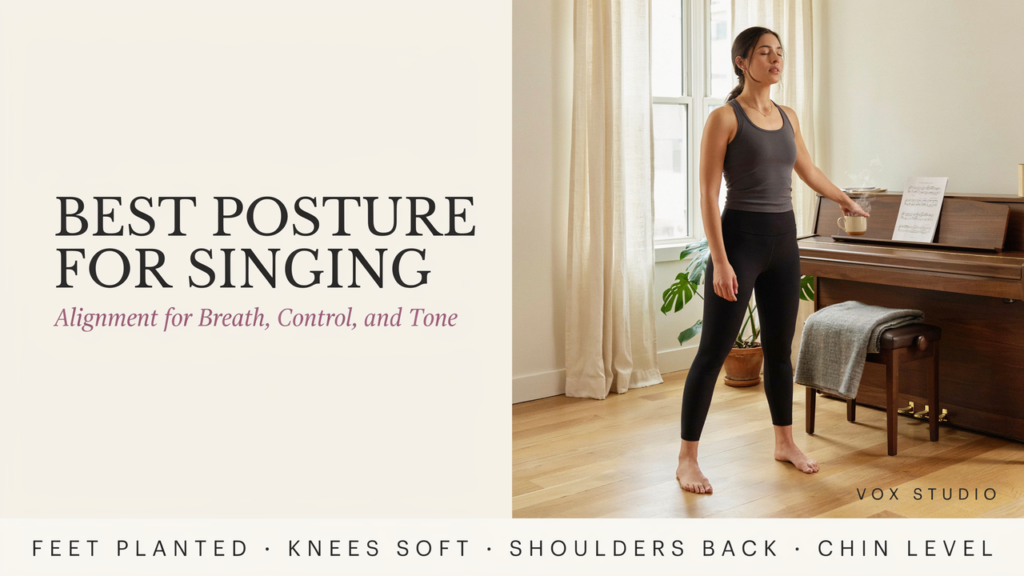
The best posture for singing is stable, upright, and flexible. Your feet or sitting bones should give you support, your knees and hips should stay responsive, your ribs should be free enough to move with breath, and your head should balance without the chin lifting or pressing down.
Good singing posture is not a frozen pose. It is a usable setup that lets breathing, vocal-fold vibration, resonance, diction, and musical expression work together with less interference.
Quick Singing Posture Checklist
- Feet about hip-width apart, or seated with both feet supported.
- Weight balanced without locking the knees.
- Pelvis neutral enough that you are not tucking or over-arching.
- Rib cage buoyant but not forced upward.
- Shoulders resting naturally, not pulled back hard.
- Head balanced over the torso, with the jaw free.
- Body flexible enough to shift, gesture, and breathe.
These are starting points, not one perfect shape. Height, mobility, pain, pregnancy, disability, footwear, instrument use, and stage movement can all change what efficient alignment looks like.
What Good Posture Actually Does for Singing
Posture helps by removing avoidable restrictions. Slumping may compress the torso and make breathing harder. Overcorrecting can be just as limiting if you hold the chest high, squeeze the abdomen, or pin the shoulders back.
Efficient posture gives you three things:
- Balance: you are not fighting gravity with constant effort.
- Breathing room: the ribs, back, abdomen, and pelvis can respond.
- Adaptability: you can move with the phrase instead of protecting a pose.
The same idea appears in the Alexander Technique for musicians, where singers learn to reduce unnecessary effort instead of forcing a corrected position.
Standing Alignment From Feet to Head
Feet: Stand with enough width to feel steady. Hip-width is a helpful default, but the right distance depends on your body and performance style.
Knees: Keep them unlocked. You do not need a visible bend; you just want to avoid pushing the knees backward into a rigid brace.
Pelvis: Avoid squeezing the glutes, tucking the tailbone hard, or exaggerating the lower-back arch. The pelvis should feel available for breath and movement.
Ribs: Let the chest feel open without holding it high. The ribs should be able to expand and recoil. The guide to breath support for singers explains why responsive ribs matter more than a military-looking chest.
Shoulders: Let them rest. Pulling the shoulders back can make you look upright while making the upper back and neck less free.
Head and jaw: Keep the head balanced over the spine. Raising the chin for high notes usually adds strain instead of range.
Best Sitting Posture for Singing
You can sing well while sitting if the position supports breath and movement. Sit with both feet supported, the pelvis balanced on the sitting bones, and the torso responsive rather than collapsed.
| Area | Helpful setup | Common problem |
|---|---|---|
| Feet | Flat on the floor or supported | Dangling feet or wrapped legs |
| Pelvis | Balanced on sitting bones | Collapsing onto the tailbone |
| Torso | Upright and mobile | Slumping or over-arching |
| Head | Balanced over the torso | Looking down at lyrics or screen |
| Arms | Free to gesture or hold music | Raised shoulders while holding a folder |
If you use sheet music or lyrics, raise them close to eye level. Do not reshape your neck around a low phone screen.
The 60-Second Posture Check
- Feel support under your feet or sitting bones.
- Notice whether your knees, hips, stomach, or shoulders are braced.
- Let the torso organize upward without forcing the chest.
- Take a quiet breath and check whether the ribs can move.
- Release unnecessary jaw and tongue pressure.
- Sing one comfortable phrase.
- Change only one thing if the phrase feels restricted.
Small adjustments are usually more useful than trying to fix the whole body at once.
Common Singing Posture Mistakes
Locking the knees: This can encourage bracing through the legs, pelvis, and abdomen.
Pulling the shoulders back: It can restrict the upper ribs and create neck tension.
Holding the chest high: A lifted chest may help briefly, but a fixed rib cage can make recovery breaths harder.
Tucking the pelvis: Constantly flattening the lower back can reduce flexibility and make the abdomen rigid.
Raising the chin: High notes do not come from pointing the face upward. They come from vocal coordination.
Trying to relax everything: Singing needs energy. The goal is coordinated effort, not limpness.
Posture for High Notes and Vocal Power
Better posture can remove extra effort, but it does not automatically create high notes. If the top of your range still feels tight, you may need registration work, vowel adjustment, and gradual strength rather than a more dramatic stance.
When singing high, keep the head balanced and avoid pushing the belly as hard as possible. If you want to build intensity without forcing, use the guide on how to increase vocal power alongside consistent warmups.
The same applies to range. Alignment may make your existing coordination easier, but it will not replace safe vocal development. For step-by-step work, start with a vocal warm-up routine before singing demanding songs.
Posture While Recording or Using a Microphone
Move the microphone toward you rather than reaching your head toward the microphone. If you are recording, place the stand or phone high enough that you do not collapse your neck to see lyrics.
For loud notes, move slightly away from the mic instead of tightening the throat. For quiet notes, come closer without hunching. Mic technique should support posture, not fight it.
Adapting Posture for Your Body
Not every singer should stand the same way. Some singers need a chair, a wheelchair, back support, a wider stance, or movement breaks. Efficient posture is functional: it helps you breathe, sing, recover, and perform with less avoidable strain.
Pay attention to warning signs. Persistent pain, numbness, dizziness, breathing difficulty, or hoarseness after singing deserves professional evaluation. The NIDCD’s voice-health guidance advises paying attention to ongoing hoarseness and vocal problems rather than ignoring them in its voice care resource.
How to Practice Better Alignment
Choose one focus per practice session. For example, test knee freedom one day, head balance the next day, and microphone position the day after that. Record short phrases and compare comfort, pitch stability, tone, and fatigue.
If you cannot tell what is helping, a teacher can provide outside feedback. The guide on whether vocal coaching works explains what a coach can observe that singers often miss. Posture also connects to the larger goal of singing better, because alignment, breath, pitch, and practice habits all influence the final sound.
Frequently Asked Questions
What is the best posture for singing?
The best posture is stable, upright, and flexible, with supported feet or sitting bones, unlocked joints, responsive ribs, relaxed shoulders, and a balanced head.
Should singers stand straight?
Yes, but not rigidly. Think tall and responsive rather than stiff or military-straight.
Is sitting bad for singing?
No. Sitting can work well if the feet, pelvis, torso, and head are supported and responsive.
Does posture increase vocal range?
It can remove restrictions that make some notes harder, but range also depends on vocal coordination, registration, training, and health.
Why does my chin rise on high notes?
It is often a reaching habit or compensation. Practice the phrase more quietly while keeping the head balanced.

Harlow is a vocal analysis and singing tools writer at Voice Range Test. She focuses on vocal range testing, voice type analysis, pitch recognition, and singing education tools for singers, musicians, choir performers, and beginners.