
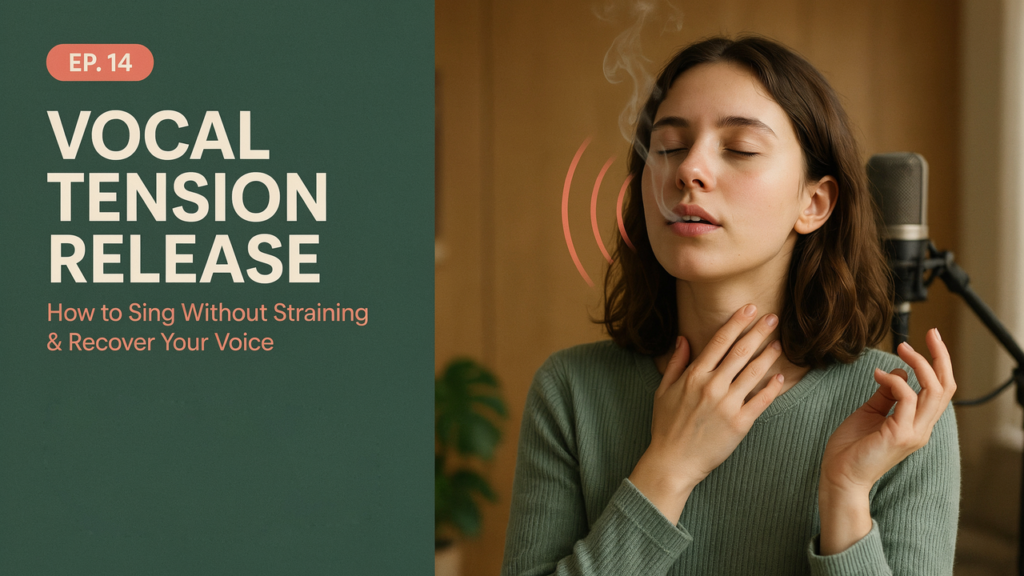
Vocal tension release means reducing unnecessary effort in the jaw, tongue, neck, shoulders, breathing system, and muscles surrounding the larynx. Singing still requires muscular coordination, so the goal is not to make the throat completely passive. The goal is to remove excess effort that makes the voice feel squeezed, tired, painful, or difficult to control.
A useful tension-release exercise should make the same vocal task feel easier—not merely different. Test a short phrase before and after each exercise so you can identify what genuinely helps your voice.
Signs of Excess Vocal Tension
Vocal tension can be felt or heard. Common signs include:
- A tight or squeezed feeling in the throat
- Jaw clenching or limited mouth movement
- The tongue pulling backward or pressing down
- Raised shoulders during inhalation
- A stiff neck or chin reaching forward
- High notes becoming louder and more forced
- Running out of breath unusually quickly
- Hoarseness or reduced vocal control after practice
- Previously easy notes becoming difficult
Some muscle activity is normal. A moving larynx, firm abdominal muscles, or a sensation of effort does not automatically indicate a problem. Tension becomes unhelpful when it restricts movement, changes the sound involuntarily, causes discomfort, or makes a task harder than necessary.
Why Vocal Tension Happens
Singers often add muscular force when a note feels difficult. They may raise the chin for high notes, press the tongue down, tighten the abdomen continuously, or force more air through the vocal folds. These compensations can create temporary volume or pitch but reduce efficiency and control.
Tension may also appear because of:
- Singing outside a currently manageable range
- Beginning with material that is too demanding
- Poorly coordinated airflow
- Inadequate preparation
- Fatigue, illness, or heavy voice use
- Anxiety or performance pressure
- Trying to imitate another singer’s tone
- Repeating a difficult phrase without correcting its cause
A balanced singing posture and coordinated breath support can reduce the need for the neck, jaw, and throat to compensate.
Take a Baseline Before the Exercises
Choose one short vocal task:
- Speak a sentence at a comfortable volume.
- Hum a five-note descending pattern.
- Sing one troublesome phrase at moderate volume.
Notice four things: throat comfort, jaw freedom, breath use, and sound consistency. Rate the overall effort from 1 to 10, where 1 feels very easy and 10 feels extremely difficult.
Repeat the identical task after each exercise. Keep an exercise only if effort decreases without producing breathiness, instability, discomfort, or loss of clarity.
Vocal Tension Release Exercises
Release the Neck and Shoulders
Stand with your feet comfortably apart and your knees unlocked. Allow your arms to hang naturally.
Slowly raise your shoulders toward your ears, hold them for two seconds, and let them fall without forcing them downward. Repeat five times. Then make five slow backward shoulder circles.
Turn your head gently to each side as though looking over one shoulder. Keep the chin level and stay within a comfortable range. Do not make full neck circles or pull on your head.
Finish by speaking your baseline sentence. The shoulders should remain quiet during the breath rather than lifting sharply.
Free the Jaw and Tongue
Place the tip of your tongue behind your lower front teeth. Allow the jaw to open and close gently while the tongue remains forward. Repeat eight times without forcing a wide opening.
Next, make a quiet “mm” sound while performing a small chewing motion. Continue for 20–30 seconds at an easy pitch. The jaw should move freely rather than snap or shift painfully.
Then extend the tongue comfortably over the lower lip for two seconds and release it. Repeat three times. Avoid pulling the tongue forcefully or pressing into the muscles under the chin.
Retest a sung phrase. Look for easier vowel changes and less gripping around the jaw.
Use a Gentle Lip Trill or Hum
Produce a light lip trill at a comfortable speaking pitch. If the trill stops, reduce the airflow rather than pushing harder.
Glide slowly from a comfortable low pitch to a comfortable middle pitch and back down. Perform five easy glides. Do not take the exercise to the top or bottom of your range.
If lip trills are difficult, hum gently on “mm.” Look for light vibration around the lips and face while keeping the teeth slightly separated. Humming should feel easy; it should not require you to press the lips together or force vibration into the nose.
Try Straw Phonation
Place a regular drinking straw between your lips and make a gentle “oo” sound through it. Sustain one comfortable pitch for approximately five seconds. Rest, then repeat three times.
Next, make three slow pitch glides through the middle of your range. Keep the sound quiet to moderate and the airflow steady. Your cheeks should not become rigid, and your throat should not feel more compressed.
Straw phonation is a semi-occluded vocal tract exercise: the vocal tract is partially narrowed at the lips. It is commonly used in voice training and therapy, but it is not a substitute for an individual assessment when symptoms persist.
A 7-Minute Tension-Release Routine
Use this sequence before moderate singing:
- One minute: Rate your baseline and sing one easy phrase.
- One minute: Perform shoulder drops and gentle head turns.
- One minute: Loosen the jaw with small chewing movements.
- One minute: Release the tongue and hum lightly.
- Two minutes: Perform lip trills or straw phonation on comfortable glides.
- One minute: Retest the original phrase at moderate volume.
Follow this with a gradual vocal warm-up routine before singing demanding repertoire. If the baseline becomes worse, stop and reassess instead of adding more exercises.
Troubleshooting Vocal Tension by Location
| What you notice | Possible compensation | Adjustment to try |
|---|---|---|
| Jaw clamps on vowels | Trying to control pitch with the jaw | Hum with a small chewing motion |
| Tongue retracts on high notes | Pulling or depressing the tongue | Keep its tip near the lower front teeth |
| Chin rises with pitch | Reaching physically for the note | Keep the gaze level and lower the key |
| Shoulders rise on every breath | Taking an oversized breath | Inhale quietly and use a smaller breath |
| Throat tightens as volume increases | Excess air pressure or loudness | Reduce volume and use a lip trill |
| Tension returns in the song | Exercise has not transferred to the lyric | Alternate one trill with one sung phrase |
When high notes repeatedly cause strain, lowering the key is a useful regression—not a failure. Build the coordination gradually before returning to more demanding high-note singing.
How to Keep Tension From Returning
Tension often disappears during an exercise but returns when lyrics, volume, or range are added. Transfer the easier coordination in stages:
- Perform the melody with a lip trill or through a straw.
- Hum the melody.
- Sing it on one comfortable vowel.
- Add the lyrics at reduced volume.
- Restore the intended dynamics gradually.
Work on one short phrase at a time. If effort rises above your baseline, return to the previous stage. This approach builds vocal control without repeatedly rehearsing the strained version.
Track progress by recording the same phrase in the same key once or twice per week. Note your effort rating, recovery time, and whether the coordination remains comfortable across several repetitions. A note is not practically usable merely because you can force it once.
When to Stop and Seek Help
Stop singing if an exercise causes pain, burning, worsening tightness, dizziness, breathing difficulty, or sudden voice loss. Do not continue demanding singing when your voice is hoarse, unusually tired, or affected by acute illness. The National Institute on Deafness and Other Communication Disorders advises avoiding speaking or singing when the voice is hoarse or tired.
Persistent strain is not always a technique problem. Muscle tension dysphonia and other voice disorders require proper evaluation rather than self-diagnosis. Consult an ENT or laryngologist for persistent or severe voice changes, pain when speaking, difficulty breathing or swallowing, or an inability to perform your normal vocal work. A voice-specialized speech-language pathologist can provide individualized voice therapy, while a qualified singing teacher can help transfer healthy coordination into singing after medical concerns have been addressed.
Frequently Asked Questions
Should your throat feel completely relaxed while singing?
No. Singing requires coordinated muscle activity. The throat should feel free enough for pitch, vowels, and volume to change without squeezing, pain, or unnecessary effort.
Why does my throat tighten on high notes?
High-note tension commonly appears when a singer raises the chin, forces extra air, increases volume too early, or carries a heavier coordination beyond its manageable range. Reduce the volume, lower the key, and practice the melody with a lip trill before adding lyrics.
Can jaw tension affect singing?
Yes. Excessive jaw gripping can restrict vowel formation and encourage tension in nearby tongue and neck muscles. Gentle movement can help, but painful clicking, locking, or restricted jaw motion warrants professional assessment.
How quickly should a tension-release exercise work?
A suitable exercise may produce an immediate small reduction in effort, but lasting change requires consistent practice and transfer into real songs. Stop using an exercise if it repeatedly makes the voice less comfortable or controlled.
Can vocal tension damage the voice?
A sensation of tension does not prove that damage has occurred. However, repeatedly singing through pain, hoarseness, or severe fatigue is unsafe. Rest the voice and obtain an appropriate evaluation when symptoms persist or worsen.

Harlow is a vocal analysis and singing tools writer at Voice Range Test. She focuses on vocal range testing, voice type analysis, pitch recognition, and singing education tools for singers, musicians, choir performers, and beginners.