
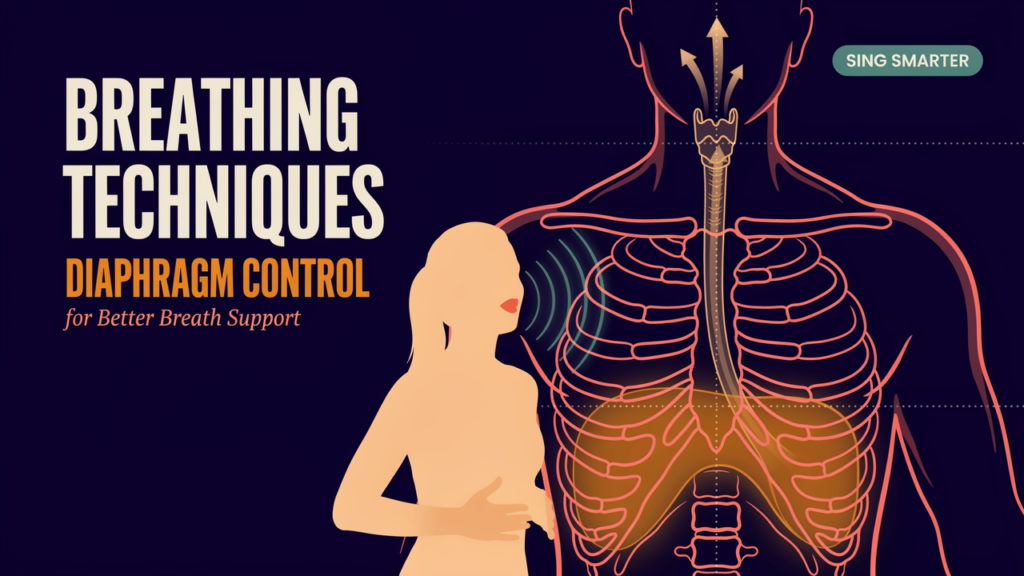
Effective breathing for singing means taking an appropriate amount of air quickly and quietly, then managing that air according to the length, pitch, volume, and words of the phrase. It does not mean inhaling as deeply as possible or pushing the abdomen outward throughout every note.
Breathing exercises are most useful when they transfer into real singing. A long hiss can develop awareness of airflow, but it does not automatically improve a song unless you practice the same coordination with pitch, vowels, consonants, and musical phrasing.
How Breathing for Singing Works
When you inhale, the diaphragm contracts and moves downward while the rib cage expands, creating space for the lungs to fill. During exhalation, the diaphragm gradually relaxes upward and the chest cavity becomes smaller.
Singers coordinate this process to match the musical phrase. The goal is not to prevent all movement or keep the ribs permanently expanded. It is to avoid two extremes:
- Collapsing immediately and releasing too much air
- Locking the body and preventing a responsive exhalation
The vocal folds convert airflow into sound. Using more air does not automatically produce a better or stronger tone. Excess airflow may make a phrase breathy, unstable, or difficult to sustain.
For a deeper explanation of how airflow, resistance, and the torso work together, read the guide to breath support for singers.
What “Breathing From the Diaphragm” Means
You cannot fill the diaphragm with air. Air enters the lungs, while the diaphragm helps create the pressure change that draws air inward.
“Diaphragmatic breathing” is commonly used to describe an inhalation in which the lower ribs and abdominal area respond without excessive shoulder lifting or upper-chest tension. The diaphragm itself works automatically; singers influence the complete breathing pattern through alignment, rib movement, abdominal response, and airflow management.
The abdomen may move outward during inhalation because the descending diaphragm affects the organs beneath it. However, visible stomach movement alone does not prove that the breath is efficient.
A useful singer’s breath is usually:
- Quiet
- Unforced
- Appropriate for the phrase
- Free from unnecessary shoulder movement
- Followed by a controlled, responsive exhalation
Check Your Current Breathing Pattern
Stand comfortably and sing one medium-length phrase. Notice where you inhale, whether your shoulders rise, and whether the phrase ends comfortably.
Then repeat the phrase and observe:
- Did you take more air than the phrase required?
- Did air escape before the first note?
- Did your chest collapse immediately?
- Did you squeeze the final words?
- Did you become louder to finish the phrase?
- Did the pitch become unstable near the end?
Record an effort rating from 1 to 10. Use the same phrase after completing the exercises so you can judge whether they improved actual singing.
Six Breathing Techniques for Singers
1. Low-Rib Breathing Awareness
Place your hands around the sides of your lower ribs. Keep your knees unlocked, neck free, and shoulders resting naturally.
Inhale quietly for three counts. Notice movement beneath and around your hands rather than deliberately pushing the stomach outward. Exhale normally for four counts.
Repeat five times.
Purpose: Develop awareness of lower-rib movement and reduce unnecessary shoulder lifting.
Common mistake: Taking an oversized breath that creates tension.
Correction: Inhale only as much as you need for a comfortable four-count exhalation.
Progression: Practice the same movement with a faster one-count inhalation while keeping it quiet.
2. Steady-Hiss Exercise
Inhale comfortably for two counts. Release the air on a gentle “sss” for eight counts.
Keep the hiss consistent from beginning to end. Do not make it strong at the start and weak at the finish. Repeat four times, resting briefly between repetitions.
When eight counts remain easy, progress to 10 or 12 counts without taking a larger, tense breath.
Purpose: Practice releasing air steadily.
Common mistake: Squeezing the abdomen hard to create the longest possible hiss.
Correction: Choose a manageable duration and prioritize consistency over length.
Use an online metronome at a moderate tempo if counting becomes inconsistent.
3. Pulsed-Airflow Exercise
Take a comfortable breath. Produce eight short “sss” pulses:
sss–sss–sss–sss | sss–sss–sss–sss
Keep the throat open between pulses. Allow the abdominal wall to respond without aggressively punching inward.
Rest and repeat three times. Next, vary the pattern:
- Four slow pulses
- Eight even pulses
- Two slow followed by four faster pulses
Purpose: Coordinate short bursts of airflow for rhythmic singing, consonants, and accented notes.
Common mistake: Closing the throat between each pulse.
Correction: Imagine one continuous exhalation divided by the tongue rather than eight separate held breaths.
4. Quick Recovery Breath
Exhale normally, then allow a small, silent breath to enter through the mouth as if beginning a surprised but quiet “ah.”
Do not gasp or lift the shoulders. Repeat five times.
Next, speak a short phrase, take a one-count recovery breath, and speak another phrase:
“Here is the first phrase” — breathe — “here is the second.”
Finally, sing two short phrases using the same timing.
Purpose: Prepare for songs that provide little time between phrases.
Common mistake: Trying to fill the lungs completely during every short pause.
Correction: Replace only the air needed for the next phrase.
5. Voiced Airflow Transfer
A silent breathing exercise does not include vocal-fold resistance. Transfer the airflow into sound using this sequence:
- Hiss for four counts.
- Sing “vvv” for four counts.
- Sing “zoo” on one comfortable pitch for four counts.
- Sing a five-note descending pattern on “zoo.”
Repeat the sequence three times.
Keep the sound clear and moderate rather than breathy or forceful. The exhalation will not feel identical to the hiss because voiced sounds use airflow differently.
Purpose: Connect breathing practice to phonation.
Common mistake: Attempting to release the same quantity of air during singing as during an open hiss.
Correction: Let the vocal sound regulate the airflow rather than pushing to recreate the hiss sensation.
Stable airflow can support pitch consistency, but it is only one component. If notes remain inaccurate, use the focused methods in how to sing on key.
6. Breath Mapping in a Song
Print or write the lyrics to a song. Mark planned breaths with a slash:
When the night begins to fall / I can hear you calling
First, speak the lyrics in rhythm. Take each breath at the marked location without lifting the shoulders or delaying the beat.
Then:
- Sing the melody on a lip trill or “vv.”
- Sing it on one vowel.
- Add the lyrics at moderate volume.
- Adjust any breath point that interrupts an important word or musical idea.
- Restore the intended dynamics.
Purpose: Match breathing to real phrases rather than abstract counting.
Common mistake: Refusing to breathe because the original singer performs the phrase in one breath.
Correction: Choose breath points that suit your current capacity, tempo, key, and interpretation.
A Seven-Minute Breathing Routine
| Time | Exercise |
|---|---|
| 0:00–1:00 | Check alignment and low-rib movement |
| 1:00–2:00 | Quiet three-count inhalations |
| 2:00–3:30 | Steady eight-count hisses |
| 3:30–4:30 | Pulsed “sss” patterns |
| 4:30–5:30 | Quick recovery breaths |
| 5:30–6:30 | “Vvv” and “zoo” voiced transfer |
| 6:30–7:00 | Retest one song phrase |
Repeat the baseline phrase after the routine. Look for a quieter inhalation, steadier tone, clearer phrase ending, and lower effort rating.
Match the Exercise to the Problem
| Singing problem | Exercise to try | What improvement looks like |
|---|---|---|
| Shoulders rise while inhaling | Low-rib awareness | Quieter breath with less neck movement |
| Air disappears too quickly | Steady hiss | More even airflow across the phrase |
| Rhythm disrupts the breath | Pulsed airflow | Clearer accents without throat gripping |
| No time between phrases | Recovery breath | Faster breath without gasping |
| Voice becomes breathy | Voiced transfer | Clearer sound with less escaping air |
| Long phrase repeatedly fails | Breath mapping | Better breath placement or phrase division |
Do not assume every phrase-ending problem is caused by insufficient air. An uncomfortable key, inefficient onset, excessive volume, unclear vowels, or physical tension may also be responsible.
How to Progress and Track Improvement
Practice the routine three or four times per week alongside normal singing work. Track:
- Length of a steady hiss without squeezing
- Quietness of inhalation
- Shoulder and neck movement
- Effort rating for the same phrase
- Number of phrase repetitions completed comfortably
- Ability to maintain pitch and volume near the phrase ending
Progress when you can repeat the exercise comfortably and consistently. Add two exhalation counts, a slightly longer phrase, or a quicker recovery breath—but change only one variable at a time.
Breath control must eventually support dynamics, phrasing, and articulation. The exercises in vocal control techniques can help you apply the coordination beyond simple sustained notes.
Common Breathing Mistakes
Avoid:
- Inhaling as much air as possible before every phrase
- Raising the shoulders deliberately
- Forcing the abdomen outward
- Holding the breath with a closed throat
- Collapsing the chest immediately
- Pushing more air for high notes
- Measuring progress only by hiss duration
- Squeezing out every last bit of air
- Practicing silent exercises without adding sound
- Copying another singer’s breath plan regardless of your needs
More air is also not the same as more volume. To develop a stronger sound without simply increasing breath pressure, use the guide to increasing vocal power.
When to Stop or Seek Help
Stop the exercise if you become dizzy, lightheaded, short of breath, or physically uncomfortable. Return to normal breathing and rest.
Do not use singing exercises to treat unexplained breathing difficulty, chest pain, wheezing, or persistent shortness of breath. Those symptoms require appropriate medical assessment.
Stop vocal practice if breathing drills lead to throat pain, worsening hoarseness, or loss of normally comfortable notes. A qualified singing teacher can help with breath coordination, while persistent voice or respiratory symptoms should be evaluated by an appropriate healthcare professional.
Frequently Asked Questions
Should your stomach move when you breathe for singing?
It may move naturally as the diaphragm descends and the torso responds to inhalation. Deliberately pushing the stomach outward is not required and does not prove that the breath is correct.
How much air should a singer inhale?
A singer should inhale enough for the upcoming phrase without creating tension. Short phrases need less air than long, loud, or demanding phrases.
Why do I run out of breath while singing?
Possible causes include taking an inefficient breath, releasing too much air, singing too loudly, using a breathy tone, choosing poor breath points, or attempting a phrase that is currently too long.
Does a long hiss mean good breath control?
Not necessarily. A steady hiss can show control during an unvoiced exercise, but singing adds vocal-fold vibration, pitch, vowels, consonants, and dynamics. The skill must transfer to a song.
Should singers hold their breath before a note?
A brief moment of balanced preparation may occur, but the throat should not lock. Avoid prolonged or forceful breath-holding before phonation.
Can breathing exercises increase vocal range?
Breathing exercises may improve coordination and reduce some unnecessary effort, but they do not guarantee additional notes. Range development also involves registration, pitch coordination, resonance, and gradual training.

Harlow is a vocal analysis and singing tools writer at Voice Range Test. She focuses on vocal range testing, voice type analysis, pitch recognition, and singing education tools for singers, musicians, choir performers, and beginners.