
Choir vocal ranges are the typical pitch ranges written for different choir parts—most commonly soprano, alto, tenor, and bass (SATB). These ranges are approximate and overlap. Choir parts describe musical roles in harmony, not fixed or permanent voice types.
What are choir vocal ranges?
In choral music, vocal range refers to the span of pitches a singer can sing, while choir vocal ranges refer to the pitches commonly written for each choir part. Composers and arrangers use these ranges to ensure music is singable and balanced for groups.
Two important clarifications:
- Choir ranges are guidelines, not hard limits.
- A singer’s assigned part depends on tessitura (where the voice is most comfortable), tone, and ensemble needs—not just highest or lowest notes.
The SATB system explained
Most mixed choirs use the SATB structure:
- Soprano – higher female or treble voices
- Alto – lower female or treble voices
- Tenor – higher male or lower adult voices
- Bass – lower male voices
Other common formats include:
- SSA / SSAA (treble choirs)
- TTBB (men’s choirs)
- SAB (mixed choirs with fewer tenors)
SATB is the most widely used system in classical, church, school, and community choirs.
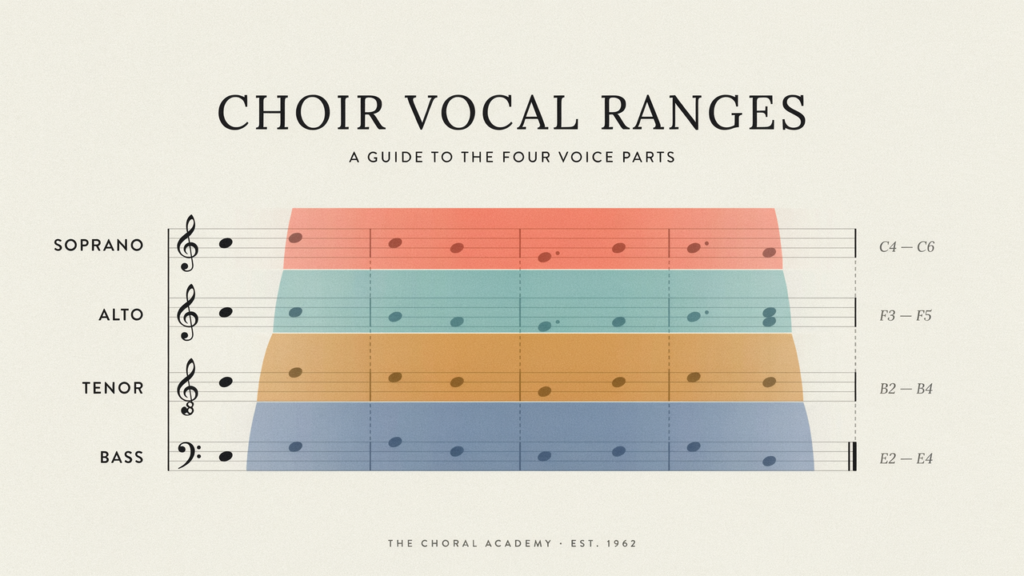
Typical choir vocal ranges (SATB)
Below are commonly accepted written ranges using scientific pitch notation (Middle C = C4). These are approximate and vary by repertoire.
Soprano
- Typical range: C4 to A5 (sometimes up to C6)
- Role: Melody or top harmony
- Characteristics: Bright tone, clarity in higher registers
Alto
- Typical range: G3 to D5 (sometimes up to F5)
- Role: Inner harmony
- Characteristics: Warm, supportive tone; strong blend
Tenor
- Typical range: C3 to G4 (sometimes up to B4)
- Role: Upper male harmony
- Characteristics: Flexible, lyrical quality
Bass
- Typical range: E2 to C4 (sometimes down to D2)
- Role: Harmonic foundation
- Characteristics: Depth, stability, resonance
Important: These ranges overlap by design. Overlap allows flexibility in voicing and better ensemble blend.
Tessitura vs. vocal range (a critical distinction)
A common misunderstanding is equating range with choir part. In practice, tessitura matters more.
- Range: The highest and lowest notes you can sing
- Tessitura: Where your voice is comfortable most of the time
A singer may:
- Reach soprano high notes but sing alto comfortably
- Sing tenor high notes but prefer baritone-range music
- Have bass low notes but function better as a baritone/tenor in choir
Choir directors assign parts based on comfort, tone, and balance, not extremes.
Do choir vocal ranges overlap?
Yes—and that’s intentional.
Overlap allows:
- Smooth voice leading
- Flexible part assignment
- Better blend across sections
- Accommodation for developing or changing voices
For example:
- Altos and tenors often overlap around C4–D4
- Sopranos and altos overlap around C4–E5
- Tenors and basses overlap around E3–C4
Overlap is a feature, not a flaw.
Choir ranges for children and youth
Children’s and youth choirs typically use treble ranges, regardless of gender.
Children’s choir (approximate)
- Range: A3 to F5
- Focus on light, flexible singing
- Avoid extremes to protect developing voices
Changing voices (adolescents)
- Ranges can be unpredictable
- Parts may shift frequently
- Flexibility and comfort are prioritized over labels
Good choral programs adapt music to the singers—not the other way around.
How choir directors assign vocal parts
Directors consider multiple factors:
- Comfortable tessitura
- Tone color and blend
- Musical literacy
- Section balance
- Repertoire requirements
Part assignment is not a judgment of ability. Being placed as alto or tenor is not “lower” than soprano or bass—it’s a musical role.
Assignments can also change over time as voices mature.
Choir parts vs. solo voice types
Another common confusion is mixing solo voice types (soprano, mezzo, baritone, etc.) with choir parts.
Key difference:
- Solo voice types describe an individual’s instrument
- Choir parts describe where a voice fits best in harmony
A mezzo-soprano may sing alto in choir.
A baritone may sing tenor or bass depending on the music.
Choir labels are practical, not permanent.
Common misconceptions about choir vocal ranges
- “My range determines my choir part forever”
- “Higher notes mean a better voice”
- “Men must sing tenor or bass”
- “Altos can’t sing high”
In reality, choral singing values blend, balance, and musicality over extremes.
Frequently asked questions
What are the four main choir vocal ranges?
Soprano, alto, tenor, and bass (SATB).
What does SATB mean in choir music?
It refers to the four standard choir parts used in mixed ensembles.
Can choir vocal ranges change over time?
Yes. Voices develop with age, training, and health.
How do I find my choir range?
A choir director or voice teacher can assess your comfortable tessitura, not just your highest and lowest notes.
Are choir ranges the same worldwide?
They’re very similar across Western choral traditions, though repertoire can vary.
- Understanding soprano and alto placement is easier when comparing key differences between alto and contralto voices.
- Voice part confusion often clears up after learning how mezzo-soprano and contralto roles differ.
- Tenor placement discussions benefit from context around how tenor and baritone voices compare.
- Lower section balance becomes clearer when reviewing the distinction between baritone and bass voices.
- Choir directors assessing male sections often reference how tenor and bass ranges differ in practice.
- Range expectations for each section are easier to judge when considering what a three-octave vocal span typically involves.
- Assigning singers to the right part improves when you understand how the vocal fach system categorizes voices.

Harlow is a vocal analysis and singing tools writer at Voice Range Test. She focuses on vocal range testing, voice type analysis, pitch recognition, and singing education tools for singers, musicians, choir performers, and beginners.