
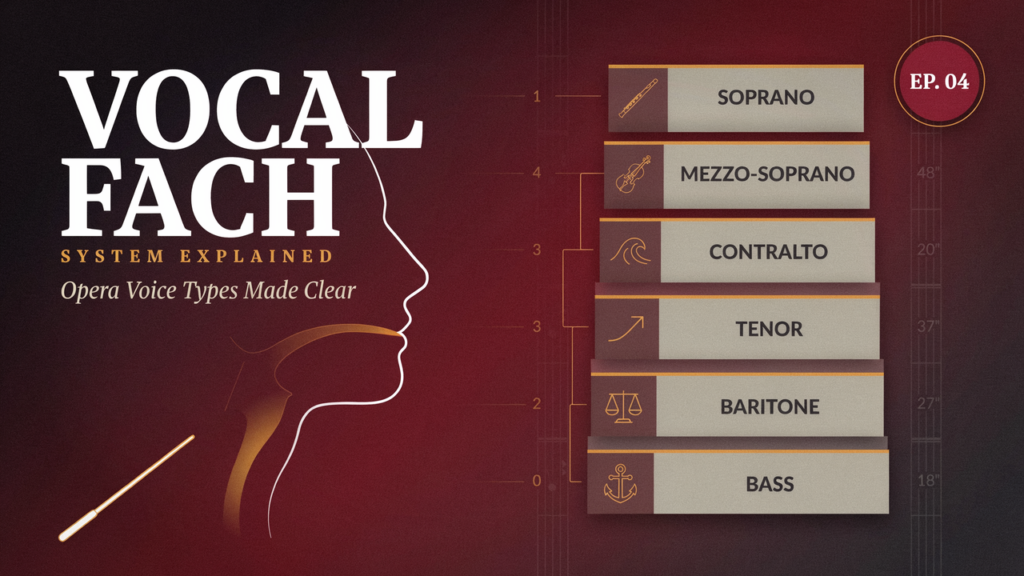
The vocal Fach system is a classification system used mainly in opera to describe specific types of singing voices according to characteristics such as vocal range, tessitura, timbre, vocal weight, agility, and the demands of particular roles. Unlike broad categories such as soprano, tenor, baritone, or bass, the Fach system provides a more detailed way to match singers with appropriate operatic repertoire.
The German word Fach roughly means “category,” “subject,” or “specialty.” In opera, it refers to a specialized vocal category used to help determine which roles are best suited to a singer’s particular voice.
What Is the Vocal Fach System?
The Fach system developed within the German operatic tradition and became especially useful for organizing singers and repertoire. Instead of classifying a singer only by whether they are a soprano, mezzo-soprano, tenor, baritone, or bass, Fach provides more specific categories within those broad voice types.
For example, two sopranos may have overlapping vocal ranges but have very different vocal qualities. One may have the agility and lightness associated with a coloratura Fach, while another may have the greater vocal weight and dramatic qualities expected of a dramatic soprano.
The system therefore considers how a voice functions, not simply which notes it can reach.
What Does “Fach” Mean in Singing?
In singing, Fach refers to a specialized vocal classification that connects a singer’s characteristics with the requirements of particular operatic roles.
A Fach can take into account:
- Vocal range
- Tessitura
- Timbre or vocal color
- Vocal weight
- Agility and flexibility
- Register characteristics
- Projection
- Stamina
- Dramatic qualities
- The demands of particular repertoire
This makes Fach different from simply measuring the lowest and highest notes a singer can produce.
For example, a singer may be able to produce a high note but still not have the vocal weight, stamina, or tessitura required for roles that repeatedly sit high and demand substantial projection.
Understanding what tessitura means is particularly useful because tessitura describes the area in which a vocal part or voice predominantly operates.
Fach vs. Basic Voice Type
A useful way to understand the system is to think of voice classification as having different levels of detail.
| Classification | Main purpose |
|---|---|
| Voice type | Broadly identifies a voice such as soprano, mezzo-soprano, tenor, baritone, or bass |
| Fach | Provides a more specialized classification within the operatic voice system |
| Role | Identifies a specific character and repertoire that may suit the singer |
For example, “soprano” is a broad voice category. Fach can provide a more specific description of what kind of soprano the singer is suited to portray in opera.
This is why a Fach classification should not be treated as simply another name for a voice type.
You can explore the broader categories in our guide to types of vocal ranges.
What Factors Determine a Singer’s Fach?
There is no single measurement that determines Fach. Several characteristics need to be considered together.
Vocal Range
Range is relevant because an operatic role may require specific low and high notes. However, range alone is insufficient.
A singer’s extreme notes may be possible without being appropriate for sustained performance.
Tessitura
Tessitura is particularly important because a role may spend much of its time in a specific part of the voice.
A singer may technically possess the notes required by a role but struggle if the majority of the music sits outside their strongest working area.
Timbre
Timbre describes the characteristic sound or color of a voice.
Two singers can sing the same pitch with different vocal colors. Fach classifications often take these tonal characteristics into account because certain operatic roles call for particular vocal qualities.
Vocal Weight
Vocal weight describes the relative lightness or heaviness of a voice.
A lighter voice may be well suited to repertoire requiring flexibility and agility, while a heavier voice may be better suited to roles requiring sustained dramatic projection.
These descriptions are not simply measurements of loudness. Vocal weight relates to the overall character and function of the voice.
Agility
Some roles demand rapid passages, ornamentation, and flexible movement between notes. A singer’s ability to execute this type of music can therefore influence the roles for which their voice is appropriate.
Stamina and Projection
Opera can require sustained singing over large ensembles and orchestral textures. A role may therefore demand not just a particular range but the ability to maintain an effective voice throughout the performance.
Major Fach Categories Explained
The Fach system contains numerous specialized classifications, and terminology can vary between classification references. It is therefore better to understand the major categories as a framework rather than memorize one universal list.
Some commonly encountered soprano-related Fächer include:
- Coloratura soprano — generally associated with exceptional agility and flexibility.
- Soubrette — typically associated with lighter, youthful roles and flexible singing.
- Lyric soprano — generally associated with a lighter-to-moderate vocal quality and sustained melodic singing.
- Spinto soprano — generally positioned between lyric and dramatic qualities, with the ability to produce greater intensity.
- Dramatic soprano — associated with substantial vocal weight, power, and dramatic demands.
Other voice families have their own specialized Fach categories.
For example, tenor classifications can include lyric tenor, character tenor, heldentenor, and other specialized categories. Baritones can likewise be divided into classifications associated with different vocal weights and dramatic requirements.
The exact terminology and boundaries are not perfectly universal, so Fach names should be interpreted in the context of the repertoire and classification tradition being used.
How Fach Is Used in Opera Casting
Fach is particularly useful because opera companies need to match singers with roles that suit their voices.
A role can place very different demands on a singer even when its written range appears manageable.
Casting considerations can include:
- Where the role spends most of its time
- Required vocal color
- Vocal weight
- Agility
- Sustained intensity
- Dramatic demands
- Interaction with the orchestra
- Length and difficulty of the role
- Stylistic requirements
A Fach system therefore provides a practical vocabulary for discussing which repertoire may suit a particular singer.
It can also help singers avoid choosing roles solely because they can technically reach all the required notes.
Why Vocal Range Alone Cannot Determine Fach
One of the most important points about the Fach system is that you cannot reliably determine a singer’s Fach from their highest and lowest notes alone.
Imagine two singers who both have a three-octave measured range. That information does not tell you:
- Which notes are strongest
- Where the voice is most comfortable
- What the voice sounds like
- How much vocal weight it has
- How well it projects
- How long it can sustain demanding passages
- How agile the voice is
- Which repertoire suits it
The same principle applies to basic voice classification. A high note does not automatically make a singer a particular type of soprano, and a low note does not automatically establish a particular bass or baritone Fach.
If you want to examine your broader range first, a vocal range calculator can provide useful range information, but that result should not be interpreted as a complete Fach assessment.
Can a Singer’s Fach Change?
A singer’s Fach is not necessarily a permanent label for every stage of a career.
Voices develop and change with age, training, technique, and experience. A singer may also discover that certain repertoire suits their mature voice better than repertoire they performed earlier in their career.
However, this does not mean that singers should deliberately force their voices into a different Fach.
A classification should reflect how the voice actually functions and the repertoire it can perform appropriately. A qualified vocal professional with experience in classical singing and opera is better positioned to evaluate these factors than a simple online range test.
For general voice classification, you can also explore our guide on how to find your voice type.
Limitations of the Fach System
The Fach system is useful, but it should not be treated as a perfectly precise scientific classification.
Voice characteristics exist on a continuum. Singers do not always fit neatly into one category, and different teachers, opera companies, or classification references may use terminology somewhat differently.
There is also a practical reason to avoid rigid labeling: assigning repertoire that consistently exceeds a singer’s appropriate capabilities can create unnecessary vocal demands.
Research into voice classification has examined relationships among vocal characteristics, classification, and vocal function, reinforcing the importance of considering more than simple pitch range when evaluating voices.
The most useful approach is therefore to treat Fach as a repertoire and classification framework, rather than a definitive label derived from a single measurement.
Frequently Asked Questions
What is the Fach system in singing?
The Fach system is an operatic voice-classification framework that groups singers according to characteristics such as range, tessitura, timbre, vocal weight, agility, and suitability for particular roles.
What does Fach mean in opera?
Fach is a German term meaning a category or specialty. In opera, it refers to a specialized classification used to describe the type of voice suited to particular repertoire and roles.
Is Fach the same as voice type?
No. Voice type is a broader classification, while Fach provides more specialized categories used primarily in opera. A singer’s Fach considers characteristics beyond simple range.
Can vocal range determine Fach?
No. Vocal range is only one factor. Tessitura, timbre, vocal weight, agility, projection, stamina, and repertoire demands can also matter.
Why is tessitura important in Fach classification?
Tessitura helps describe where a singer or vocal part spends much of its time. A role may be technically within a singer’s total range but still be unsuitable if its tessitura consistently sits in a demanding area of the voice.
Can a singer change Fach?
A singer’s classification can evolve as the voice develops and repertoire changes. Fach should be based on how the voice actually functions rather than forcing the voice to fit a predetermined category.

Harlow is a vocal analysis and singing tools writer at Voice Range Test. She focuses on vocal range testing, voice type analysis, pitch recognition, and singing education tools for singers, musicians, choir performers, and beginners.