
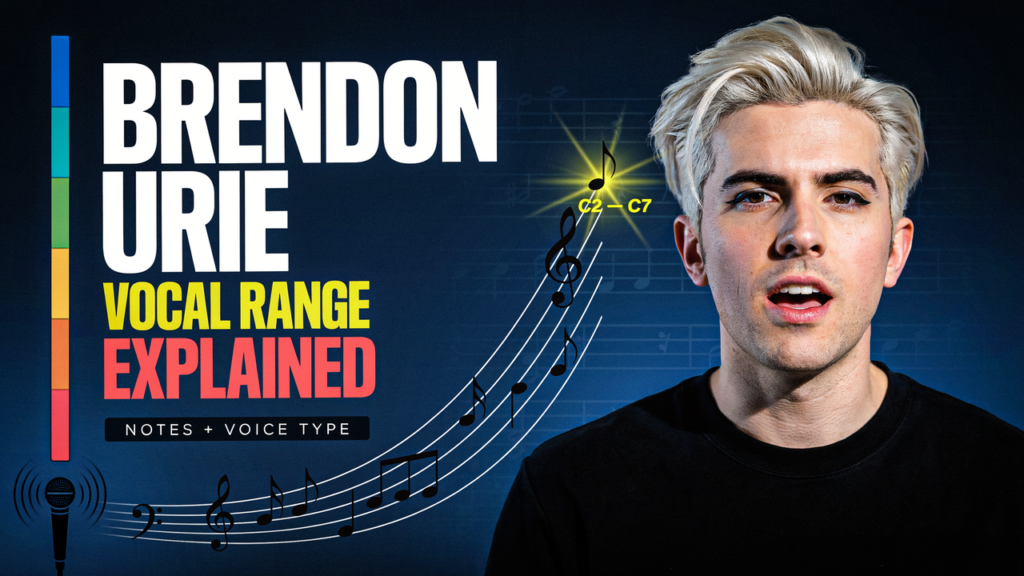
Brendon Urie’s commonly reported vocal range is approximately D2 to D6, spanning exactly four octaves. Some fan-made analyses extend the upper boundary to C7, but that broader claim includes a brief, unusually high sound rather than a note representative of his normal singing. The most accurate interpretation is therefore a four-octave demonstrated range, with a disputed extreme extension approaching C7.
Urie is generally described as a high lyric tenor. His reputation, however, comes less from the total number of notes he has produced and more from his powerful mixed voice, bright upper register, flexible falsetto, and ability to sing demanding pop-rock material live.
What Is Brendon Urie’s Vocal Range?
Brendon Urie’s documented and commonly reported range can be summarized as follows:
| Vocal measurement | Reported result | Evidence status |
|---|---|---|
| Lowest commonly accepted note | D2 | Reported, but very low and sometimes fry-like |
| Strong upper singing | Fifth-octave notes | Repeatedly demonstrated in songs and performances |
| Commonly accepted upper extension | D6 | Demonstrated through light upper-register production |
| Broadest claimed extreme | C7 | Brief and source-dependent |
| Defensible overall span | D2–D6 | Exactly four octaves |
| Broadest claimed span | D2–C7 | Four octaves and 11 semitones |
This distinction matters. A singer’s complete range can include isolated notes produced in chest voice, mixed voice, head voice, falsetto, or vocal fry. Those sounds do not necessarily belong to the singer’s comfortable or repeatable range.
If D2 and C7 are both counted, the distance is 59 semitones, which equals four octaves and 11 semitones. It is nearly five octaves—not more than five octaves.
Brendon Urie’s Lowest Note
D2 is the lowest note most frequently associated with Brendon Urie. That pitch is remarkably low for a singer whose voice normally functions like a tenor.
However, D2 should not be interpreted as the bottom of his everyday tessitura. Some of Urie’s lowest sounds have a rough, quiet, or fry-influenced quality. They demonstrate access to low frequencies but do not carry the same strength or musical usefulness as his middle and upper notes.
His lower register contributes contrast to songs with dramatic changes in intensity. Darker verses can make the brighter choruses feel even higher, particularly when he moves quickly from a low phrase into a strong mixed-voice climax.
This is also why comparing range boundaries alone can be misleading. A singer may touch a bass-like pitch without possessing a bass voice. The difference between tenor and bass voices depends on comfort, resonance, vocal weight, and tessitura—not one unusually low note.
What Is Brendon Urie’s Highest Note?
D6 is a more defensible upper boundary for Brendon Urie’s demonstrated singing range, although the precise limit depends on which registers and performances are included. His strongest and most representative high singing generally occurs lower, particularly in the upper fourth and fifth octaves.
The frequently repeated C7 claim originates from a brief upward sound associated with a live performance of “Camisado.” It is better classified as an extreme, momentary extension than as a controlled note that defines his normal range.
This produces three useful upper-range categories:
- Strong musical upper range: notes used purposefully in demanding phrases and climaxes
- Light upper extension: head-voice or falsetto pitches approaching D6
- Claimed absolute extreme: the brief, disputed C7 sound
Keeping these categories separate provides a more realistic picture than listing C7 without context. Similar care is necessary when examining other singers with exceptional upper extensions, such as Dimash Kudaibergen’s vocal range or the unusually varied sounds in Mike Patton’s vocal range.
Does Brendon Urie Have a Five-Octave Range?
Brendon Urie has an exactly four-octave range when measured from D2 to D6. Counting the claimed C7 extension expands the span to four octaves and 11 semitones—one semitone short of five complete octaves.
Calling this simply a “five-octave range” hides several important details:
- The D2 is an extreme low rather than his normal vocal center.
- The C7 claim comes from a brief live sound.
- Different registers are included at opposite ends.
- His most controlled, repeatable singing occupies a smaller area.
- Maximum range is not the same as comfortable tessitura.
Therefore, “four demonstrated octaves with a disputed extension approaching five” is a more transparent description.
The distinction does not diminish Urie’s ability. Four octaves is still an unusually broad demonstrated span, especially alongside his sustained high tessitura and powerful live delivery.
What Voice Type Is Brendon Urie?
Brendon Urie is most reasonably classified as a tenor, often described more specifically as a high or lyric tenor in contemporary vocal discussions.
His classification is supported by the way his voice functions rather than by D2 or D6 alone. Relevant characteristics include:
- A bright, cutting tonal quality
- Comfort in an elevated pop-rock tessitura
- Strong access to the upper fourth octave
- Frequent use of mixed coordination in the fifth octave
- A flexible, comparatively light upper register
- The ability to maintain clarity over dense instrumentation
A classical Fach cannot be assigned conclusively from commercial recordings. Pop singers use microphones, stylistic distortion, register blending, altered vowels, and studio production in ways that differ from unamplified classical singing. Calling Urie a tenor is useful, but a highly specific classical label should remain qualified.
For a clearer explanation of this category, see what defines a tenor voice. Urie can also be compared with Adam Lambert’s vocal range, as both singers are known for theatrical delivery and prominent upper-register singing.
How Brendon Urie Produces High Notes
Urie does not produce every high note with the same coordination. His upper range includes chest-dominant sounds, mixed voice, head-dominant production, and falsetto.
His mixed voice is particularly important. Instead of carrying a heavy chest configuration upward unchanged, he adjusts the balance of the voice as pitch rises. This helps him retain intensity without making every high note sound like pure falsetto.
Several audible qualities contribute to his signature sound:
- Bright resonance: His upper notes have a focused quality that cuts through loud arrangements.
- Register blending: He can move from fuller sounds into lighter coordination without always creating an obvious break.
- Vowel modification: High vowels are adjusted to make demanding pitches more manageable.
- Controlled distortion: Grit and rasp may be added for style, but they are not the source of the pitch itself.
- Dynamic contrast: Softer phrases make his high climaxes sound even more dramatic.
Listeners can hear another version of forceful upper-register rock singing when exploring Steven Tyler’s vocal range, although the two singers use different tone colors and stylistic balances.
Songs That Showcase Brendon Urie’s Voice
Several Panic! at the Disco songs demonstrate different parts of Urie’s instrument.
“Death of a Bachelor” highlights smooth phrasing, dynamic control, register changes, and a theatrical approach influenced by classic pop singing. It is useful for hearing more than raw range alone.
“This Is Gospel” demonstrates the contrast between controlled verses and increasingly forceful upper phrases. The arrangement places significant demands on intensity and endurance.
“Emperor’s New Clothes” showcases an aggressive tone, rhythmic precision, and chest-dominant energy. The performance is dramatic without depending exclusively on extreme pitches.
“Victorious” stays energetic and relatively high for repeated sections, making stamina as important as the highest individual note.
“Say Amen (Saturday Night)” is frequently cited for its extreme closing passage. That moment demonstrates upper-register access, but its lighter production should not be confused with a sustained chest-voice belt.
“High Hopes” may not display his absolute extremes, but its repeated elevated phrases show the practical challenge of maintaining a bright sound and reliable energy throughout a commercially demanding song.
Vocal Range Versus Usable Range
Brendon Urie’s absolute range is not the same as the range he would use continuously in a song. His usable range consists of notes he can phrase, sustain, repeat, and connect reliably. His tessitura is the region where much of the music sits and where his vocal characteristics are most consistently apparent.
An isolated D2 or C7 reveals an outer boundary. It does not show where his voice sounds strongest across an entire performance.
That is why Urie’s upper-middle and high singing is more important to his vocal identity than either extreme. His tone, register transitions, phrasing, endurance, and stage delivery provide more information than an octave count alone. Readers can explore what tessitura means to understand this distinction.
Frequently Asked Questions
What is Brendon Urie’s vocal range?
Brendon Urie’s commonly accepted range is approximately D2–D6, or exactly four octaves. A broader D2–C7 estimate includes a disputed, momentary upper extension.
What is Brendon Urie’s highest note?
D6 is a more defensible demonstrated upper boundary. C7 is frequently claimed, but it appears to come from a brief live sound rather than a sustained, repeatable musical note.
What is Brendon Urie’s lowest note?
D2 is his most commonly reported lowest note. Its fry-like or lightly produced quality means it should not be treated as evidence that he has a bass tessitura.
Is Brendon Urie a tenor?
Yes. Brendon Urie is generally classified as a tenor because of his high tessitura, bright timbre, upper-register facility, and strong mixed voice—not simply because of his highest note.
Can Brendon Urie sing five octaves?
His broadest claimed D2–C7 span covers four octaves and 11 semitones, which is one semitone short of five full octaves. The more defensible D2–D6 range covers exactly four octaves.
Does Brendon Urie use falsetto?
Yes. He uses falsetto and other light upper-register coordinations alongside a powerful mixed voice. Register classification is essential when interpreting his highest notes.

Harlow is a vocal analysis and singing tools writer at Voice Range Test. She focuses on vocal range testing, voice type analysis, pitch recognition, and singing education tools for singers, musicians, choir performers, and beginners.