
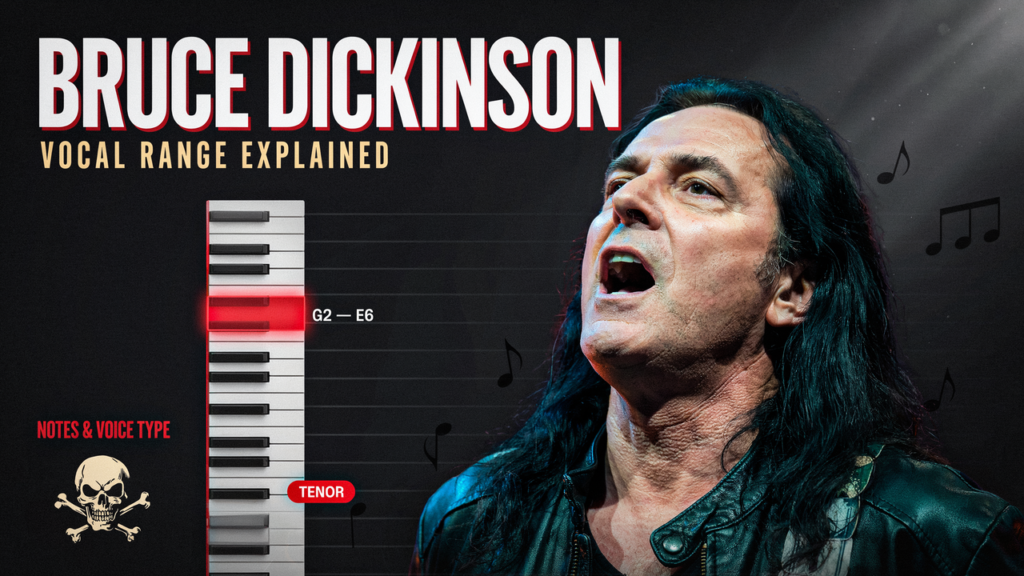
Bruce Dickinson’s best-supported musical vocal range is approximately E2 to E5, covering three complete octaves. Broader fan transcriptions extend his range from about C♯2 to B5, while some published estimates reach C6. Those wider figures include brief screams, falsetto-like sounds, vocal effects, and pitches whose exact classification is disputed.
Dickinson’s voice is best described as a powerful rock tenor with a high working tessitura. His reputation is built not simply on touching extreme notes, but on sustaining forceful upper-register phrases over dense Iron Maiden arrangements—often while delivering an intensely physical live performance.
Bruce Dickinson’s Vocal Range at a Glance
| Vocal detail | Best-supported assessment |
|---|---|
| Conservative musical range | Approximately E2–E5 |
| Conservative span | Three octaves |
| Broader reported range | Approximately C♯2–B5 |
| Broader reported span | Three octaves and 10 semitones |
| Other published upper extreme | C6, but source-dependent |
| Voice type | Rock tenor |
| Characteristic high area | Approximately B4–D5 |
| Signature qualities | Power, bright resonance, wide vibrato and sustained intensity |
The conservative E2–E5 estimate represents notes that can be discussed as part of Dickinson’s musical singing with greater confidence. The broader C♯2–B5 estimate includes unusual outer-register sounds that are less representative of his normal repertoire.
This distinction prevents one isolated scream or quiet low effect from being treated as equal to a note delivered clearly throughout a song.
Bruce Dickinson’s Lowest Notes
E2 is a reasonable lower boundary for Bruce Dickinson’s clearly musical range. Low passages around this area have been associated with performances of “Dance of Death,” “Sign of the Cross,” and “The Talisman.”
Some range compilations place him as low as C♯2, D2, or even below. These claims need more caution because the sounds may be brief, quiet, speech-like, fry-influenced, or difficult to separate from surrounding instrumentation. They show that Dickinson can color his voice far below his usual center, but they do not make him a bass or baritone.
His lower range became more noticeable during the later part of his career. Compared with many early Iron Maiden recordings, later material often allows him to use a darker tone and a heavier lower-middle register. These qualities add narrative weight to longer songs without replacing the bright upper sound for which he is known.
A useful contrast can be heard in James Hetfield’s vocal range. Hetfield’s vocal identity is more strongly connected to a weighty middle and lower register, whereas Dickinson’s voice remains defined primarily by its upper reach.
What Is Bruce Dickinson’s Highest Note?
Bruce Dickinson’s highest reliably musical notes are better placed around E5, with more extreme sounds reported from F♯5 through B5. A C6 upper limit also appears in some published range lists, but it should not be presented as an undisputed, regularly repeatable note.
His famous opening scream in “The Number of the Beast” rises into an extreme area of his voice. It is an expressive metal scream rather than an ordinary sustained lyric, so its highest pitch can vary depending on how the sound and overtones are measured.
High-note compilations also associate upper fifth-octave sounds with “Gangland,” “Flight of Icarus,” “Where Eagles Dare,” “Back in the Village,” and live versions of “Remember Tomorrow.” The most extreme readings are difficult to verify consistently because distortion, wide vibrato, sliding pitch, and instrumental overtones can affect note identification.
| Reported area | Song or context | Production | Evidence interpretation |
|---|---|---|---|
| E2 area | “Dance of Death” and later material | Low sung tone | Strong candidate for musical lower range |
| B4–D5 | Numerous Iron Maiden choruses | Full, projected upper singing | Central to his practical high range |
| E5 area | Early Iron Maiden material | High sustained or accented singing | Reasonable musical upper extension |
| A5 area | “The Number of the Beast” scream | Distorted scream | Audible extreme, not normal tessitura |
| B5 | Frequently linked to “Gangland” | Brief extreme or light production | Commonly reported but source-dependent |
| C6 | Broad published range estimates | Unclear or disputed context | Not secure enough to define his core range |
This evidence supports a three-octave conservative range while leaving room for broader performance extensions.
Does Bruce Dickinson Have a Four-Octave Range?
Bruce Dickinson can reasonably be described as approaching four octaves when every reported register and performance effect is included. However, the commonly cited C♯2–B5 span measures 46 semitones, equal to three octaves and 10 semitones—not four complete octaves.
Other boundaries produce different totals:
- E2–E5: 36 semitones, or exactly three octaves
- E2–C6: 44 semitones, or three octaves and eight semitones
- C♯2–B5: 46 semitones, or three octaves and 10 semitones
- C♯2–C♯6: 48 semitones, or four complete octaves
A four-octave label is therefore possible only if both the lower and upper extremes used in the calculation are accepted. Since those boundaries remain source-dependent, it is more accurate to state the notes and explain their context than to rely on a single impressive octave figure.
What Voice Type Is Bruce Dickinson?
Bruce Dickinson is generally classified as a tenor, though descriptions such as high tenor, low tenor, and spinto tenor appear in informal analyses.
“Rock tenor” is the safest practical label because Dickinson sings amplified heavy-metal repertoire rather than classical opera. His voice nevertheless shows several traits commonly associated with tenor singing:
- A bright and penetrating upper register
- Strong projection around B4–D5
- An elevated working tessitura
- The ability to sustain long upper phrases
- Clear resonance over distorted guitars
- A dramatic, quasi-operatic delivery
His low notes do not make him a baritone. Voice type is determined by more than the lowest available pitch; it also involves tessitura, timbre, vocal weight, register transitions, and the area where the singer performs most effectively. The male vocal-range guide explains why different male voice categories can overlap considerably.
Dickinson’s approach can be compared with Rob Halford’s vocal range. Both helped establish high, theatrical singing as a defining sound of heavy metal, although their timbres, register choices, and extreme-note production are not identical.
Why Is His Voice Called the Air Raid Siren?
Bruce Dickinson earned the nickname “The Air Raid Siren” because of the piercing power, sustained height, and dramatic intensity of his singing. The description refers to how his voice cuts through Iron Maiden’s layered guitars and fast rhythm section, not merely to his highest measured note.
Several features create that effect:
- Bright resonance keeps the sound audible in a dense mix.
- Strong upper harmonics give the voice a metallic edge.
- Wide vibrato adds movement and scale to sustained notes.
- Clear consonants preserve the lyrics during high passages.
- Controlled intensity allows long phrases to remain dramatic.
His sound is powerful, but it is not simply shouting. Much of the perceived force comes from resonance, vowel adjustment, breath management, and an efficient balance between vocal weight and upper-register freedom.
Geddy Lee’s vocal range provides another useful example of a rock singer whose bright tone remains audible over complex instrumentation, though Lee’s thinner timbre differs noticeably from Dickinson’s heroic metal sound.
Songs That Best Demonstrate His Range
“Aces High” is one of Dickinson’s most demanding performances. Its difficulty comes from the combination of speed, elevated tessitura, repeated high phrases, and limited opportunities to recover. It reveals more about his functional range and stamina than a brief isolated scream.
“The Number of the Beast” contains his most recognizable scream. The moment demonstrates intensity and upper-register extension, but it should be evaluated separately from the melodic range used throughout the rest of the song.
“Run to the Hills” requires repeated, energetic singing in an exposed high register. The chorus demonstrates how Dickinson maintains clarity and projection without relying on one climactic note.
“Hallowed Be Thy Name” showcases dynamic storytelling, controlled lower passages, sustained upper phrases, and a gradual increase in intensity.
“Flight of Icarus” emphasizes broad, sustained melodic lines and powerful high singing. It also provides a useful example of Dickinson’s wide vibrato and dramatic phrasing.
“Dance of Death” explores more of his mature lower and middle register before opening into forceful upper passages. The contrast illustrates how his instrument changed over time.
Listeners comparing different approaches to modern metal vocals may also explore David Draiman’s vocal range, where rhythmic attack and darker tonal weight play a greater role.
Studio Range Versus Live Range
Dickinson’s live performances are particularly important because Iron Maiden’s songs demand sustained singing across long concerts. Studio recordings can combine selected takes and controlled conditions, but a concert reveals how a singer manages tessitura, pacing, movement, and fatigue.
Not every live performance will reproduce the same extremes. Keys, phrasing, note duration, tone, and melodic choices may change across tours. Age and accumulated vocal use can also affect the weight and brightness of the instrument.
His later voice generally sounds darker and heavier than it did during the early 1980s. Some extreme highs have become less consistent, while the lower and middle registers often carry more depth. That represents a change in balance, not the disappearance of his recognizable vocal identity.
A contemporary comparison is available in Ronnie Radke’s vocal range, which demonstrates how modern rock vocalists may combine clean singing, distortion, screams, and contrasting registers within one performance.
Frequently Asked Questions
What is Bruce Dickinson’s vocal range?
Bruce Dickinson’s best-supported musical range is approximately E2–E5, or three octaves. Broader estimates extend from about C♯2 to B5 or C6 by including screams, light production, and disputed extremes.
What is Bruce Dickinson’s highest note?
E5 is a reasonable upper boundary for his clearly musical singing. Notes up to B5 or C6 have been reported, but their pitch, register, and repeatability are source-dependent.
What is Bruce Dickinson’s lowest note?
E2 is a defensible low sung note. Lower pitches around C♯2 or D2 have been reported, although some may be brief, quiet, fry-influenced, or difficult to verify.
Is Bruce Dickinson a tenor or baritone?
Bruce Dickinson is best classified as a rock tenor. His elevated tessitura, bright resonance, sustained upper singing, and vocal weight are more relevant than his isolated low notes.
Does Bruce Dickinson have a four-octave range?
A four-octave estimate depends on accepting disputed pitches at both ends of his range. His conservative musical span is three octaves, while broader performance estimates approach four.
What is Bruce Dickinson’s most difficult Iron Maiden song?
“Aces High” is widely regarded as one of his most difficult songs because it combines fast phrasing, a high tessitura, repeated upper notes, and substantial endurance demands.

Harlow is a vocal analysis and singing tools writer at Voice Range Test. She focuses on vocal range testing, voice type analysis, pitch recognition, and singing education tools for singers, musicians, choir performers, and beginners.