
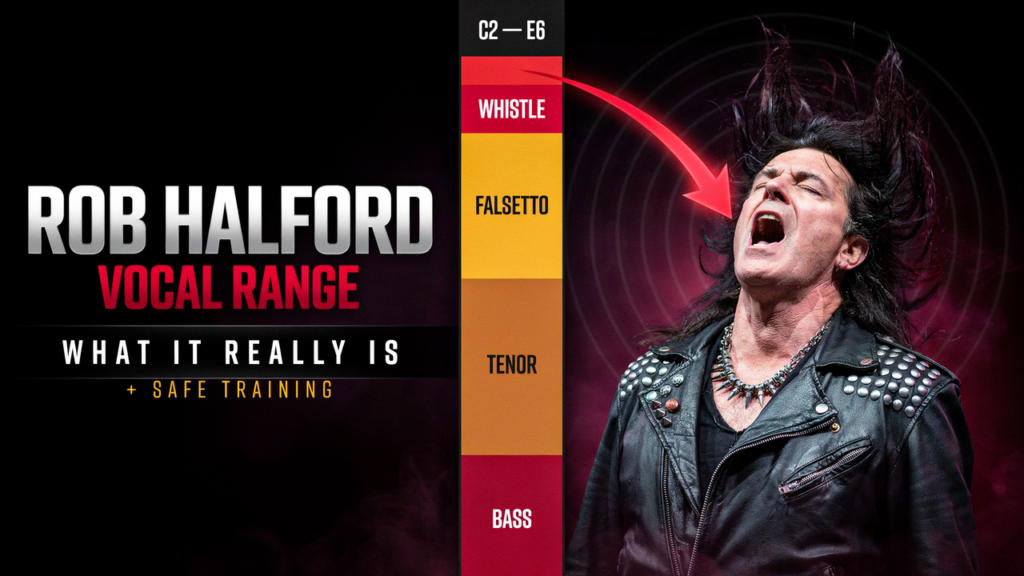
Rob Halford’s vocal range is commonly reported as approximately C2 to C♯6, spanning four octaves and one semitone. However, those endpoints should be treated as a source-dependent estimate rather than an independently certified measurement. The total combines different periods of his career, vocal registers, distorted sounds, and brief extreme notes—not four octaves of equally comfortable full-voice singing.
What is firmly demonstrated throughout Halford’s work with Judas Priest is extraordinary versatility. He can move from dark low phrases and clean midrange singing to piercing upper-register notes, theatrical falsetto, rasp, and controlled metal screams. That contrast is a more useful description of his voice than an octave count alone.
What Is Rob Halford’s Vocal Range?
The frequently cited C2–C♯6 estimate covers 49 semitones, equivalent to four octaves plus one semitone. This makes Halford one of the most wide-ranging prominent singers in traditional heavy metal—provided every register and production style is included.
A careful interpretation separates three different ideas:
- Demonstrated range: Every identifiable pitch Halford has produced in a recording or performance
- Usable range: Notes he can employ musically and repeat with reasonable control
- Tessitura: The area where most of a song or performance sits
A momentary C♯6 does not mean Halford routinely sings melodies in the sixth octave. Likewise, a low growled or lightly produced C2 does not prove that the bottom of the second octave is his normal tessitura.
His recorded catalogue is especially broad because it spans more than five decades. Different albums also demand very different vocal colors, from the clearer progressive-metal singing of the 1970s to the sharper attack heard on Painkiller.
Evidence Behind His Lowest and Highest Notes
There is no universally accepted, professionally published note-by-note catalogue of Rob Halford’s voice. Online range compilations frequently disagree because their creators may count different recordings, live improvisations, layered vocals, spoken pitches, or distorted sounds.
The following table therefore distinguishes useful musical evidence from commonly repeated endpoint claims:
| Range evidence | Song or context | Vocal production | Evidence status |
|---|---|---|---|
| Low second-octave notes | Various studio and solo recordings | Low clean tone, speech-like singing, or growl | Source-dependent |
| Wide low-to-high movement | “Dreamer Deceiver” | Clean singing rising into a light, high register | Strongly demonstrated |
| Extended upper-register climax | “Victim of Changes” | Head-dominant singing and metal screams | Strongly demonstrated |
| Piercing sustained highs | “Love Bites” performances | Bright, compressed upper register | Clearly demonstrated; exact peak varies by performance |
| Relentless high placement | “Painkiller” | Distorted, head-dominant metal singing | Clearly demonstrated |
| C2–C♯6 total span | Multiple career-spanning recordings | Combined registers and contexts | Commonly reported, not universally verified |
This evidence supports the conclusion that Halford has demonstrated roughly four octaves across his career. It does not establish C2–C♯6 as his current warm-up range or comfortable day-to-day range.
Songs That Best Demonstrate Rob Halford’s Range
“Dreamer Deceiver”
“Dreamer Deceiver” is one of the clearest examples of Halford’s early vocal flexibility. He begins with controlled, melodic phrasing before climbing into bright, floating high notes. The transitions and sustained musical lines make this a better range example than an isolated scream.
“Victim of Changes”
This song displays Halford’s command of contrast. Its quieter passages reveal tonal control and phrasing, while the climactic sections feature the intense upper-register sound that helped define Judas Priest. The performance demonstrates dynamics, register changes, and stamina—not merely pitch height.
“Love Bites”
Live versions of “Love Bites” are frequently mentioned in discussions of Halford’s extreme upper range. The exact highest pitch depends on the performance and the method used to classify the sound, but the song reliably demonstrates his ability to produce penetrating, sustained highs above an already demanding melody.
“Painkiller”
“Painkiller” may be Halford’s most famous high-vocal performance, but it should not automatically be called his highest song. Its difficulty comes from sustained high placement, distortion, aggressive consonants, intensity, and repeated phrases with limited recovery time.
That combination makes “Painkiller” exceptionally demanding even if another recording contains a higher isolated note. Readers comparing metal singers may also notice how Halford’s approach differs from the operatic power associated with Bruce Dickinson’s vocal range or the blues-influenced upper register heard in Robert Plant’s singing.
Is Rob Halford a Tenor?
Rob Halford is generally described as a tenor, but “heavy-metal tenor” is more useful here than a narrow classical classification. His voice has the bright upper-register access, projection, and tonal focus commonly associated with rock tenors.
The dark colors in his low range do not automatically make him a baritone. Voice type is determined by more than a singer’s lowest note; tessitura, register transitions, vocal weight, and where the voice functions most naturally also matter. The site’s guide to what a tenor is explains these distinctions in more detail.
Halford’s sound also differs significantly from Ozzy Osbourne’s vocal range and lighter, more nasal delivery. Both singers are central to British heavy metal, but they create intensity through different vocal qualities.
Why His Voice Sounds More Extreme Than Four Octaves
Halford’s reputation is built on more than numerical range. Several characteristics make his performances sound unusually expansive:
- Strong register contrast: He can move from restrained low phrases to brilliant upper-register sounds.
- Bright resonance: His highs cut through dense guitars without needing to sound unusually heavy.
- Controlled distortion: Rasp and distortion add intensity without necessarily changing the underlying pitch.
- Dynamic range: Quiet singing makes the following scream appear even larger.
- Theatrical phrasing: Sudden climbs, long sustains, vibrato, and carefully timed attacks heighten the effect.
- Stylistic flexibility: His catalogue includes ballads, midrange anthems, aggressive metal, and highly demanding upper-register material.
This is why vocal-range comparisons need context. James Hetfield’s vocal range, for example, is used more heavily around forceful midrange delivery, while Mike Patton’s extensive range includes a different collection of experimental sounds and registers.
How Has Rob Halford’s Voice Changed?
Halford’s vocal balance has changed naturally across his long career. Recordings from the 1970s often highlight clean, flexible singing and extended high passages. The 1980s combine powerful hooks with sharper metallic highs, while Painkiller represents a particularly intense and distorted approach.
Later performances commonly feature a heavier lower and middle register, with high notes selected more strategically. Live keys, phrasing, register choice, recovery time, and touring conditions can all affect how a singer handles older material.
These changes do not erase Halford’s documented achievements. They show why a career-spanning range should not be presented as a measurement of what a singer can reproduce comfortably at every age or in every performance.
Anyone exploring their own classification can use a consistent, comfortable sample with the Voice Type Test. Halford’s screams should not be used as beginner range targets. Pain, burning, sudden hoarseness, or the loss of normally easy notes are signals to stop rather than push higher.
Frequently Asked Questions
How many octaves can Rob Halford sing?
Rob Halford is commonly credited with approximately four octaves. The often-repeated C2–C♯6 estimate spans four octaves and one semitone, although its endpoints combine different registers and career periods.
What is Rob Halford’s highest note?
C♯6 is frequently reported as Halford’s highest note, often in connection with live material. The claim is source-dependent, so it is more accurate to describe C♯6 as a commonly reported extreme than a universally verified sustained note.
Page Title
Rob Halford Vocal Range: High Notes, Voice Type and Evidence
Rob Halford’s vocal range is commonly reported as approximately C2 to C♯6, spanning four octaves and one semitone. However, those endpoints should be treated as a source-dependent estimate rather than a definitive measurement of his comfortable singing range.
The Judas Priest vocalist’s real distinction is how he moves between dark low notes, a powerful middle register, piercing head-dominant highs, falsetto-like sounds, and controlled distortion. Songs such as “Dreamer Deceiver,” “Victim of Changes,” “Love Bites,” and “Painkiller” reveal different parts of that ability.
What Is Rob Halford’s Vocal Range?
The most frequently cited estimate for Rob Halford’s vocal range is:
- Reported lowest note: C2
- Reported highest note: C♯6
- Calculated span: 49 semitones
- Approximate width: Four octaves and one semitone
- Broad voice classification: Tenor
- Signature qualities: Bright upper register, metallic resonance, distortion, dramatic register changes and sustained high-intensity singing
This estimate combines sounds produced in different registers, songs and career periods. It does not mean that Halford sings every note between C2 and C♯6 with equal strength or comfort.
A singer’s total demonstrated range is also different from tessitura—the part of the voice used repeatedly and comfortably. Halford’s demanding upper passages are important to his style, but isolated screams should not be mistaken for his everyday tessitura.
Evidence Behind Halford’s Lowest and Highest Notes
No universally accepted scholarly transcription establishes Rob Halford’s exact career-wide endpoints. Online range compilations commonly propose C2 and C♯6, but the classification of individual sounds can vary depending on whether analysts count vocal effects, layered studio vocals, growls or brief live exclamations.
For that reason, the range is best understood through evidence levels:
| Range evidence | Song or context | Vocal production | Evidence status |
|---|---|---|---|
| Very low second-octave sounds | Selected Judas Priest, Fight and solo recordings | Low singing, growling or speech-like production | Source-dependent |
| Contrasting low and high phrases | “Dreamer Deceiver” | Clean singing with soaring upper-register passages | Strong repertoire example |
| Dramatic high screams | “Victim of Changes” | Head-dominant or falsetto-like high production with intensity | Strong repertoire example |
| Piercing sustained highs | “Love Bites” performances | Bright, compressed upper-register singing | Frequently cited example |
| Relentless upper-register attack | “Painkiller” | Distorted high singing and screams | Directly demonstrated stylistic example |
| Exact C2–C♯6 endpoints | Career-spanning fan analyses | Multiple registers and contexts | Commonly reported, not definitive |
This distinction matters because a brief distorted sound is not equivalent to a sustained clean note. Likewise, studio layering can create an effect that should not automatically be treated as one unprocessed vocal performance.
Songs That Best Demonstrate His Range
“Dreamer Deceiver”
“Dreamer Deceiver” is one of the clearest demonstrations of Halford’s early vocal flexibility. Its restrained passages expose the color of his clean voice, while the rising phrases display control and brightness in the upper register.
The song is especially useful because it shows more than screaming. Listeners can hear changes in dynamics, tone and register inside a melodic performance.
“Victim of Changes”
“Victim of Changes” moves between forceful midrange singing, quieter phrases and climactic high screams. It demonstrates the theatrical side of Halford’s voice and his ability to create contrast across a long arrangement.
Listeners exploring similarly dramatic high-register metal singing may also compare his approach with Bruce Dickinson’s vocal range. Both singers are associated with high metal vocals, although their tone and phrasing remain distinct.
“Love Bites”
Live versions of “Love Bites” are frequently discussed in analyses of Halford’s upper range. The high sounds are bright, penetrating and deliberately dramatic. Exact pitches can depend on the performance and the method used to classify short or distorted sounds.
“Painkiller”
“Painkiller” may be Halford’s most recognizable extreme vocal performance, but it should not be reduced to a single highest note. Much of its difficulty comes from repeated upper-register singing, aggressive articulation, distortion and sustained intensity.
That makes the song demanding even when another recording contains a higher isolated pitch. For a contrasting form of forceful metal delivery centered lower in the voice, see James Hetfield’s vocal range.
Is Rob Halford a Tenor?
Rob Halford is generally described as a tenor, based on the placement, brightness and function of his singing voice. “Tenor” is a useful broad label for his contemporary metal voice, but it should not be interpreted as a formal operatic Fach assignment.
Voice type cannot be established from a singer’s highest and lowest notes alone. Tessitura, vocal weight, timbre, register transitions and the area where the voice functions most naturally are also important. The guide to tenor voices explains these distinctions in more detail.
Halford’s low notes do not automatically make him a baritone. Trained tenors can extend into lower territory, particularly through relaxed, speech-like, darkened or distorted production. Similarly, his sixth-octave sounds do not make him a countertenor or soprano.
How Rob Halford Produces His High-Metal Sound
Halford’s trademark highs combine several audible characteristics:
- Bright resonance that helps the sound cut through heavy guitars
- Head-dominant coordination in parts of the upper register
- Controlled transitions between clean tone and distortion
- Focused vowels that support high pitches
- Strong dramatic phrasing and clear consonants
- Strategic use of screams rather than one unchanging vocal setting
Not every high sound should be labeled falsetto. Some passages sound reinforced and connected, while others use a lighter or more falsetto-like coordination. Distortion can make these differences difficult to judge from a finished recording alone.
Halford’s versatility becomes clearer when compared with the darker delivery associated with Ozzy Osbourne’s vocal range or the unusually broad palette examined in Mike Patton’s vocal range.
Has Rob Halford’s Voice Changed Over Time?
Yes. Halford’s voice has changed across a recording career spanning more than five decades. Early Judas Priest recordings often feature a youthful, flexible upper register and extended clean passages. Later performances can sound heavier, darker or more strategically arranged.
That does not mean his technique can be judged only by whether he reproduces every early note exactly. Live keys, phrasing, resonance, distortion and the duration of demanding passages can all change as a singer adapts. A current performance and a multitracked studio recording from decades earlier are not directly equivalent evidence.
Halford has nevertheless retained the recognizable contrast between commanding midrange vocals and sharp upper-register attacks that defines much of Judas Priest’s sound.
Can You Compare Your Range With Rob Halford’s?
You can measure your current lowest and highest repeatable pitches with the site’s Voice Type Test, but the result should not be used as a target for imitating Halford’s screams.
A usable note should be repeatable with stable pitch and without pain, burning or lingering hoarseness. Stop if normally easy notes disappear or your speaking voice becomes rough after practice. Distorted metal vocals are best studied with a qualified teacher who understands contemporary vocal effects.
Frequently Asked Questions
How many octaves can Rob Halford sing?
Rob Halford is commonly credited with approximately four octaves and one semitone, based on the reported span from C2 to C♯6. That total includes different registers and possibly some effect-based sounds.
What is Rob Halford’s highest note?
C♯6 is a frequently reported upper endpoint, while other claims propose different notes from particular studio or live performances. The precise career-high note remains source-dependent because analysts do not always classify screams and distorted sounds consistently.
Is “Painkiller” Rob Halford’s highest song?
Not necessarily. “Painkiller” is among his most demanding upper-register performances, but its difficulty comes from repeated intensity and distortion—not solely one maximum pitch.
Does Rob Halford sing in falsetto?
Halford uses several upper-register colors, including lighter falsetto-like sounds and stronger head-dominant production. It would be inaccurate to classify every one of his high screams as the same register.
Who has a wider range, Rob Halford or Axl Rose?
Published range estimates often credit Axl Rose with a broader total span, but comparisons depend on which registers, vocal effects and isolated notes are counted. Range width alone does not determine which singer has better control or technique.

Harlow is a vocal analysis and singing tools writer at Voice Range Test. She focuses on vocal range testing, voice type analysis, pitch recognition, and singing education tools for singers, musicians, choir performers, and beginners.