
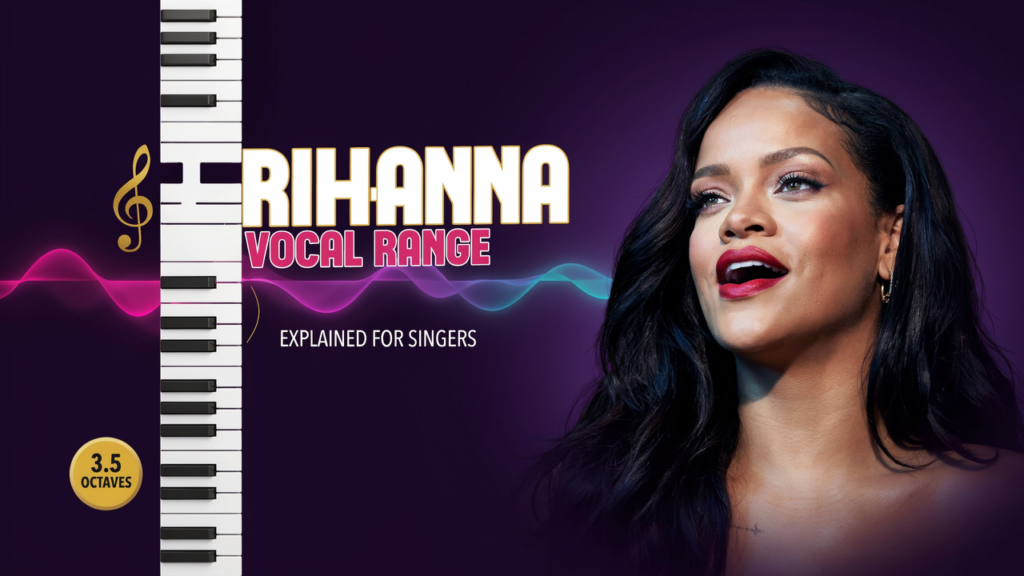
Rihanna’s vocal range is often estimated as B2–C-sharp6, but this review does not verify those notes as her complete career boundaries. A specific published reference is a long audition cut of “Stay,” listed at G3–E5. The two figures describe different things and should not be combined.
A duet arrangement also needs careful attribution. A melody associated with Rihanna and Mikky Ekko cannot automatically be treated as a measurement of Rihanna’s voice alone.
What Does B2–C-sharp6 Mean?
The claimed interval is 38 semitones: three octaves plus a major second. A narrower D3–C-sharp6 estimate would span 35 semitones, one semitone short of three octaves.
Neither calculation establishes the notes themselves. A career-range claim needs recordings, timestamps, clear identification of the singer, and a statement of whether brief effects or background parts are included.
“Conservative” is not a substitute for evidence. Reducing a proposed span does not make its endpoints verified, and a database’s largest entry is not automatically an artist’s maximum capability.
A Published “Stay” Range
The Musicnotes long audition cut of “Stay”, product MN0177169, lists G3–E5 in A minor. It is a Piano/Vocal/Guitar, Singer Pro arrangement containing partial lyrics.
Its span is 21 semitones: one octave plus a major sixth. Because this is a cut, it should not be presented as the range of every passage in the complete original duet.
Use the edition’s requirements to choose audition material. To make a claim about Rihanna’s recorded notes, separately identify which performer sings each passage and compare the actual performance.
Alto or Mezzo-Soprano?
Mezzo-soprano and alto appear in popular descriptions of Rihanna. This article does not establish a formal classical classification. Alto can describe a choir part, while mezzo-soprano is a solo voice category used in a different context.
A low note, dark tone, or bright upper phrase is not sufficient to settle voice type. Sustained tessitura, transitions, vocal weight, and repertoire provide additional information.
The mezzo-soprano guide explains why endpoints alone are insufficient. Pop descriptions should remain descriptive unless supported by an appropriate assessment.
Range and Tessitura Answer Different Questions
Range identifies outer notes. A song’s tessitura concerns where the line spends its time. One upper note can be manageable while several repeated phrases slightly below it remain tiring.
For a cover, mark both the boundaries and the longest sustained passages. Test the words, not just the pitches on a neutral vowel. Breath locations and consonants can change the difficulty.
An artist’s entire catalogue is a poor substitute for this score-specific check. You need the requirements of the version you will perform.
How to Choose a Key for “Stay”
First decide whether you are singing a duet, a solo arrangement, or the cited audition cut. Assign the parts before testing the key; a solo version may combine passages originally shared by two voices.
For the listed G3–E5 cut, lowering the melody two semitones gives F3–D5. The interval width stays the same. Recheck the lower phrases after any downward transposition rather than judging only the new high note.
Use the vocal range calculator to document your own repeatable notes, then sing complete phrases. Reaching both endpoints once does not prove the arrangement will remain comfortable.
If the verse becomes too low while the chorus still feels difficult, try another arrangement or different material. Increasing force is not a useful solution.
What to Listen for Beyond Octave Count
Choose one passage and focus on rhythm, then diction, then dynamic shape. These features can communicate intensity without requiring the largest possible range.
Avoid assuming that a heard tone identifies a precise vocal mechanism. Recording production, vowel choices, and phrasing can affect brightness and apparent weight.
Comparisons with Dua Lipa or SZA are more informative when tied to specific songs and phrases. Similar range estimates would not make the voices interchangeable.
Checking a High-Note Claim
Keep the recording version, timestamp, proposed note, and vocal part together. At the alleged peak, determine whether the sound is sustained, a passing pitch, or an effect.
A pitch detector may follow a harmony or an instrument in a dense mix. Confirm surprising readings with a reference and another listening pass. If the source does not allow clear attribution, label the note uncertain.
Frequently Asked Questions
Does Rihanna have a three-octave range?
The B2–C-sharp6 estimate is slightly wider than three octaves, but this review does not certify its endpoints.
Does the “Stay” cut show her full range?
No. It describes one arrangement containing only part of a song associated with two performers.
What is Rihanna’s highest note?
An absolute career maximum is not established here. A specific, attributable performance is required to evaluate any proposed endpoint.
Is a low voice automatically a contralto?
No. Tone and a low note alone do not establish a formal voice classification.

Harlow is a vocal analysis and singing tools writer at Voice Range Test. She focuses on vocal range testing, voice type analysis, pitch recognition, and singing education tools for singers, musicians, choir performers, and beginners.