
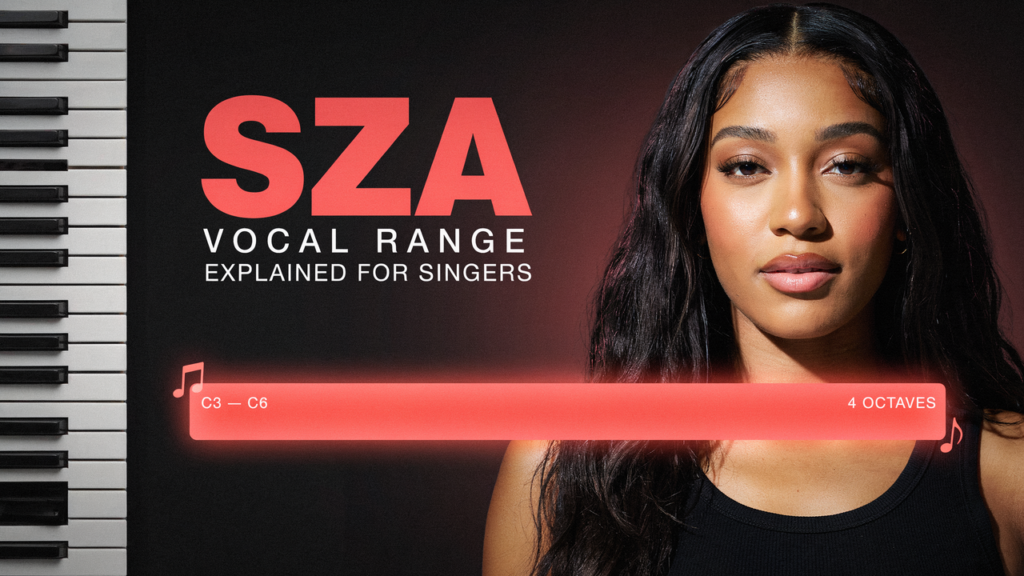
SZA’s exact career-wide vocal range is not established by the sources checked for this article. A useful documented example is E♭3–B♭4 in a published arrangement of “Kill Bill.” Broader claims such as B2–G5 should be treated as estimates, not verified limits.
That distinction matters if you want to sing her songs. You need the notes and phrasing of a particular version, rather than every sound attributed to her across studio recordings, harmonies and ad-libs.
What Can We Verify About SZA’s Range?
The Musicnotes “Kill Bill” arrangement, MN0267460, lists a vocal range of E♭3–B♭4 in A♭ major. That is 19 semitones: one octave plus a perfect fifth.
This is evidence about a specific published vocal part. It does not establish SZA’s lowest possible note, highest possible note or complete recorded range. The listing offers transpositions, so changing the selected key also changes the notes a singer must perform.
For example, moving this part up two semitones changes E♭3–B♭4 to F3–C5. The interval remains 19 semitones. A higher key raises the whole melody; it does not give the song a wider range.
Does SZA Have a Three-Octave Range?
B2–G5, a range circulated in online discussions, spans 32 semitones: two octaves and eight semitones. It is four semitones short of three full octaves. The arithmetic is clear, but the endpoints need separate evidence.
Another estimate, D3–F♯5, spans 28 semitones. Calling it “conservative” does not make it verified. A narrower guess can still combine unidentified performances or confuse the melody with a background layer.
A reliable career-range claim would identify each endpoint’s recording, timestamp, pitch and vocal context. This article does not certify either estimate, and the “Kill Bill” example should not be expanded into a career-wide conclusion.
The female vocal range guide provides reference categories, but those charts are not proof of an individual artist’s extremes.
Is SZA a Soprano, Mezzo-Soprano or Alto?
These labels are used inconsistently in discussions of SZA. There is not enough evidence here to assign a formal classical category or a more specific subtype.
Voice classification considers sustainable tessitura, transitions, vocal weight and repertoire. A low note does not automatically establish contralto, and a light high note does not establish soprano. The alto versus mezzo-soprano distinction also matters: a choir part and a solo voice type describe different things.
For learning her music, identify where the melody repeatedly sits. That practical question is more useful than deciding which label best fits a produced recording.
What Makes Her Songs Challenging?
Range is only one demand. Speech-like rhythms, slides, ornaments and changing tone can make a melody difficult even when every written pitch is accessible.
Use “Kill Bill” to separate pitch from delivery. Learn the basic melody first, with clear starts and endings. Add rhythmic details next, then selected slides. If you copy every expressive feature immediately, it becomes harder to hear whether the underlying note is accurate.
With layered songs such as “Good Days,” choose one vocal line to follow. Moving between the lead and a backing harmony can accidentally create a part that no single singer performs throughout the recording.
Breathiness is a sound quality, not sufficient evidence of a particular register. Avoid assuming that every airy note is falsetto or that matching an artist requires leaking as much air as possible.
How to Choose a Comfortable Key
Sing a short verse and chorus in the same key. Check the lowest words for clarity, then repeat the busiest upper phrase. A key that solves the chorus but makes the verse disappear is not yet a good fit.
Tessitura explains why repeated phrases can matter more than isolated endpoints. Try a small transposition, record both versions and compare control rather than resemblance.
For another contemporary song-based comparison, the Rihanna vocal range guide distinguishes an arrangement from a singer’s entire range. Apply that same distinction when comparing artists.
Frequently Asked Questions
What is SZA’s highest note?
This article does not establish an absolute highest note. G5 and higher claims need identifiable performance evidence; a published song range cannot settle her career maximum.
What is her lowest note?
E♭3 is the lower boundary in the cited “Kill Bill” arrangement. It is not presented as her lowest-ever sung pitch.
Can beginners sing SZA songs?
Choose a suitable key and simplify ornaments initially. Work on the melody, rhythm and breath points separately. The guide to effective singing practice can help structure that process.

Harlow is a vocal analysis and singing tools writer at Voice Range Test. She focuses on vocal range testing, voice type analysis, pitch recognition, and singing education tools for singers, musicians, choir performers, and beginners.