
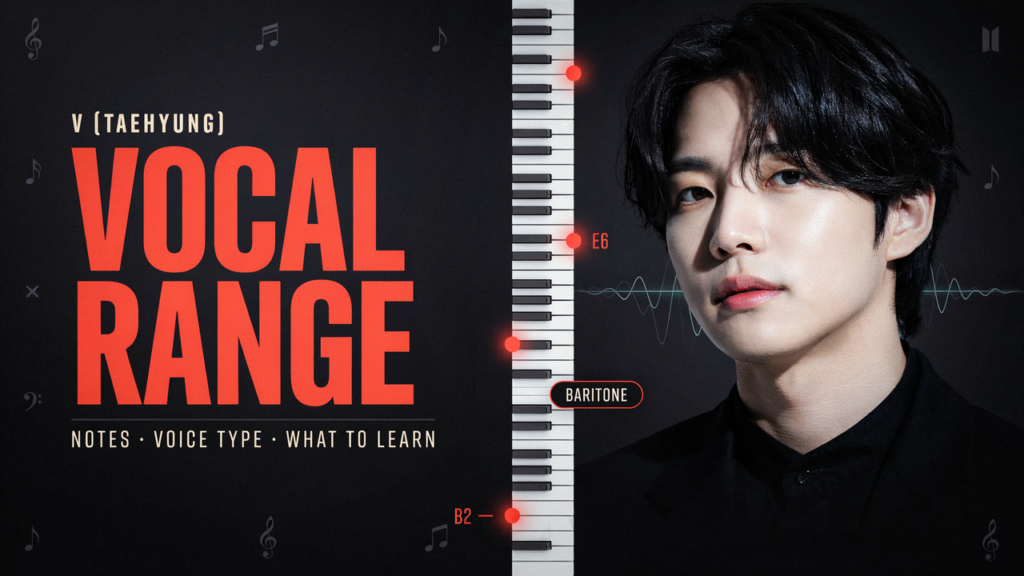
Taehyung, also known as V of BTS, is often described as a baritone, but his exact career-wide vocal range is not established by the sources checked here. Claims such as E2–C5 or E2–C6 need recording-level evidence before they can be treated as measured limits.
His voice-type description and his range are separate questions. A dark vocal color can help explain the baritone label without proving a particular lowest note, and singing high notes does not automatically change someone into a tenor.
What Supports the Baritone Description?
Weverse Magazine’s discussion of V’s vocals on Layover describes his baritone sound while examining his musical delivery. This supports baritone as a published description of his voice.
It does not provide a clinical assessment, a full note inventory or a formal operatic subtype. “Lyric baritone” is therefore more specific than the evidence here warrants.
The baritone voice guide explains the category’s middle position between tenor and bass. In contemporary music, these terms often describe perceived color and musical function more loosely than they do in opera.
How Many Octaves Do the Range Claims Cover?
E2–C5 spans 32 semitones, or two octaves and eight semitones. E2–C6 spans 44 semitones, or three octaves and eight semitones. Neither is an exact three- or four-octave interval.
The additional octave comes entirely from changing the proposed upper endpoint. Before accepting that change, ask whether the higher sound is a clearly pitched sung note, a brief effect, a backing part or another sound in the recording.
Calling E2–C5 a “dependable musical range” would require evidence of repeatability and musical use at both ends. This article does not have that evidence, so it does not promote the smaller estimate to a verified range.
Calculation is not verification: knowing the distance between two note names tells us what a claim means, not whether the singer actually produced those notes.
What Are Taehyung’s Highest and Lowest Notes?
A reliable answer would identify the exact performance and timestamp for each endpoint. It would also explain whether the note belongs to the lead vocal and whether it is sustained, briefly touched or part of an effect.
E2, E♭2 and C2 appear in discussions of his low range; C5 and sixth-octave pitches appear in upper-range claims. The sources checked here do not establish an absolute lowest or highest note.
A deep timbre should not be mistaken for a low frequency. Two singers can sing the same pitch while one sounds substantially darker. Likewise, an apparently piercing sound may include strong harmonics rather than the extremely high fundamental a listener assumes.
For interpreting those labels, scientific pitch notation distinguishes note name from octave: C5 is one octave above middle C, while C6 is two.
Songs to Use for a Listening Comparison
“Singularity,” “Stigma,” “Love Me Again” and “Slow Dancing” offer different material for comparing phrasing and vocal color. Treat them as listening references rather than a certified list of range endpoints.
Start by following the lead melody in one section. Then notice where the delivery becomes lighter, darker, more sustained or more rhythmically active. Compare those changes with the accompaniment so that an instrumental sound is not accidentally attributed to the singer.
For “Stigma,” separate the main melodic line from upper embellishments before deciding what a cover must include. For a Layover song, pay attention to phrase length and timing rather than assuming that a restrained delivery must be easy.
Can a Baritone Sing His Higher Material?
Potentially, if the specific key and phrases suit the singer. The baritone label does not prohibit upper notes, but it also does not guarantee that another baritone can reproduce V’s songs in the same way.
Tessitura describes the sustained pitch demands that an endpoint chart misses. A phrase may contain an accessible top note yet remain tiring because the surrounding melody stays high.
Try the melody at moderate volume, then adjust the key if necessary. Do not force a darker tone to imitate his lower sound. The tenor versus baritone comparison explains why range overlap makes one-note classification unreliable.
Frequently Asked Questions
Is Taehyung a bass?
His voice is described as baritone in the cited coverage. A deep speaking voice or a low isolated note does not establish bass. See baritone versus bass for the relevant distinctions.
Does he have four octaves?
The E2–C6 claim is four semitones short of four octaves, and its endpoints are not verified here. Do not round the interval up and present the result as established fact.
Does falsetto count toward range?
It can, when the measurement explicitly includes it. A transparent analysis should identify different vocal productions rather than implying every note has the same tone, intensity and repeatability.

Harlow is a vocal analysis and singing tools writer at Voice Range Test. She focuses on vocal range testing, voice type analysis, pitch recognition, and singing education tools for singers, musicians, choir performers, and beginners.