
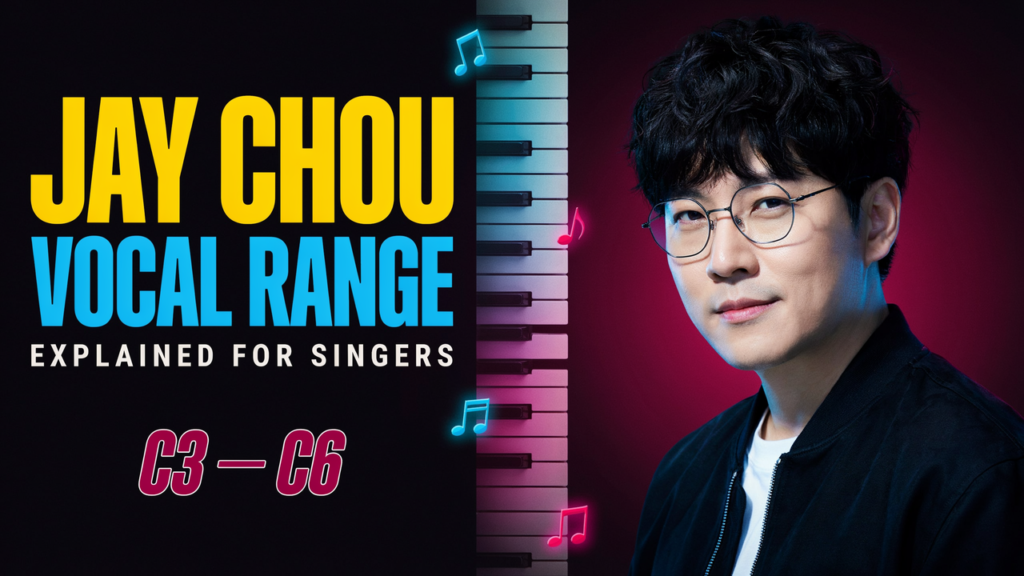
Jay Chou’s complete vocal range is not verified by the primary sources reviewed for this article. Exact lowest and highest notes require identifiable performances and a clear decision about which sounds count. Treat a fixed career-wide note span as an estimate unless that evidence is supplied.
For singing his music, the more useful question is whether a particular song and key suit your voice. A catalogue-wide total can include brief sounds that tell you little about the range needed for a chorus or a live cover.
What the Available Evidence Establishes
Jay Chou’s official JVR Music profile documents his recording and performing career, including the albums Jay and Common Jasmine Orange. It does not provide a measured vocal range, a highest-note certificate, or a formal voice classification.
That distinction matters: an official artist page is a reliable starting point for identifying the performer and releases, but it cannot be used as evidence for numbers it does not publish. Fan analyses may offer leads; their endpoint claims still need checking against the actual recordings.
Is A2–F♯5 a Confirmed Jay Chou Range?
No primary documentation reviewed here establishes A2–F♯5 as his complete range. The notation itself describes 33 semitones—two octaves plus nine semitones—but correct arithmetic does not verify that either endpoint is his career limit.
A defensible range report would identify each endpoint by song, version, timestamp, and vocal context. It would also state whether lighter upper-register singing, spoken sounds, or brief effects were included. Without those details, an attractive-looking range chart can imply much more certainty than the evidence supports.
Use a vocal range chart to understand note placement, not as independent proof that a singer produced every listed note. A database containing only a few songs describes its sample, not necessarily the artist’s capabilities.
Is Jay Chou a Tenor or a Baritone?
This article does not assign a definitive classical voice type. A singer’s speaking pitch, one low phrase, or one high note is insufficient for that classification. Timbre can also be affected by microphone technique, recording choices, and musical style.
The guides to tenor voices and baritone voices explain the categories, but applying them to a pop singer requires care. Comfortable tessitura, repeated phrase demands, transitions, and vocal weight matter alongside range.
Descriptions such as “light,” “dark,” “breathy,” or “bright” refer to qualities a listener hears. They do not by themselves prove a particular vocal-fold mechanism. Avoid assuming that every clear high note is chest voice or every soft high note is falsetto.
How to Assess a Jay Chou Song for Your Voice
Choose one identifiable version first. Use its title, release, and key when making notes; translated titles can differ between catalogues. A live arrangement, karaoke track, and studio release may not share the same melody or key.
Work through the melody in short phrases. Mark the lowest required note, the highest required note, and the passages that spend the longest time near either boundary. Then check the lyric and tempo. A phrase can remain difficult even when all its notes fall inside your measured range.
Treat sustained vowels, quick syllables, melodic slides, and rhythmic entrances as separate tasks. Speak the lyric in rhythm, sing the melody on an easy vowel, then put the two together. If the pitch works until the words return, repeat the smallest troublesome phrase rather than the entire track.
Use the vocal range calculator to document your own repeatable endpoints. Test your voice without loud accompaniment so the software does not read an instrument or the original singer instead.
A Practical Key-Selection Example
Suppose a song arrangement—not a verified Jay Chou song measurement—requires G3–C5, while C5 is unreliable for you. Lowering the track by two semitones changes the requirement to F3–B♭4. The upper note is lower, but you must also check whether F3 remains clear and comfortable.
If the chorus improves but the verse disappears into an indistinct low sound, lowering the key has traded one problem for another. Try a different key or arrangement, or choose material with a narrower span. Never judge fit by the highest note alone.
Record one verse-to-chorus transition after a gentle warm-up. A useful test includes the approach to the high phrase and the recovery afterward. Reaching the peak once in isolation does not show that you can repeat it throughout a song.
The effective singing practice guide can help organize this into short attempts, feedback, and a clear next step. Avoid treating a famous recording as a requirement to imitate someone else’s natural tone.
Why Online Range Figures Differ
Different lists may sample different years, recordings, or kinds of sound. A number built from one song can be too narrow; a compilation counting every squeak, backing part, and processed effect can overstate what the lead singer reliably sings.
Pitch tools can also follow an instrument or a harmonic rather than the vocal fundamental. Preserve the original audio speed, compare the note against a reference, and identify the lead voice clearly. If the evidence is ambiguous, label the note uncertain rather than filling a gap with a guess.
The same standard should apply to the low and high ends. A clearly repeated melodic note provides different evidence from a momentary spoken inflection. Neither should be silently substituted for comfortable tessitura.
Frequently Asked Questions
How many octaves can Jay Chou sing?
A verified career-wide octave total is not established here. Calculate a span only after both endpoints and their sources are documented; do not round a partial octave upward.
What is his highest note?
This article does not certify an absolute highest note. A credible claim needs an identifiable performance, timestamp, and explanation of what vocal sound is being counted.
Do I need the same range to sing his songs?
No. You need the notes and sustained phrase demands of your chosen arrangement in a suitable key. An artist’s full catalogue may require far more than any one song.
Should I force a high note to match the recording?
No. Change the key or simplify the task if the phrase requires increasing effort. Stop for pain or hoarseness, and seek qualified guidance if problems continue.

Harlow is a vocal analysis and singing tools writer at Voice Range Test. She focuses on vocal range testing, voice type analysis, pitch recognition, and singing education tools for singers, musicians, choir performers, and beginners.