
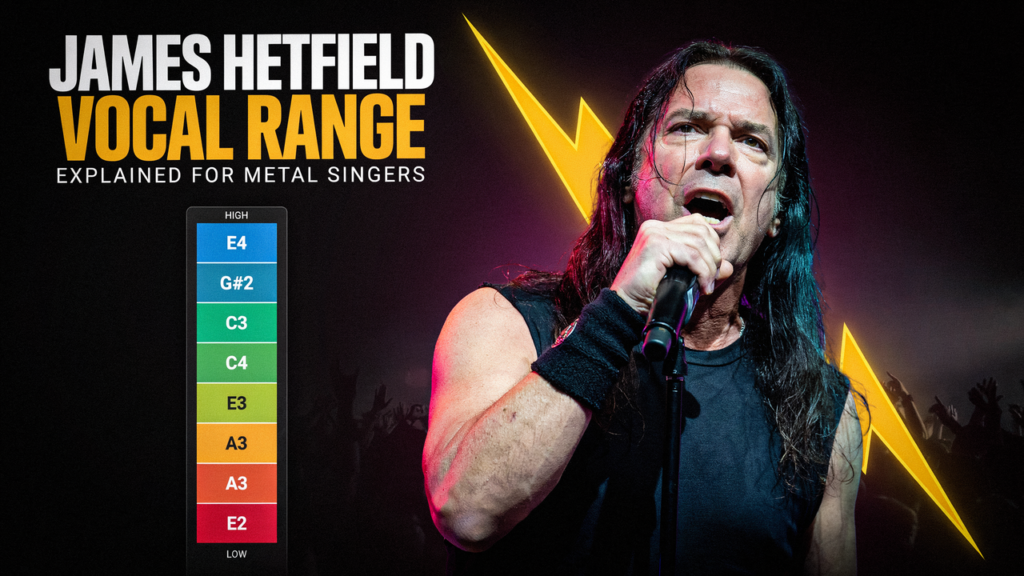
James Hetfield’s commonly reported melodic vocal range is approximately C2 to B♭5, spanning 46 semitones—or three octaves and ten semitones. However, that figure needs context. Some catalog-based compilations extend his total demonstrated output from A1 to A6, but those endpoints include spoken delivery and brief screamed effects rather than conventional, repeatable singing.
The most accurate description is therefore not simply “a five-octave singer.” Hetfield is a baritone-leaning rock vocalist whose practical strength lies in his forceful lower-middle register, commanding belts, rhythmic precision, and controlled use of vocal distortion.
What Is James Hetfield’s Vocal Range?
A frequently cited range for James Hetfield is C2–B♭5. A detailed fan-made compilation also lists an A6 extension, although that pitch is better treated as a momentary screamed effect than part of his normal melodic range.
Here is the clearest way to interpret the available claims:
| Range category | Approximate notes | Span | What it represents |
|---|---|---|---|
| Commonly reported melodic range | C2–B♭5 | 46 semitones | Pitched singing plus some aggressive upper-register sounds |
| Practical performance area | Lower-middle male register | Not fixed | The region used most consistently across Metallica songs |
| Broad effects-inclusive output | A1–A6 | 60 semitones | Spoken lows, sung notes, screams, and isolated effects combined |
The C2–B♭5 compilation covers three octaves and ten semitones, which is just two semitones short of four complete octaves. The A1–A6 calculation covers five octaves mathematically, but it does not represent five octaves of equally controlled melodic singing.
This distinction matters when comparing Hetfield with singers such as Corey Taylor, whose published range claims may also combine clean notes, screams, and other vocal effects.
James Hetfield’s Lowest and Highest Notes
Hetfield’s extreme-note claims come from different kinds of vocal production. A spoken note, a distorted shout, and a sustained clean pitch can all register at a measurable frequency, but they do not demonstrate the same singing ability.
| Note | Song or performance | Context | Evidence status |
|---|---|---|---|
| A1 | “Loverman” | Low spoken passage | Demonstrated pitch, but not conventional singing |
| C2 | Catalog-based range compilations | Low melodic production | Commonly reported lower sung boundary |
| G♯5 | “Of Wolf and Man” | Aggressive upper-register sound | Source-dependent but commonly catalogued |
| B♭5 | “The Small Hours,” live in 1998 | Brief high scream or exclamation | Demonstrated live effect; not normal tessitura |
| A6 | “Hit the Lights,” live in 1982 | Short, extremely high scream | Disputed as a usable vocal-range endpoint |
A catalog analysis identifies “The Small Hours” and an early live performance of “Hit the Lights” as examples behind the B♭5 and A6 claims. Because these are brief aggressive sounds, they should not be presented as sustained clean notes or evidence of Hetfield’s comfortable upper register. The commonly circulated C2–B♭5 range compilation also places the A6 in parentheses, reflecting its exceptional status.
At the lower end, a detailed vocal compilation identifies A1 in “Loverman.” The passage is spoken, however, so C2 is the more defensible lower boundary when discussing melodic singing.
Is James Hetfield a Baritone?
James Hetfield is most reasonably described as a baritone-leaning heavy-metal vocalist, but this is a contemporary stylistic description rather than a formal classical classification.
His voice has the weight, dark color, and lower-middle authority commonly associated with baritones. Songs such as “Enter Sandman,” “Sad but True,” “The Unforgiven,” and “Until It Sleeps” place much of their vocal impact in this part of his voice.
At the same time, his early Metallica performances contain high, bright screams that extend far above an ordinary baritone repertoire. Those extremes do not automatically make him a tenor. Voice type is determined through tessitura, timbre, vocal weight, register transitions, and sustained comfort—not merely the highest note produced once.
Hetfield’s dependable singing center is considerably narrower than his full compiled range. That is normal: a singer’s demonstrated range includes everything captured on record, while tessitura describes the region where the voice functions most consistently.
What Makes Hetfield’s Voice Distinctive?
Hetfield’s vocal identity depends more on coordination and delivery than on extreme notes.
His most recognizable characteristics include:
- A dense, chest-dominant lower-middle register
- Strong consonants synchronized closely with guitar rhythms
- Controlled rasp and distortion over a pitched foundation
- Bright, cutting high shouts in early Metallica recordings
- Darker, heavier resonance in later material
- Clean, restrained delivery in ballads and acoustic performances
His rhythm is particularly important. Because Hetfield frequently sings while playing intricate rhythm-guitar parts, his vocal phrases often lock tightly to the riff. The result is a percussive style in which vowels carry the pitch while consonants reinforce the attack.
His approach differs from the more fluid, sustained intensity heard in Layne Staley’s vocal style. It also contrasts with David Draiman’s lower-register metal singing, which relies on a different balance of articulation, resonance, and rhythmic phrasing.
How Hetfield’s Voice Changed Across His Career
Hetfield’s early-1980s voice was lighter, sharper, and more willing to leap into uncontrolled-sounding screams. Recordings from the Kill ’Em All and Ride the Lightning period reveal youthful brightness and an aggressive upper extension.
By Master of Puppets and …And Justice for All, his delivery had gained more weight and authority. The singing remained abrasive, but the phrases became more focused and recognizable.
The Black Album marked another major shift. Hetfield increasingly used a thicker, darker sound with clearer melodic shaping. “Nothing Else Matters” and “The Unforgiven” also displayed a more exposed clean voice rather than relying exclusively on thrash-metal aggression.
The Load and Reload era brought blues, hard-rock, and country-influenced colors into his singing. Later performances generally show a more measured approach: fewer uncontrolled extreme screams, more deliberate phrasing, and greater reliance on sustainable midrange delivery.
That evolution is worth remembering when comparing him with a vocalist such as Phil Anselmo. Both use aggressive colors, but neither singer’s entire career can be represented accurately by one isolated range number.
Demonstrated Range Versus Usable Range
Hetfield’s case illustrates why vocal-range figures can be misleading. If every spoken pitch and momentary scream is included, his output may be described as A1–A6. If the goal is to represent recognizable melodic singing, approximately C2–B♭5 is more informative, though even its upper boundary is an extreme effect rather than a comfortable note.
A usable range requires notes that can be repeated with stable pitch, suitable tone, and reasonable control. Most Metallica songs occupy a much smaller area than the complete compilation suggests.
You can use the site’s vocal range calculator to calculate the distance between two notes. When comparing your result with Hetfield’s, record your ordinary sung range separately from fry, speech, falsetto, or screamed effects.
Frequently Asked Questions
What is James Hetfield’s highest note?
A6 has been attributed to an early live performance of “Hit the Lights,” but it is a brief screamed effect. B♭5 is a more commonly accepted effects-inclusive upper boundary, though it is still not part of his normal tessitura.
What is James Hetfield’s lowest note?
A1 has been identified in the spoken passage of “Loverman.” For conventional melodic singing, C2 is a more defensible commonly reported lower limit.
How many octaves can James Hetfield sing?
The commonly cited C2–B♭5 range spans three octaves and ten semitones. An A1–A6 effects-inclusive measurement equals five octaves, but it combines speech, singing, and extreme screams.
Is James Hetfield a bass or baritone?
Hetfield is better described as baritone-leaning. His dark vocal color and powerful lower-middle register support that description, but his exact classical voice type cannot be established from recorded extremes alone.
Does Hetfield’s growl count toward his vocal range?
It counts when a distorted sound contains a stable, identifiable fundamental pitch. Noise-dominant growls, multiphonic effects, and unpitched screams should not be treated as ordinary sung notes.

Harlow is a vocal analysis and singing tools writer at Voice Range Test. She focuses on vocal range testing, voice type analysis, pitch recognition, and singing education tools for singers, musicians, choir performers, and beginners.