
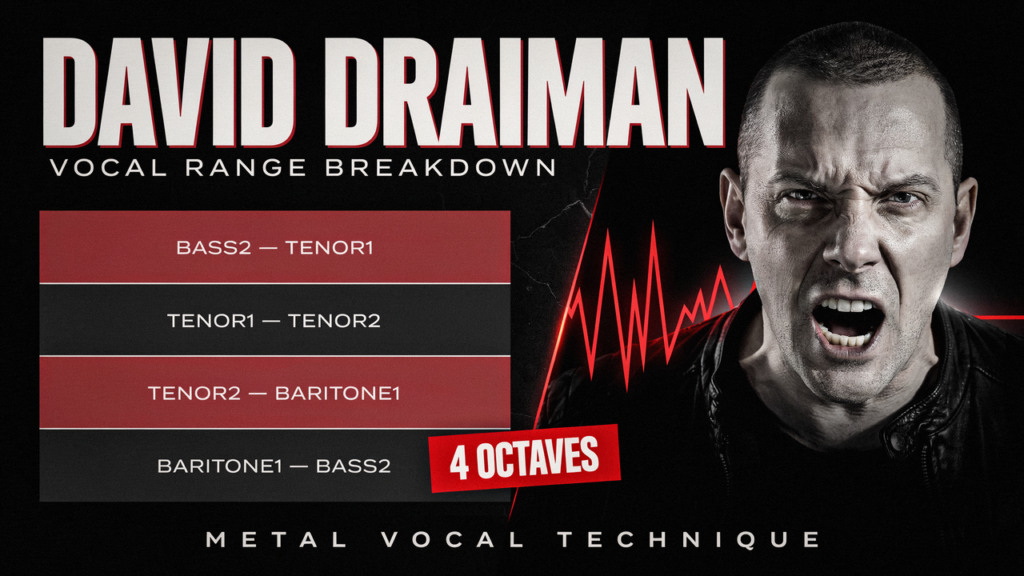
David Draiman’s vocal range is commonly estimated around A#1 to G#5, but that should be treated as a reported extended-range estimate, not an official laboratory measurement. A more useful description is that he has a baritone-centered rock and metal voice with strong upper extension, clean low resonance, controlled grit, and precise rhythmic attack.
The exact number changes depending on what an analysis counts: clean notes, mixed notes, falsetto, screams, spoken sounds, growls, or studio-layered effects. Draiman’s real strength is not a single extreme pitch. It is how clearly he can keep melody, rhythm, and character inside aggressive vocal production.
David Draiman Vocal Range at a Glance
| Category | Best practical assessment |
|---|---|
| Common reported range | About A#1-G#5 |
| Approximate span | Three octaves plus ten semitones |
| More conservative clean/mixed area | Often described closer to E2-B5 |
| Likely voice type | Baritone-centered rock/metal voice |
| Signature sound | Dark resonance, grit, clipped rhythm, and controlled intensity |
| Main caution | Distorted sounds and clean singing should not be counted the same way |
If you want a neutral reference for note locations, use the site’s vocal range chart. It helps separate pitch names from voice-type labels, which is important when analyzing metal vocals.
What Is David Draiman’s Lowest Note?
Draiman is often credited with lows around A#1 or B-flat1, though E2 is a safer conservative boundary for clearly musical low singing in many analyses. His low range matters because it supports the dark authority of his voice, especially in slower and cleaner material.
Disturbed’s version of “The Sound of Silence” changed how many casual listeners heard him. The opening reveals a low, steady, resonant tone before the arrangement grows in intensity. That performance is more useful for understanding his voice than treating an isolated database note as the whole story.
A low sound can be modal singing, speech, vocal fry, or a growl. Those do not all show the same usable singing ability. For that reason, low-note claims should be tied to the specific recording and vocal production.
What Is David Draiman’s Highest Note?
G#5 is often cited as Draiman’s high endpoint, while some online claims go higher. Those higher numbers should be handled carefully unless the note is clearly identified by song, timestamp, and production type.
In rock and metal, upper notes can come from several different coordinations:
- Clean full voice or mixed voice
- Head-dominant singing
- Falsetto
- Pitched distortion
- Screams with a detectable pitch center
- Layered studio sounds
A distorted high sound can be musically powerful without being equivalent to a sustained clean belt. This is why comparing Draiman with Rob Halford is useful: Halford is more strongly associated with sustained high-register metal singing, while Draiman’s signature sits in darker, rhythmic, baritone-centered intensity.
How Many Octaves Can David Draiman Sing?
The A#1-G#5 estimate spans 46 semitones, or three octaves plus ten semitones. Some sources repeat five-octave claims, but those claims need stronger transparent evidence before they should be treated as confirmed.
A simple octave number can hide the most important question: are the notes clean, repeatable, healthy, and usable in songs? A metal vocalist may produce many pitch-like sounds that are artistically valid but not the same as a clean singing range.
Is David Draiman a Baritone?
Yes, he is best described as a baritone-centered rock and metal singer. His dark timbre, lower-middle strength, and heavy vocal color support that description. He also has enough upper extension to avoid being boxed into a narrow low-voice category.
This is a practical contemporary label rather than a classical fach assignment. For a broader explanation, see what a baritone voice is. Voice type depends on tessitura, vocal weight, passaggio behavior, and repeatable phrasing, not just the lowest and highest sounds.
His low-centered power invites comparison with James Hetfield, though Hetfield’s bite, vowels, and thrash-influenced attack are different. Draiman often sounds more rounded, compressed, and rhythmically clipped.
Clean Singing vs. Grit and Distortion
Draiman’s aggressive sound works because the pitch remains organized underneath the grit. In many Disturbed songs, the melody is still clear even when the surface of the tone is rough.
That is different from simply shouting. Shouting often loses pitch center, endurance, and vowel clarity. Draiman’s better performances keep the line controlled while adding distortion for character.
The contrast is obvious across his catalog:
- “The Sound of Silence”: low resonance, clean tone, and gradual dynamic build.
- “Prayer”: melodic intensity with a controlled edge.
- “Inside the Fire”: aggressive articulation and rhythmic pressure.
- “Down with the Sickness”: percussive vocal character and timing.
- “Remember”: clearer melodic rock singing.
This clean-to-aggressive flexibility can be compared with Corey Taylor and Chester Bennington. All three mix melody with aggression, but their center of gravity and distortion style differ.
Is the “Ooh-Wah-Ah-Ah-Ah” Part of His Range?
The famous sound from “Down with the Sickness” shows timing, attack, and character, but it should not automatically be used as a range endpoint. Its value is rhythmic and expressive more than melodic.
Metal vocal analysis gets messy when character sounds, spoken effects, yelps, screams, and clean notes are all counted the same way. A fair range estimate should separate the type of sound before calculating the span.
The same issue appears when analyzing Serj Tankian’s vocal range, because unusual colors can be central to the style without always functioning as conventional singing notes.
Why “The Sound of Silence” Matters
“The Sound of Silence” showed many listeners that Draiman’s voice was not only aggression. The performance highlights breath control, low resonance, clean vowels, sustained phrasing, and gradual dynamic growth.
That song is also a good reminder that vocal range is not the same as vocal impact. A controlled phrase that grows from quiet to powerful can be more impressive than a single extreme note.
Singers who want to study this kind of control should begin with clean coordination. Use vocal control techniques before attempting distortion, and avoid copying aggressive sounds if they create pain or lasting hoarseness.
How to Approach Draiman-Style Vocals Safely
- Build clean pitch and breath control first.
- Practice low and middle-register resonance without forcing volume.
- Add grit gradually and only at comfortable intensity.
- Stop if the throat hurts, scratches, or loses function.
- Do not copy screams from a finished studio recording at full intensity.
- Work with a qualified teacher if you want to learn distortion seriously.
Aggressive vocals should still feel coordinated. If you lose your voice after every attempt, the technique is not sustainable.
Frequently Asked Questions
What is David Draiman’s vocal range?
His range is commonly estimated around A#1-G#5, but that should be treated as a reported extended range rather than an official confirmed measurement.
Is David Draiman a baritone?
Yes. He is best described as a baritone-centered rock and metal singer with strong upper extension.
Does David Draiman have a five-octave range?
Five-octave claims appear online, but they are not well established without transparent song-by-song evidence and clear separation of clean notes, screams, and effects.
Does David Draiman scream or sing?
He does both depending on the song. Much of his signature style is pitched singing with added grit or distortion rather than uncontrolled shouting.
Why is “The Sound of Silence” important for his voice?
It reveals his clean low resonance, sustained phrasing, dynamic build, and vocal control more clearly than many heavier Disturbed tracks.

Harlow is a vocal analysis and singing tools writer at Voice Range Test. She focuses on vocal range testing, voice type analysis, pitch recognition, and singing education tools for singers, musicians, choir performers, and beginners.