
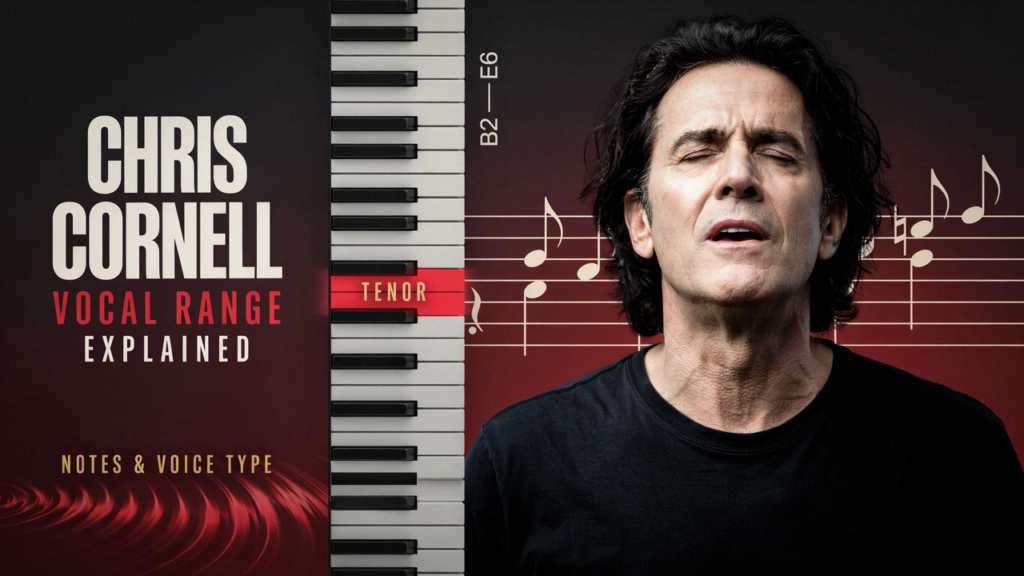
Chris Cornell’s commonly reported vocal range was approximately C2 to A5, spanning three octaves and nine semitones—just three semitones short of four complete octaves. Some fan-made compilations extend his range to G6, but that broader figure may include brief falsetto sounds, screams, or pitches without clearly documented song-level evidence.
Cornell’s voice was remarkable because he combined deep baritone color with powerful singing in the tenor range. He could move from restrained low phrases to ringing belts, rasp, falsetto, and piercing high cries while keeping a recognizable melodic center.
Chris Cornell’s vocal range C2–A5
65.4–880 Hz · 3 octaves and 9 semitones · Deep baritone color with power in the tenor range
Documented range Wider reported range (C2–G6) You
Don’t know your range? Take the voice range test.
What Was Chris Cornell’s Vocal Range?
The most defensible commonly reported estimate for Chris Cornell is C2–A5. Some analyses place the bottom at C♯2, which would reduce the measured span by one semitone.
| Vocal area | Typical use | Evidence interpretation |
|---|---|---|
| C2–C♯2 | Reported lower extreme | Source-dependent |
| Second and third octaves | Dark low phrases and baritone resonance | Strongly represented |
| Fourth octave | Main melodic and belting range | Central to his singing |
| Fifth octave | High belts, cries, falsetto, and distortion | Frequently demonstrated |
| Up to A5 | Commonly reported upper boundary | Plausible extended high |
| G6 | Claimed by some fan compilations | Insufficiently verified extreme |
This range combines sounds made through different registers and vocal qualities. A clean low note, a sustained belt, a brief falsetto, and a distorted scream do not demonstrate the same degree of control.
Cornell’s practical range was narrower than every sound he produced across his career. That usable range—the notes he could phrase, sustain, repeat, and perform in complete songs—is more valuable than the broadest possible compilation.
What Was Chris Cornell’s Lowest Note?
C2 is often cited as Chris Cornell’s lowest note, although some analyses use C♯2 as the lower boundary. The exact recording used to support C2 is not consistently identified, so it should be treated as a commonly reported extreme rather than an undisputed endpoint.
Cornell’s lower register is clearly demonstrated even without relying on one isolated C2. Songs from his solo career, Soundgarden, and Audioslave reveal a dark, resonant lower-middle voice that contrasts sharply with his famous high singing.
His low notes could sound warm and intimate in acoustic arrangements or heavy and ominous over distorted guitars. That depth is one reason his voice should not be classified from his highest notes alone.
A comparison with Eddie Vedder’s vocal range makes this difference clear. Both singers possessed dark colors associated with Seattle rock, but Cornell had a more dramatic upper extension, while Vedder’s identity remained more firmly connected to his lower and middle registers.
What Was Chris Cornell’s Highest Note?
A5 is the highest note in the widely repeated C2–A5 estimate. Cornell regularly demonstrated fifth-octave power, although the register and reliability of individual extreme notes vary between recordings.
His highest sounds may include:
- Full or chest-dominant belts
- Mixed coordination
- Head voice
- Falsetto
- Pitched screams
- Brief distorted cries
“Beyond the Wheel” is central to any analysis of Cornell’s upper range. Both studio and live versions demonstrate large jumps between registers and exceptionally high, intense vocal production. The song reportedly covers about three octaves within one performance, though its highest cries should still be classified according to register and duration.
Some compilations credit Cornell with G6. That pitch sits ten semitones above A5 and would expand a C2–G6 range to four octaves and seven semitones. However, the G6 claim should remain unverified unless it can be traced to a clear recording in which Cornell’s voice, pitch, and production are identifiable.
Cornell’s upper-register intensity connects him with singers such as Robert Plant, but Cornell often brought greater baritone weight into his high rock singing.
Did Chris Cornell Have a Four-Octave Range?
Chris Cornell had nearly four octaves under the commonly reported C2–A5 measurement.
The calculation is:
- C2 to C3: one octave
- C3 to C4: a second octave
- C4 to C5: a third octave
- C5 to A5: nine additional semitones
The complete distance is 45 semitones. Four full octaves contain 48 semitones, so C2–A5 is three semitones short.
Calling that range “nearly four octaves” is accurate. Describing it as exactly four octaves would require a high C6 or another pair of endpoints separated by 48 semitones.
If the lower boundary is C♯2 instead, the span to A5 is 44 semitones: three octaves and eight semitones. These calculations show why clearly defining the endpoints matters.
Was Chris Cornell a Baritone or Tenor?
Chris Cornell is most accurately described as a baritone with an unusually strong tenor extension. His natural tonal weight and lower register support the baritone description, while his technique allowed him to sing pitches normally associated with tenor repertoire.
His highest notes did not automatically make him a tenor. Voice type also depends on:
- Comfortable tessitura
- Timbre and vocal weight
- Register transitions
- Sustainable phrasing
- Where the voice carries its strongest natural resonance
Rock singers also use microphones, distortion, modified vowels, falsetto, and nonclassical production. A rigid operatic subtype would therefore imply more certainty than the available evidence supports.
The distinction between tenor and baritone voices helps explain Cornell’s unusual profile. His range overlapped both categories, but his dark foundation remained audible even when he climbed into high territory.
How Cornell Combined High Notes and Distortion
Cornell’s high singing often contained rasp or distortion while retaining a clear underlying pitch. This made his voice sound larger and more urgent without turning every intense moment into an unpitched scream.
“Slaves & Bulldozers” offers a strong example. The performance grows progressively heavier, moving from a blues-influenced tone into aggressive rock singing. “Jesus Christ Pose” relies on stamina, projection, and repeated high intensity, while “Birth Ritual” displays bright, cutting upper-register attacks.
His high notes also varied in density. Some sounded full and metallic; others became lighter or more scream-like as they rose. Treating every sound as pure chest voice would misrepresent how the coordination changed.
Cornell’s balance of melody and grit influenced later rock singers, including Chester Bennington. Both could preserve an identifiable pitch through intense distortion, though their vocal weight and stylistic placement differed.
Performances That Reveal His Range
“Beyond the Wheel” is the clearest showcase of Cornell’s dramatic register contrast. The low passages establish weight before the voice rises into extreme cries.
“Slaves & Bulldozers” demonstrates progressive intensity, blues phrasing, grit, and sustained high rock singing.
“Birth Ritual” places Cornell’s voice in a demanding upper register with a bright, forceful edge.
“Say Hello 2 Heaven” reveals his ability to combine resonance, emotional control, and high sustained phrases without relying on constant aggression.
“Like a Stone” presents a more contained side of his voice. The melody uses his low and middle register before expanding into higher emotional peaks.
“You Know My Name” combines lower authority with high, urgent phrasing suited to its cinematic rock arrangement.
“Nothing Compares 2 U” highlights tone, dynamics, and lyric interpretation in a stripped-back setting. It shows why Cornell’s musicianship cannot be reduced to screaming or maximum range.
His softer solo work also invites comparison with Jeff Buckley’s vocal range. Both singers could shift from intimate restraint to exposed upper-register intensity, although their timbres and technical approaches remained distinct.
Studio, Demo and Live Range
Studio recordings can provide clean audio, but they may include layered vocals, edited takes, effects, or harmonies. Live footage offers stronger evidence that a singer produced a note in performance, yet crowd noise, instrument bleed, and recording quality can obscure its exact pitch.
Different versions of the same Cornell song may also contain different notes. “Beyond the Wheel,” for example, exists in studio, demo, and live forms, and Cornell did not reproduce every high phrase identically.
A reliable range analysis should therefore identify:
- The precise version
- Whether the sound is Cornell’s lead vocal
- The note and its duration
- Whether it is sung cleanly or distorted
- The register or likely production
- Whether the note appears repeatedly
This prevents an isolated scream from being presented as Cornell’s comfortable upper limit. It also avoids excluding high notes simply because they use distortion. The correct approach is to include the sound with an accurate label.
Why Chris Cornell’s Voice Was Exceptional
Cornell’s range was impressive, but his ability to connect contrasting vocal qualities made it musically important. He could carry a melody through dense guitars, deliver unusual intervals, control long crescendos, and make high notes sound emotionally necessary.
He also adapted his instrument across several settings. Soundgarden emphasized unusual tunings, heavy riffs, and dramatic screams. Audioslave often placed his voice against groove-based hard rock. His acoustic performances exposed the underlying pitch, phrasing, and tonal control.
The contrast is especially clear beside Layne Staley’s vocal range. Staley often created intensity through compressed tone and layered harmony, while Cornell frequently used larger dynamic arcs and more expansive high-register movement.
Cornell’s legacy rests on that combination of range, tone, control, songwriting, and emotional directness. The C2–A5 estimate offers a useful measurement, but it cannot fully describe what listeners hear in the performances.
Frequently Asked Questions
What was Chris Cornell’s vocal range?
Chris Cornell’s commonly reported range was C2–A5, spanning three octaves and nine semitones. Some sources use C♯2 as the lowest note or propose higher extensions.
Did Chris Cornell have a four-octave range?
His widely reported C2–A5 range falls three semitones short of four complete octaves, so “nearly four octaves” is the more accurate description.
What was Chris Cornell’s highest note?
A5 is the commonly reported upper boundary. Claims extending to G6 exist, but the retrieved evidence does not clearly establish that pitch as a verified musical note.
Was Chris Cornell a baritone?
Yes. Cornell is commonly described as a baritone with an exceptional ability to sing high in the tenor range. His upper extension did not erase the weight and color of his lower voice.
Did Chris Cornell use falsetto?
Yes. Cornell used falsetto alongside modal singing, high belts, rasp, and pitched screams. His upper range cannot be assigned to one vocal register.
Which song best demonstrates Chris Cornell’s range?
“Beyond the Wheel” is the strongest single example because it contrasts low passages with extreme upper-register singing. Several versions exist, and their exact notes may differ.

Harlow is a vocal analysis and singing tools writer at Voice Range Test. She focuses on vocal range testing, voice type analysis, pitch recognition, and singing education tools for singers, musicians, choir performers, and beginners.