
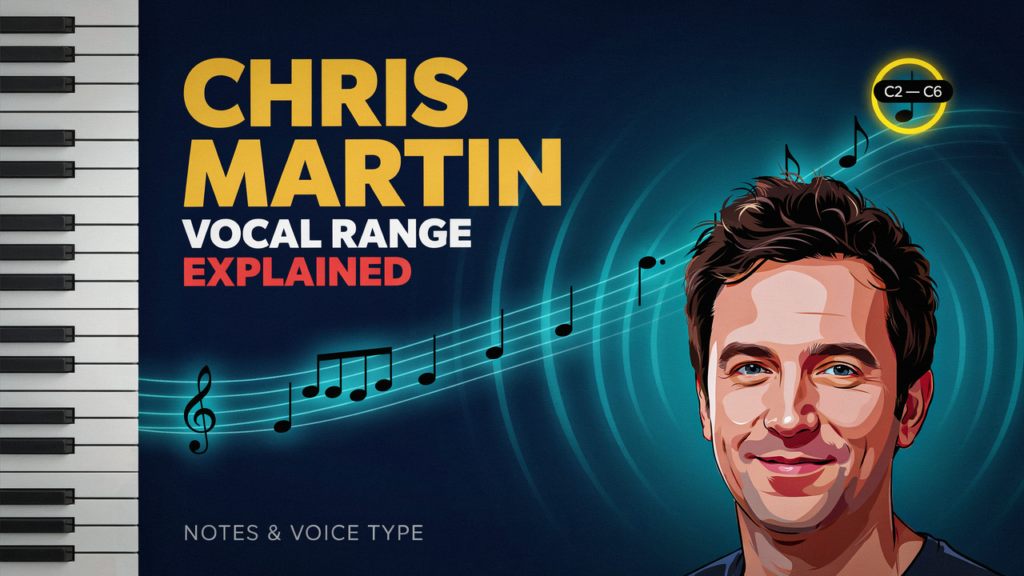
Chris Martin’s vocal range is usually estimated at around F2 to G5, depending on whether you include falsetto and studio vocal effects. In practical Coldplay songs, his comfortable singing sits much lower than that number suggests. His voice is built around a soft, bright middle range, emotional delivery, and frequent falsetto lifts rather than constant high belting.
That is why Chris Martin’s range can be confusing. Some lists describe him as a tenor, some call him a baritone, and some give very wide note ranges without explaining which notes are full voice, head voice, or falsetto. The clearest answer is this: Chris Martin has a tenor-leaning pop/rock voice with a strong falsetto extension, but his signature sound depends more on tone and phrasing than vocal power.
For comparison, you can hear a similar pop-rock use of bright upper notes in singers like Adam Levine and Harry Styles, though Martin’s delivery is usually more breathy, intimate, and less aggressive.
What Is Chris Martin’s Vocal Range?
Chris Martin’s commonly discussed vocal range is approximately F2 to G5. That gives him about three octaves and two semitones of total range if falsetto and upper extensions are included.
A more realistic working range for his main Coldplay vocals is closer to the lower and middle parts of that span. His modal voice often works around the baritone-tenor area, while many of his highest notes come from falsetto or a light head voice sound.
A useful way to understand his range is:
| Register Area | Approximate Notes | How He Uses It |
|---|---|---|
| Low range | F2 to B2 | Occasional low phrases, not his main comfort zone |
| Main singing range | C3 to A4/B4 | Most Coldplay melodies and choruses |
| Falsetto/head voice | C5 to G5 | Emotional lifts, ad-libs, atmospheric hooks |
This is also why two people can listen to the same singer and disagree. One person may focus on his spoken-like lower tone and call him a baritone. Another may focus on his high pop melodies and falsetto and call him a tenor.
Chris Martin’s Lowest Notes
Chris Martin’s lower range has been reported around F2, though those very low notes are not the center of his singing identity. In most Coldplay songs, he does not rely on deep, heavy low notes the way a true bass-baritone or low baritone would.
His lower voice is usually light, conversational, and gentle. It works well for intimate verses because it gives the song a reflective feeling. Songs like “The Scientist,” “Yellow,” and “Trouble” show this side of his voice clearly. He often begins with restrained phrasing, then opens the sound as the song builds.
The important point is that a low note does not automatically make someone a baritone. Singers can touch lower notes without living there comfortably. Chris Martin can reach into a lower area, but his most recognizable vocal moments usually happen higher, especially when the melody moves into a floating falsetto.
Chris Martin’s Highest Notes
Chris Martin’s highest commonly discussed notes are usually placed around G5, with some sources claiming even higher notes such as A5. Those upper notes should be treated carefully because they are generally not full-voice belted notes.
His high notes are usually produced with falsetto, head voice, or a light mixed approach. That is part of the Coldplay sound. Instead of pushing a huge rock belt, Martin often lets the upper notes feel airy, emotional, and slightly fragile.
This is especially clear in songs such as “Fix You,” “True Love,” and “A Sky Full of Stars.” The high notes are not just there to show range. They create lift. When the band arrangement opens up, his voice often rises into a thinner, brighter register that feels expansive without sounding heavy.
That separates him from singers like Sam Smith, whose upper range often carries a different kind of dramatic weight, or The Weeknd, whose falsetto is a much more central R&B-style signature.
How Many Octaves Can Chris Martin Sing?
If we use the approximate range of F2 to G5, Chris Martin has a total range of about three octaves and two semitones. However, that number includes falsetto and upper register singing.
His full-voice or modal range is likely much smaller. A safer estimate for his main usable singing range is roughly F2 to A4/B4, depending on the song and performance. That still gives him plenty of range for pop and rock music, but it avoids the common mistake of treating every high falsetto note as if it were the same as a chest-dominant belt.
This distinction matters because vocal range is not just the distance between the lowest and highest note a singer has ever made. For singers, the better question is often: where does the voice sound controlled, expressive, repeatable, and comfortable?
Chris Martin’s answer is his middle and upper-middle range. That is where his voice sounds most natural.
Is Chris Martin a Tenor or Baritone?
Chris Martin is usually described as a tenor, or at least a tenor-leaning contemporary pop singer. However, there is some understandable debate because his tone can feel lighter and lower in certain verses.
He does not have the thick, dark, classical baritone quality associated with traditional baritone singing. At the same time, he also does not sing like a high rock tenor who constantly belts near the top of the range. His style sits somewhere between categories, which is common in modern pop and alternative rock.
The best practical classification is:
Chris Martin is a light pop/rock tenor with a strong falsetto extension.
That description is more useful than simply calling him a tenor or baritone. It explains both sides of his voice: the gentle lower-middle tone and the floating upper register.
If you are comparing him with other male pop singers, Ed Sheeran is a useful nearby reference because both singers rely more on melodic phrasing and emotional directness than extreme vocal athleticism.
Modal Voice, Head Voice, and Falsetto
The biggest mistake people make with Chris Martin’s vocal range is mixing all registers together without explanation.
His modal voice is the part that sounds closest to his regular full singing tone. This is the voice he uses for most Coldplay verses and many choruses. It is warm, light, and direct.
His falsetto is the airy upper sound that appears in songs like “Fix You.” It is less dense than full voice and gives the music a vulnerable, floating quality.
His head voice or light mix can sit between those two sounds. Depending on the song and performance, some upper notes may not be pure falsetto, but they are still not the same as a heavy chest-voice belt.
This is why range charts can be misleading. A singer who reaches G5 in falsetto is doing something very different from a singer who belts G5 in a powerful full voice. Chris Martin’s upper range is impressive because it is musical and recognizable, not because it is the loudest or most forceful version of those notes.
Chris Martin’s Vocal Range in Coldplay Songs
Coldplay’s music is a good study in how a singer can sound emotionally powerful without using extreme vocal force. Chris Martin’s melodies often start in a comfortable area, then rise into repeated hooks or falsetto phrases.
“Fix You” is one of the clearest examples. The song begins with a fragile, controlled tone and uses higher falsetto color to create emotional lift. The vocal does not need to be huge to feel intense.
“Trouble” shows a softer and more restrained side of his range, with a melody that sits comfortably and lets his tone carry the emotion. “The Scientist” works in a similar way, using simplicity and repetition instead of technical display.
“True Love” and “A Sky Full of Stars” are helpful for discussing his higher range because they include upper extensions around the G5 area. These moments are usually better understood as falsetto or head-voice effects rather than full-voice range markers.
“Yellow,” “Clocks,” “Viva La Vida,” “Magic,” and “Adventure of a Lifetime” show the practical Coldplay formula: memorable melodic shapes, a bright upper-middle range, and a voice that cuts through without sounding heavy.
What Makes Chris Martin’s Voice Distinctive?
Chris Martin’s voice is distinctive because of its emotional clarity. He is not known for huge vibrato, complex runs, or dramatic belting. His strength is making simple melodies feel sincere and open.
His tone often has a breathy edge, especially in quieter songs. He also uses falsetto as a color, not just a high-note trick. That is a major part of why Coldplay choruses can feel wide and atmospheric even when the vocal line itself is simple.
Another important part of his singing is restraint. Martin often leaves space in the vocal. He does not over-sing every phrase. That makes his bigger moments more effective when they arrive.
For singers trying to understand their own range, Chris Martin is a good reminder that vocal identity is not only about how many notes you can hit. It is also about where your voice sounds honest, repeatable, and expressive. A tool like the vocal scale finder can help map notes, but your best singing range is the part you can actually use well in songs.
Range vs Comfortable Tessitura
Chris Martin’s total range may reach from the low second octave into the fifth octave, but his comfortable tessitura is narrower. Tessitura means the part of the range where a singer spends the most time and sounds most natural.
For Chris Martin, that area is mostly the middle and upper-middle range. His songs rarely depend on nonstop extreme notes. Instead, the melodies are written so his voice can sound clear, emotional, and recognizable.
That is why his voice works so well for Coldplay. He does not need to dominate the track with volume. His tone sits inside the arrangement, then rises when the song needs lift.
So, while the headline answer is that Chris Martin’s vocal range is around F2 to G5, the more useful answer is this: his musical strength lives in his light tenor-like middle range, with falsetto used as one of his most important expressive tools.
FAQ
What is Chris Martin’s vocal range?
Chris Martin’s vocal range is commonly estimated at around F2 to G5, including falsetto and upper register notes. His most usable singing range is likely narrower.
What is Chris Martin’s highest note?
His highest commonly discussed notes are around G5, usually in falsetto or a light head-voice sound. Some sources claim higher notes, but those should be treated cautiously unless the register and performance are clearly verified.
What is Chris Martin’s lowest note?
Chris Martin has been reported as reaching around F2, though his lower notes are not the main feature of his vocal style.
Is Chris Martin a tenor or baritone?
Chris Martin is best described as a light pop/rock tenor or tenor-leaning singer. Some listeners hear baritone qualities in his lower-middle tone, but his Coldplay melodies and falsetto use point more toward a tenor-like practical role.
Does Chris Martin sing in falsetto?
Yes. Falsetto is one of Chris Martin’s signature vocal tools, especially in emotional Coldplay songs such as “Fix You.”
What is Chris Martin’s range in “Fix You”?
“Fix You” is often discussed around a B2-B4 type span, with falsetto color playing an important role in the song’s emotional sound.
Is Chris Martin hard to sing?
Chris Martin can be harder to sing than he first sounds because his style requires control, breath management, and smooth register changes. The notes are not always extreme, but the soft high singing and falsetto transitions can be challenging.

Harlow is a vocal analysis and singing tools writer at Voice Range Test. She focuses on vocal range testing, voice type analysis, pitch recognition, and singing education tools for singers, musicians, choir performers, and beginners.