
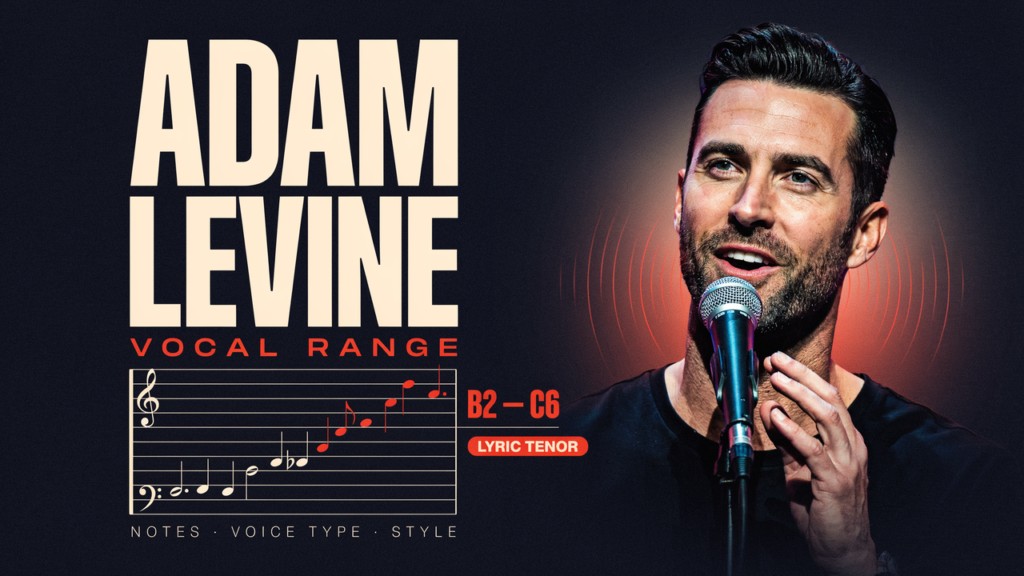
Adam Levine’s vocal range is commonly estimated at approximately C3 to C6 when falsetto is included, giving him a reported span of three octaves. However, a more conservative range supported by clearly attributable song material is approximately C3 to E5, or two octaves and two semitones.
Levine is best classified as a light contemporary tenor. His voice sounds consistently high because Maroon 5 songs often sit in an elevated tessitura, while his bright resonance and frequent movement into falsetto make the upper register especially prominent. He is not a countertenor simply because he sings high or uses falsetto regularly.
Adam Levine’s Vocal Range at a Glance
| Vocal characteristic | Approximate assessment |
|---|---|
| Broad reported range | C3–C6 |
| Broad calculated span | 3 octaves |
| Conservative song-supported span | C3–E5 |
| Conservative calculated span | 2 octaves and 2 semitones |
| Common voice type | Light contemporary tenor |
| Approximate functional center | G3–B4 |
| Upper-register approach | Light mix, head-dominant coordination and falsetto |
| Signature qualities | Bright tone, high tessitura and smooth register changes |
The reported C6 sits in Levine’s light upper register rather than his normal full-voice range. His practical singing range is narrower and includes the pitches he can use repeatedly with reliable tone, phrasing, and control.
This distinction explains why different analyses produce ranges such as A2–B5, B2–C6, C3–C6, or even E2–B5. Each may count different songs, performances, registers, and fleeting sounds.
What Are Adam Levine’s Lowest and Highest Notes?
C3 is a defensible lower endpoint in published song material, particularly in analyses of “Lost Stars” and “She Will Be Loved.” Lower pitches between E2 and B2 are attributed to Levine in some fan-made vocal compilations, but these claims require clearer song and register identification.
E5 is a supportable upper pitch in “Lost Stars,” while E♭5 appears in published range data for “She Will Be Loved.” Levine also reaches considerably higher through falsetto, with B5 and C6 often cited as broader career extremes.
| Range claim | Evidence status | Interpretation |
|---|---|---|
| C3–E5 | Supported by identifiable song material | Conservative lead-vocal range |
| C3–C6 | Commonly reported | Broad range including falsetto |
| A2–B5 | Reported by some vocal profiles | Recording-dependent estimate |
| E2–B5 | Found in fan compilations | Requires stronger note-level verification |
| G3–B4 | Approximate functional center | Area used consistently in many songs |
A C6 produced briefly in falsetto does not mean Levine sings entire songs near C6. Likewise, an isolated low pitch does not establish a baritone tessitura. His voice type is revealed more clearly by where his melodies sit and how comfortably he navigates the upper-middle register.
Is Adam Levine a Tenor or Countertenor?
Adam Levine is a tenor, not a countertenor. More specifically, he is often described as a light tenor because his voice has relatively low vocal weight, a bright timbre, and easy access to high melodies.
A countertenor typically develops an upper-register coordination for repertoire historically associated with alto or mezzo-soprano parts. The label describes more than the ability to sing falsetto. Levine primarily performs contemporary pop and rock as a tenor who uses falsetto as a recurring stylistic color.
His lower notes do not sound as heavy or central as those of a typical baritone. At the same time, his upper-middle notes appear frequently enough in complete songs to support a naturally tenor-leaning classification.
Readers can compare the common pitch areas of different categories in this guide to the main types of vocal ranges. The categories overlap, so no single high note can confirm a singer’s voice type.
Full Voice vs. Falsetto in Adam Levine’s Range
Understanding Levine’s registers makes his range easier to interpret.
| Vocal coordination | Typical role in his singing | General sound |
|---|---|---|
| Chest-dominant modal voice | Lower verses and grounded phrases | Clear, direct and relatively light |
| Mixed coordination | Upper-middle melodies and energetic choruses | Connected, bright and more intense |
| Head-dominant voice | Transitions toward the upper register | Focused and lighter |
| Falsetto | High hooks, sustained accents and expressive peaks | Thin, airy or flute-like |
Levine often moves between these coordinations without making the change sound abrupt. That smooth connection is a major reason his upper register can seem effortless.
Not every light high note should automatically be called falsetto. Some phrases retain enough closure and intensity to be described as head-dominant or mixed. Conversely, a high pitch that sounds loud after studio compression is not necessarily a full chest-voice belt.
Falsetto still plays a central role in Levine’s recognizable sound. It allows him to extend melodies upward while preserving the sleek, flexible character that suits Maroon 5’s pop, funk, and R&B influences.
Vocal Ranges and Demands of Key Songs
“Lost Stars” provides one of the clearest published examples of Levine’s range, extending approximately from C3 to E5. It moves from a restrained lower-middle opening into an emotional upper register, revealing more of his voice than a typical Maroon 5 dance-pop track.
“She Will Be Loved” is commonly analyzed around C3–E♭5 when upper embellishments are included. Its challenge lies in moving smoothly between conversational verses and lighter high phrases without allowing the vocal break to become disruptive.
“This Love” highlights bright resonance, clipped rhythmic articulation, and upper-middle stamina. The melody must remain energetic without becoming heavy.
“Sugar” sits high enough to challenge many lower voices even when it does not use Levine’s absolute highest note. Its repeated choruses require endurance, rhythmic accuracy, and efficient vowel shaping.
“Moves Like Jagger” relies on narrow, bright vocal production that helps the lead cut through its dense dance arrangement. Falsetto colors and rhythmic precision matter more than sustained belting.
“Animals” uses a sharper and more aggressive delivery. Levine adds intensity while maintaining the light coordination needed for its elevated melody.
“Payphone” demonstrates how his tone can remain bright and youthful over repeated upper-middle phrases. The song’s difficulty comes partly from tessitura: many notes are not isolated extremes, but they remain relatively high for extended periods.
Listeners can use a pitch detector to identify individual notes in a melody, although studio harmonies and instrumental overtones can confuse automatic readings.
Why Does Adam Levine’s Voice Sound So High?
Levine’s voice sounds high for several related reasons.
High tessitura: Many of his melodies remain near the upper part of a typical male range. A song can feel difficult even without containing one extraordinary peak if it provides little opportunity to rest lower.
Light vocal weight: Levine does not carry a thick, heavy sound through every phrase. The lighter production makes the upper voice more flexible and gives the tone a youthful character.
Bright resonance: His narrow, forward sound emphasizes upper harmonics. This can make a note seem higher or sharper than another singer producing the same pitch with a darker tone.
Frequent falsetto: Upper-register accents appear so regularly that they become part of the basic vocal identity rather than an occasional special effect.
Focused vowels: Levine often narrows or modifies vowels as the melody rises. This helps maintain clarity and prevents the vocal tract from fighting the pitch.
Minimal vibrato: Many phrases use a relatively straight tone. That direct sound suits rhythmic pop production and makes his pitch attacks more noticeable.
Adam Levine’s Signature Vocal Technique
Levine’s technique prioritizes flexibility and stylistic consistency over vocal mass. His phrases frequently combine precise rhythm, light onset, short slides, and quick changes in register.
Breathy beginnings can create intimacy, especially in verses. In choruses, he increases closure and brightness without necessarily turning the sound into a heavy belt.
His tone is sometimes described as nasal. A more useful explanation is that he often uses concentrated forward resonance and narrow vowels. Nasality can be part of the result, but the brightness also helps his voice remain audible inside dense productions.
Levine’s sound should not be imitated by squeezing the throat or forcing the larynx upward. The apparent ease of his high notes depends on light coordination. Singers who carry excessive chest weight toward his pitches may experience tension long before reaching the same note.
Adam Levine Compared with Other Pop Tenors
Levine and The Weeknd both use high tessitura and falsetto as defining colors. The Weeknd’s falsetto often has a smoother R&B character, while Levine’s delivery tends to be brighter and more rhythmically pointed.
Justin Timberlake’s vocal range offers another close comparison. Both singers blend pop, funk, and R&B influences, but Timberlake frequently uses more intricate runs and rhythmic ornamentation. Levine often favors direct melodic hooks and a narrower tonal edge.
Harry Styles generally brings more chest weight and rock-influenced texture into his upper-middle range. Levine’s sound is lighter, brighter, and more consistently falsetto-oriented.
Steve Perry’s vocal range represents a more powerful rock-tenor approach. Perry’s upper register is known for ringing sustained tone and stronger vocal weight, whereas Levine usually creates height through lightness, focus, and register flexibility.
These comparisons show why singers with the same general tenor label can have very different tessituras, tone colors, and technical strategies.
Frequently Asked Questions
What is Adam Levine’s vocal range?
Adam Levine’s broad reported range is approximately C3–C6 when falsetto is included. A conservative span supported by identifiable songs is approximately C3–E5.
How many octaves can Adam Levine sing?
The commonly reported C3–C6 range spans three octaves. His clearly supported lead-song range is narrower.
What is Adam Levine’s highest note?
C6 is commonly reported as his highest falsetto note. B5 is another frequently cited upper endpoint, while E5 is easier to connect to specific published song material.
What is Adam Levine’s lowest note?
C3 is a defensible lower note in identifiable song data. Lower claims extending to A2 or E2 remain dependent on the recording and measurement method.
Is Adam Levine a countertenor?
No. He is best classified as a light contemporary tenor who uses falsetto extensively.
Does Adam Levine always sing in falsetto?
No. He uses chest-dominant modal voice, mixed coordination, head-dominant production, and falsetto. Falsetto is prominent, but it is only one part of his vocal approach.

Harlow is a vocal analysis and singing tools writer at Voice Range Test. She focuses on vocal range testing, voice type analysis, pitch recognition, and singing education tools for singers, musicians, choir performers, and beginners.