
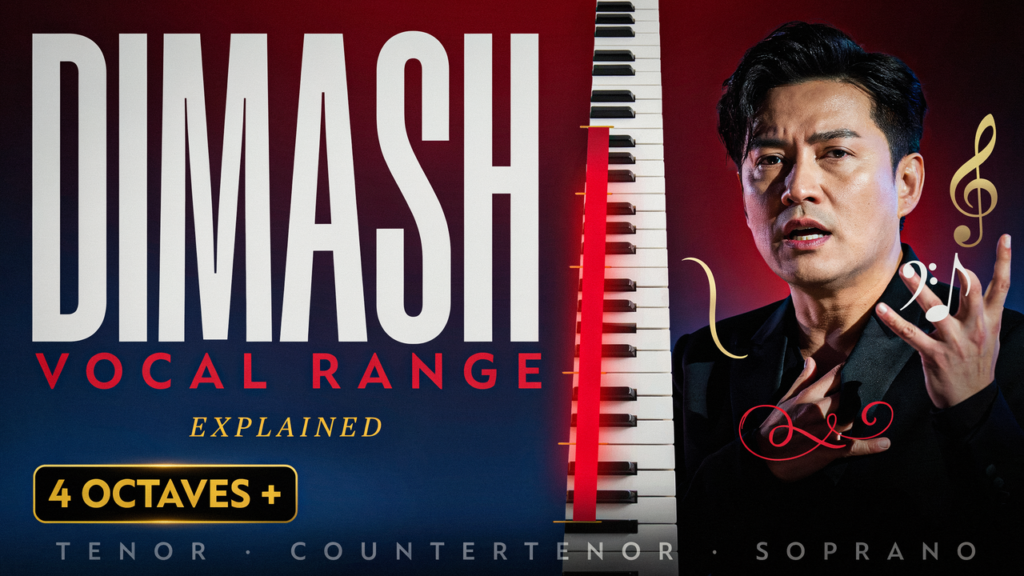
Dimash Kudaibergen’s vocal range is commonly described as D2 to D8, which equals exactly six octaves when the D8 whistle-register note is included. Some wider claims place his lowest sounds below D2, but those usually involve growl, vocal fry, or effect-based production rather than ordinary clean singing.
The best answer is therefore not one number. Dimash has an exceptional total demonstrated span, but his full sound-production range, usable singing range, comfortable tessitura, and voice type are different things.
Dimash Vocal Range at a Glance
| Category | Best practical assessment |
|---|---|
| Commonly reported range | D2-D8 |
| Approximate span | Six octaves |
| Highest famous note | D8, usually associated with “Unforgettable Day” |
| Low extension claims | Sometimes below D2 when growl or fry sounds are counted |
| Likely classification | Classically trained crossover male vocalist with exceptional extension |
| Main caution | Whistle notes, growls, and clean melodic notes should be labeled separately |
For listeners comparing ranges, the vocal range chart helps place notes like D2 and D8 in context. It also shows why a total range number alone cannot define a singer’s voice type.
What Is Dimash’s Highest Note?
Dimash’s most famous high note is the D8 widely associated with live performances of “Unforgettable Day.” It sits above the top C on a standard 88-key piano, which is why it attracts so much attention in vocal range discussions.
That D8 should be understood as an extreme whistle-register demonstration. It does not mean Dimash sings ordinary melodies throughout the eighth octave, and it should not be compared directly with a sustained operatic high note or a pop belt.
The achievement is still extraordinary. The important point is classification: a whistle-register D8 is a different type of vocal event from a modal chest note, a mixed high note, or a head-voice phrase.
What Is Dimash’s Lowest Note?
D2 is a conservative lower boundary for Dimash’s conventionally counted singing range. Lower claims, including E1 or F#1 in some discussions, usually depend on whether growls or fry-based sounds are counted as part of the singing range.
A growl may contain a pitch, but it is not the same as a stable low note used in a melody. Vocal fry can also reach very low frequencies without showing where a singer’s ordinary low singing voice sits.
This distinction also matters when comparing Dimash with Tim Storms, Vitas, or Mike Patton. Rankings change dramatically depending on whether fry, growls, screams, whistle notes, and studio effects are counted equally.
Does Dimash Have Six or Seven Octaves?
D2-D8 is exactly six octaves. The calculation is simple: D2 to D3 is one octave, and continuing to D8 gives six complete octave intervals.
| Claim | Distance | How to read it |
|---|---|---|
| D2-D8 | 72 semitones | Exactly six octaves |
| F#1-D8 | 80 semitones | Six octaves plus eight semitones |
| E1-D8 | 83 semitones | Six octaves plus eleven semitones |
Even E1-D8 is one semitone short of seven complete octaves. Calling Dimash a six-octave singer is more mathematically precise unless a lower accepted endpoint completes the seventh octave under the chosen measurement rules.
Registers in Dimash’s Voice
Dimash’s range crosses several vocal productions. The low end may include modal voice, growl, or fry-like sounds. The middle range includes fuller singing and mixed coordination. The upper range includes head-dominant sounds, falsetto-like colors, and whistle-register notes.
Those labels are useful, but they are not always easy to assign from public recordings. A listener can often identify the pitch more confidently than the exact internal coordination used to create it.
What makes Dimash unusual is not only that he reaches distant extremes. It is that he can make large register changes feel musical, dramatic, and connected in performance.
What Voice Type Is Dimash?
Dimash is often called a tenor, baritenor, countertenor, or simply a male singer with a highly unusual range. The safest description is a classically trained crossover vocalist with extraordinary upper-register facility.
Reaching soprano pitches does not make a male singer a soprano in the traditional classical sense. Producing very low effects does not make him a bass either. Voice type depends on tessitura, passaggi, tone, projection, and repeatable repertoire, not just the lowest and highest notes.
To understand why, read what tessitura means and compare it with the broader vocal Fach system. Dimash’s total range is impressive, but classical classification requires more than total pitch span.
Performances That Show Dimash’s Range
- “Unforgettable Day”: the most famous example of the D8 high note.
- “SOS d’un terrien en detresse”: dramatic register contrast and expressive high singing.
- “Opera 2”: upper-register agility and crossover showmanship.
- “Stranger”: dark low colors and dramatic high extension.
- “The Story of One Sky”: varied vocal effects, colors, and theatrical range.
These performances are best studied by asking what kind of sound is being produced, how long the note lasts, whether the note is part of a phrase, and whether it is repeated reliably in live contexts.
Why Control Matters More Than the Range Headline
A six-octave label is striking, but Dimash’s musical impact comes from control: accurate pitch targeting, smooth register transitions, dynamic contrast, long phrases, and the ability to move between different colors without making the performance sound like a technical demonstration.
Most singers should not train by chasing D8 or extreme low growls. A useful range is made of notes that can be produced cleanly, repeatedly, and without pain. Use the vocal range calculator to measure your current practical boundaries rather than forcing extremes.
Frequently Asked Questions
What is Dimash’s vocal range?
Dimash’s commonly reported range is D2-D8, which equals six octaves when the D8 whistle-register note is included.
Did Dimash sing a D8?
A D8 is widely associated with his performance of “Unforgettable Day.” It is best treated as an extreme whistle-register note.
Does Dimash have seven octaves?
D2-D8 is six octaves. Some lower-effect claims bring the total close to seven octaves, but they depend on whether growl or fry sounds are counted.
Is Dimash a tenor?
He is often described as a tenor or baritenor, but his extreme notes alone cannot define his classical voice type. Tessitura and vocal function matter more.
Does Dimash have the widest range in the world?
There is no single standardized public ranking that settles this. Different lists use different rules for fry, whistle notes, growls, studio recordings, and live performances.

Harlow is a vocal analysis and singing tools writer at Voice Range Test. She focuses on vocal range testing, voice type analysis, pitch recognition, and singing education tools for singers, musicians, choir performers, and beginners.