
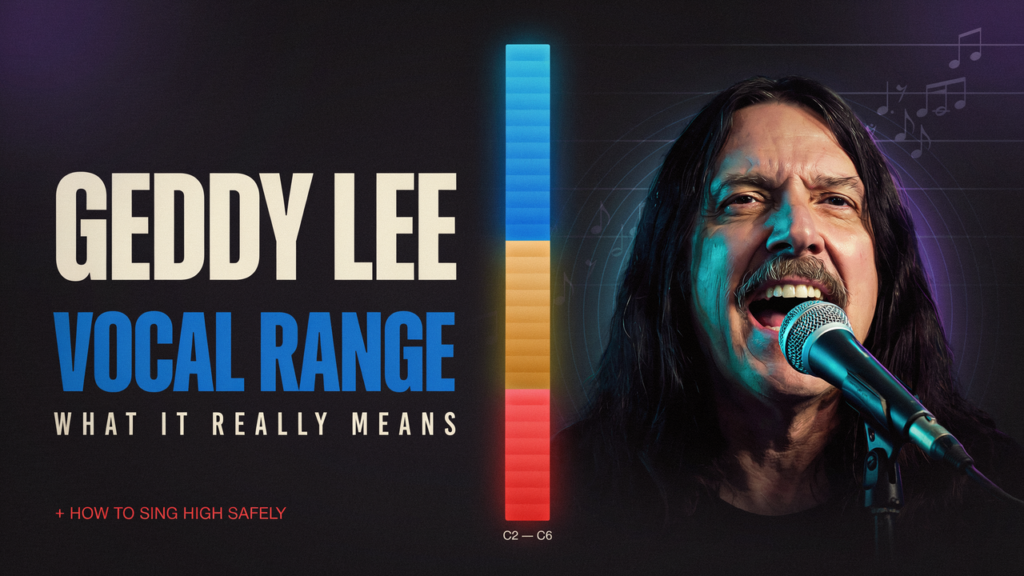
Geddy Lee’s documented studio vocal range is approximately G♯2 to B5, spanning three octaves and two semitones. Some analyses extend his lower boundary to E2 when unusual live performances are included, producing a possible lifetime range of about three octaves and seven semitones.
His highest widely documented studio note is the B5 near the climax of “Cygnus X-1 Book I: The Voyage.” However, Lee’s reputation was not built on one isolated high note. His demanding upper tessitura, piercing tone, sustained fifth-octave singing, and ability to perform complex music while playing bass made his early Rush vocals remarkable.
What Is Geddy Lee’s Vocal Range?
The most defensible estimate depends on which performances and vocal sounds are counted.
| Range category | Approximate notes | Interpretation |
|---|---|---|
| Documented studio range | G♯2–B5 | Notes identified in released Rush recordings |
| Wider reported range | E2–B5 | Includes an unusually low live performance |
| Core career range | Roughly third to fifth octave | The area containing most recognizable Rush vocals |
| Later-career range | Lower and narrower | Reflects changing keys, tone, and vocal maturity |
From G♯2 to B5 is 38 semitones, equal to three octaves and two semitones. From E2 to B5 is 43 semitones, or three octaves and seven semitones.
The wider figure is valid only if the E2 performance is accepted as a controlled sung note. It should not be mistaken for Lee’s everyday tessitura. Anyone comparing these boundaries can enter them into the vocal range calculator to see their exact octave and semitone span.
What Is Geddy Lee’s Lowest Note?
Lee’s lowest frequently cited studio note is around G♯2, associated with the later Rush catalog. Some range lists identify an E2 from a country-style live rendition of “The Spirit of Radio,” but that performance sits outside his normal vocal approach.
The G♯2 boundary is therefore more useful when describing his recorded range. Even then, his lower notes do not represent the center of his most famous singing. They became more noticeable as his voice matured and Rush began writing vocal melodies in more moderate keys.
Later recordings reveal a warmer and less sharply focused lower register. Lee increasingly relied on conversational phrasing, controlled midrange singing, and darker resonance rather than the relentless upper-register attack heard on the band’s 1970s albums.
What Is Geddy Lee’s Highest Note?
Lee’s highest widely documented studio note is B5, heard near the end of “Cygnus X-1 Book I: The Voyage.” The pitch occurs during the dramatic description of the story’s protagonist being pulled into a black hole.
The note is extreme even for a high male rock singer. It sounds more like an intense cry or climactic upper-register effect than a comfortable note he could repeat throughout an entire song. For that reason, B5 defines the top of his demonstrated studio range, not the top of his ordinary usable range.
“Freewill” provides another important example of Lee’s upper singing. He identified its final verse as reaching the highest part of his voice. The passage is especially challenging because it demands repeated high phrases rather than a single momentary peak.
Lee’s upper-register intensity can be compared with the bright cries heard across Robert Plant’s vocal range. Both singers helped define high male rock vocals, but Lee’s thinner, more concentrated tone remains immediately recognizable.
Is Geddy Lee a Tenor or Countertenor?
Geddy Lee is best described as a high rock tenor, not automatically a classical countertenor.
A countertenor typically performs primarily through a developed falsetto or reinforced head-voice coordination in a range associated with alto or mezzo-soprano repertoire. Lee’s early high notes often have a direct, speech-connected, chest-dominant, or mixed-rock quality. His tone may resemble a countertenor in pitch, but pitch alone does not establish that classification.
Tenor is the more practical label because it reflects his natural vocal identity and the location of his strongest early singing. Even this term should be understood as a contemporary description rather than a formal operatic Fach assignment. Our guide to the tenor voice explains why tessitura, vocal weight, timbre, and transition points matter alongside range.
Lee’s unusually high placement also differs from the heavier metallic approach found within Bruce Dickinson’s vocal range. Both are high male voices, but they use different tonal weight, resonance, and phrasing.
How Did Geddy Lee Produce His High Notes?
Lee’s classic sound combined a naturally bright instrument with narrow vowels, forward resonance, strong breath energy, and an intense upper-register coordination. His high notes often sound sharp and penetrating because their energy is concentrated rather than broad and heavy.
His early technique included several recognizable features:
- Bright, forward tonal placement
- Strong chest-to-mix connection
- Narrowed vowels on high pitches
- Cry-like attacks
- Controlled rasp and urgency
- A lighter vocal weight that helped him ascend quickly
Listeners sometimes describe his singing as falsetto because of its height. However, much of his classic Rush sound has more closure, edge, and speech-like intensity than ordinary breathy falsetto. Some extreme peaks may use a head-dominant coordination, but not every high note is produced in exactly the same register.
A useful comparison is Steven Tyler’s vocal range. Tyler also uses cries, distortion, and high rock resonance, although his tone is raspier and his phrasing draws more heavily from blues.
Why Geddy Lee’s Tessitura Matters More Than B5
A singer’s highest note receives attention, but tessitura reveals how demanding the music really is. Tessitura is the region where most of a vocal part remains, not merely its lowest and highest pitches.
Early Rush songs frequently keep Lee in a high, bright part of his voice for long stretches. “2112,” “The Temples of Syrinx,” “A Farewell to Kings,” “Hemispheres,” and “Freewill” require repeated upper-register singing with little recovery time.
This sustained placement can be more difficult than briefly reaching B5. A singer might produce one extreme pitch during a dramatic effect yet struggle with several minutes of continuous fourth- and fifth-octave phrases.
Lee’s vocal achievement therefore lies partly in endurance. He sang challenging material while simultaneously performing intricate bass lines and managing keyboards or bass pedals during live shows.
How Geddy Lee’s Voice Changed Over Time
Lee’s early-1970s voice was exceptionally bright, thin, and piercing. That sound suited Rush’s heavy progressive-rock arrangements, where the vocal needed to remain audible above distorted guitar, forceful drums, and his own active bass playing.
By the early 1980s, Lee began moving away from the most extreme version of that style. His melodies became less consistently high, and his tone gradually developed more midrange weight. This transition was already noticeable around “Freewill,” whose final verse acts almost like a farewell to the band’s most aggressive early vocal writing.
During the following decades, Rush adjusted some live keys and arrangements. Lee used a darker tone, changed certain melodies, and approached high passages more selectively. These adaptations were practical responses to maturation, touring demands, and the physical realities of singing difficult material over a long career.
That evolution resembles the adjustments made by other long-running rock vocalists, including Paul McCartney. A changing voice does not erase earlier achievements; it shows how a singer modifies repertoire to preserve expression and performance stamina.
Studio Range Versus Live Usable Range
G♯2–B5 describes Lee’s approximate studio extremes, but it does not mean every note within that span was equally available at every concert.
In his early career, the upper fourth and fifth octaves formed a major part of his recognizable sound. In later performances, his practical range shifted downward. He could still deliver demanding Rush material, but the highest passages required altered melodies, lower keys, lighter coordination, or selective omission.
This creates three distinct measurements:
- Lifetime demonstrated range: Every credible pitch documented across his career
- Period-specific range: The notes available during a particular Rush era
- Usable live range: Notes he could repeat reliably throughout a complete concert
The first produces the largest number, while the third offers the most realistic view of functional singing ability.
Frequently Asked Questions
How many octaves could Geddy Lee sing?
His documented G♯2–B5 studio range spans three octaves and two semitones. Including a reported E2 live note expands the total to three octaves and seven semitones.
What is Geddy Lee’s highest note?
His highest widely documented studio note is B5 in “Cygnus X-1 Book I: The Voyage.” It is an extreme climactic sound rather than a representation of his comfortable tessitura.
What is Geddy Lee’s lowest note?
G♯2 is a commonly cited studio low. An E2 has also been reported from an unusual country-style live rendition of “The Spirit of Radio,” but it was not part of his regular singing range.
Is Geddy Lee a countertenor?
He is more accurately described as a high rock tenor. Calling him a countertenor based only on his highest pitches ignores how classical countertenors typically produce and use their voices.
Why did Geddy Lee sing so high?
His naturally bright voice suited Rush’s early heavy arrangements and the dramatic characters in the band’s progressive-rock songs. Forward resonance and a light but intense upper coordination helped his vocals cut through the instruments.
Did Geddy Lee lose his high range?
His practical upper range became lower and less consistent with age, as happens with many singers. Rush responded by adjusting keys, melodies, and vocal arrangements rather than expecting his later voice to reproduce every 1970s note identically.

Harlow is a vocal analysis and singing tools writer at Voice Range Test. She focuses on vocal range testing, voice type analysis, pitch recognition, and singing education tools for singers, musicians, choir performers, and beginners.