
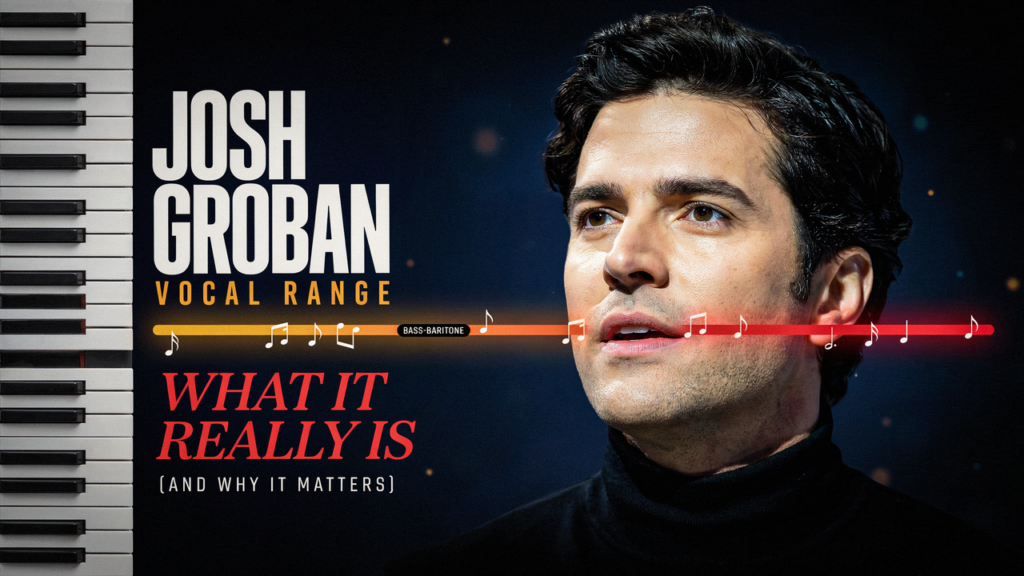
Josh Groban’s commonly documented vocal range extends from approximately G2 to B4, covering two octaves plus a major third. Some range compilations credit him with notes outside these limits, but G2–B4 provides a more conservative picture of the clearly recognizable singing heard throughout his recorded and live repertoire.
Groban is best described as a high lyric baritone with a strong upper extension. His rich lower-middle register, controlled sustained phrases, and ability to approach tenor territory explain why listeners sometimes disagree about whether he is a baritone or tenor.
Josh Groban’s Vocal Range at a Glance
| Vocal characteristic | Evidence-based description |
|---|---|
| Commonly documented range | Approximately G2–B4 |
| Total span | 28 semitones |
| Octave span | 2 octaves and a major third |
| Common voice classification | High lyric baritone |
| Alternative description | Baritenor |
| Strongest area | Lower-middle and middle register |
| Upper approach | Chest-dominant mix, balanced mix and head voice |
| Primary styles | Classical crossover, pop, musical theatre and traditional vocal music |
These endpoints describe an observed performance range, not necessarily every pitch Groban has ever produced. Isolated low sounds, background notes, vocalized effects, and brief head-voice pitches should not automatically be treated as part of his reliable singing range.
Listeners can use a vocal range calculator to compare their own measured notes with this range. However, matching Groban’s endpoints does not mean having the same voice type or vocal quality.
Josh Groban’s Lowest and Highest Notes
The G2 commonly associated with Josh Groban’s lower limit appears in range discussions connected with performances such as “Caruso,” “Le Temps des Cathédrales,” and “To Where You Are.” This pitch sits in recognizable baritone territory and complements the dark, rounded quality of his lower-middle voice.
Groban’s commonly cited upper full-voice boundary is around B♭4 to B4. These pitches are more demanding than his central singing range and typically appear in climactic phrases rather than throughout an entire song. The upper notes depend on carefully balanced registration and should not be interpreted as effortless extensions of his speaking voice.
Broader compilations sometimes list upper head-voice notes in the fifth octave or low notes below G2. Such claims may involve brief sounds, non-modal production, altered live phrasing, or recordings that are difficult to verify consistently. They should therefore be separated from his conservative demonstrated range.
| Range claim | Context | Evidence status |
|---|---|---|
| G2 | Low sung notes associated with several performances | Commonly documented |
| B♭4–B4 | Climactic upper full-voice or mixed passages | Strongly supported |
| Notes above B4 | Head-dominant or brief upper production | Recording-dependent |
| Notes below G2 | Occasional expanded-range claims | Insufficiently consistent |
This evidence-based separation prevents an isolated extreme from being mistaken for Groban’s everyday working range.
Is Josh Groban a Baritone or Tenor?
Josh Groban is most reasonably classified as a high lyric baritone, although “baritenor” can be a useful informal description of his crossover singing. He has enough upper extension to sing phrases associated with tenor repertoire, but range alone does not determine voice type.
Groban has described himself as a baritone with high notes available. He has also been called a tenor and previously used the description “tenor in training,” which helps explain the continuing disagreement.
A voice type is determined by more than the highest available pitch. Important factors include:
- Where the voice is most comfortable
- Where its resonance is strongest
- The location of register transitions
- Vocal weight and timbre
- The range that can be sustained repeatedly
- How the voice behaves across a complete repertoire
Groban’s voice has more warmth, weight, and stability in the lower-middle register than a typical lyric tenor. His upper notes sound like an extension of that baritone foundation rather than proof that his entire voice functions as a tenor.
The distinction becomes clearer when comparing him with the darker crooning style in Michael Bublé’s vocal range or the unusually low country resonance found in Josh Turner’s vocal range. Groban occupies a higher and more classically influenced baritone position than either comparison suggests on its own.
Vocal Range Versus Tessitura
Josh Groban’s total vocal range is not the same as his tessitura. Vocal range includes the lowest and highest pitches a singer can demonstrate, while tessitura describes the area where most sustained singing feels and sounds comfortable.
Groban’s effective tessitura appears to sit mainly in the middle and upper-middle baritone range. His arrangements frequently allow him to begin with warm, restrained phrases before building toward resonant fourth-octave climaxes.
“You Raise Me Up” illustrates this difference well. The song displays his sustained phrasing, dynamic control, and upper-middle resonance, but it does not necessarily contain his absolute lowest and highest recorded notes. A famous song should not be treated as a complete vocal-range test.
What Makes Josh Groban’s Voice Distinctive?
Groban’s strongest quality is not an unusually enormous range. It is the consistency and tonal control he maintains through the range he uses musically.
His sound is characterized by:
- A warm, rounded baritone center
- Clear diction across several languages
- Long, controlled legato phrases
- Gradual dynamic development
- A strong but polished upper-middle register
- Smooth movement between speech-like and classically influenced production
His resonance often creates the impression of a larger or higher voice than the written pitches alone indicate. Orchestral arrangements also frame his climactic notes effectively, allowing the upper register to feel expansive without requiring constant extreme singing.
Groban is influenced by operatic and classical traditions, but he is primarily a classical-crossover singer rather than an opera singer pursuing an operatic career. Comparing his vocal approach with Luciano Pavarotti’s range and operatic tenor technique reveals an important difference: singing operatic material does not automatically make someone an operatic tenor.
His theatrical experience also matters. Groban’s Broadway roles demand character delivery, text clarity, vocal stamina, and coordination across repeated performances. These abilities reveal more about his functional voice than a single spectacular high note.
Can Most Baritones Sing Josh Groban’s Songs?
Many baritones can reach some of the pitches in Josh Groban’s songs, but reproducing his performances requires more than reaching the endpoints. Sustained breath management, stable vowels, register balance, and the ability to maintain resonance through long phrases are equally important.
“You Raise Me Up,” for example, becomes challenging because of its rising intensity and repeated climactic singing. A singer may possess all the required notes yet struggle to maintain the phrase length or tonal consistency.
Lowering the key is usually more sensible than forcing Groban’s upper resonance. Singers should choose a key that preserves both the low phrases and the climax without strain. Losing normally comfortable notes, developing throat pain, or becoming hoarse indicates that the chosen key or coordination is unsuitable.
Frequently Asked Questions
How many octaves can Josh Groban sing?
The commonly documented G2–B4 range spans 28 semitones, equal to two octaves and a major third. Broader estimates exist, but they often include less consistently verified extremes.
What is Josh Groban’s highest note?
B4 is a reasonable conservative estimate of his upper demonstrated full-voice or mixed range. Higher head-voice notes have been reported, but their context and consistency vary by source.
What is Josh Groban’s lowest note?
G2 is his most commonly documented lower sung note. Claims below G2 should be treated cautiously unless they can be connected to a clear recording and genuinely sung production.
Is Josh Groban a tenor?
Josh Groban is more accurately described as a high lyric baritone with strong tenor-range extension. He can sing high passages, but his tonal center and comfortable repertoire generally support a baritone classification.
Is Josh Groban an opera singer?
No. Josh Groban is principally a classical-crossover, pop, and musical-theatre singer. He uses classically influenced sounds and sings operatic material, but that differs from working as a specialist opera singer.

Harlow is a vocal analysis and singing tools writer at Voice Range Test. She focuses on vocal range testing, voice type analysis, pitch recognition, and singing education tools for singers, musicians, choir performers, and beginners.