
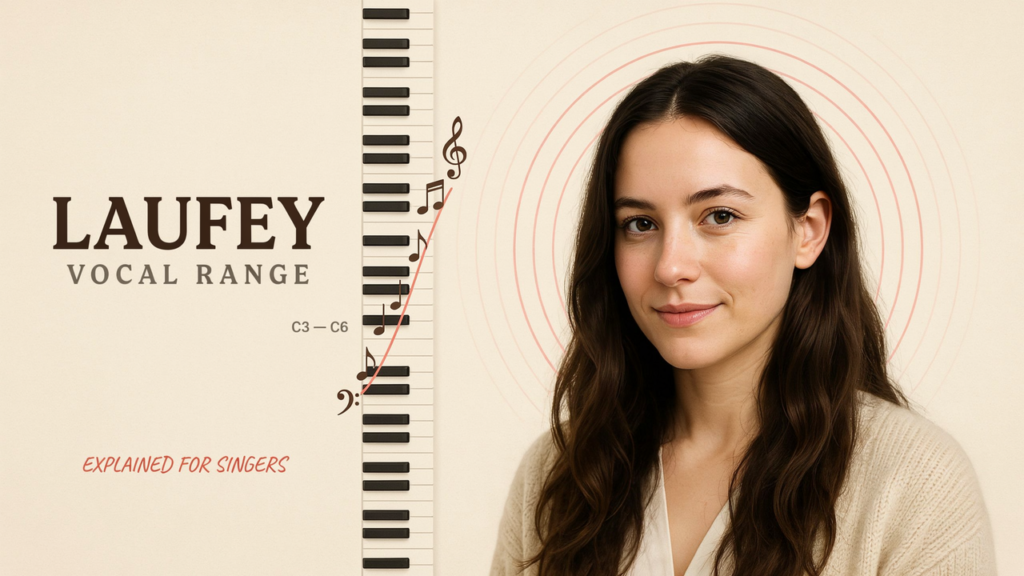
Laufey’s best-supported recorded vocal range is approximately D3 to D5, covering two octaves. Some databases report her range as D3–C♯6, but the unusually high endpoint appears to result from an octave-labeling error for “From the Start.” Published vocal music places that song around A♭3–D♭5, not A♭4–D♭6.
Laufey is most reasonably described as a mezzo-soprano with alto coloring. Her warm lower register, rounded vowels and restrained jazz delivery make her sound lower than many contemporary singers. However, a dark vocal color does not automatically make someone a contralto.
Her appeal also has little to do with chasing extreme notes. Laufey’s signature comes from her intimate dynamics, precise phrasing, connected chest voice and ability to make a relatively compact melodic range feel emotionally expansive.
Laufey Vocal Range Summary
| Vocal characteristic | Approximate assessment |
|---|---|
| Best-supported recorded range | D3–D5 |
| Total span | 2 octaves |
| Commonly reported but questionable range | D3–C♯6 |
| Likely voice type | Mezzo-soprano with alto coloring |
| Strongest area | Lower-middle and middle register |
| Common registers | Chest voice, light mix and head voice |
| Signature qualities | Warm tone, soft onset and jazz-influenced phrasing |
This D3–D5 estimate reflects identifiable song evidence rather than every note Laufey may be capable of producing privately, during warm-ups or in unmeasured live improvisations.
Why Some Sources Report C♯6
The C♯6 claim appears to come from a database entry for “From the Start.” That entry places the song at A♭4–D♭6, while published vocal sheet music places it approximately one octave lower at A♭3–D♭5.
The published range also agrees more naturally with the audible melody and Laufey’s surrounding repertoire. If D♭6 were correct, “From the Start” would contain pitches above soprano high C, making it dramatically higher than it sounds.
This type of error can occur when a transcription is shifted into the wrong octave. Note names remain correct, but the octave numbers do not. As a result, Laufey’s upper endpoint becomes exaggerated by twelve semitones.
D♭5 remains a significant melodic note, but it is very different from D♭6. The corrected evidence supports an overall range closer to D3–D5.
What Is Laufey’s Lowest Note?
D3 is the strongest currently documented candidate for Laufey’s lowest recorded note. It appears in catalog information for “Castle in Hollywood” and published vocal music for “Snow White.”
Several other songs also demonstrate her lower range:
- “Falling Behind” reaches approximately E3
- “Misty” reaches approximately F3
- “Bored” and “Goddess” reach approximately F♯3
- “Promise” reaches approximately G3
- “Letter to My 13 Year Old Self” reaches approximately G3
These low notes are central to Laufey’s sound rather than isolated effects. She often allows melodies to remain around the lower third and fourth octaves, using chest resonance and close, conversational phrasing.
Her warm lower register can be compared with Fiona Apple’s vocal range. Both singers can create depth without relying on constant high belting, although Apple often uses a more speech-driven and rhythmically forceful delivery.
What Is Laufey’s Highest Note?
D5 is a well-supported upper endpoint in Laufey’s recorded repertoire. It appears in published or cataloged ranges for songs such as “Bored,” “Misty,” “Valentine” and “Tough Luck.”
“From the Start” reaches approximately D♭5, while “Goddess” also rises to about D♭5. These notes are only a semitone below D5 and demonstrate how Laufey’s upper-middle register can expand without losing the softness associated with her voice.
She may have sung higher pitches in live improvisations or performances not included in available catalogs. However, C♯6 should not be treated as confirmed merely because it appears in an incorrectly labeled entry.
Unlike singers who build climaxes around forceful fifth-octave belts, Laufey usually lightens her vocal production as the melody rises. This creates contrast while preserving the intimate character of the song.
Laufey’s Range in Popular Songs
| Song | Approximate vocal range | Main challenge |
|---|---|---|
| “Castle in Hollywood” | D3–B♭4 | Low-register support and smooth phrasing |
| “Snow White” | D3–G4 | Quiet low notes and tonal consistency |
| “Falling Behind” | E3–F4 | Bossa nova rhythm and conversational delivery |
| “Misty” | F3–D5 | Jazz phrasing, legato and upper extension |
| “Bored” | F♯3–D5 | Wide melodic movement and dynamic control |
| “Goddess” | F♯3–D♭5 | Gradual emotional and vocal expansion |
| “Promise” | G3–B4 | Exposed pitch and breath management |
| “From the Start” | A♭3–D♭5 | Agility, rhythm and upper-register lightness |
| “Letter to My 13 Year Old Self” | G3–B♭4 | Intimate dynamics and sustained storytelling |
Exact ranges can vary between studio versions, live performances and published arrangements. The table shows the practical territory of each song rather than every optional or improvised pitch.
Is Laufey an Alto, Contralto or Mezzo-Soprano?
Laufey is often called an alto because her voice sounds deep, warm and mature. In everyday music discussions, “alto” may simply describe a woman who is comfortable singing lower harmonies.
Contralto is a more specific voice classification. It generally refers to an unusually low female voice with substantial weight and comfort in a low tessitura. Laufey reaches notes associated with contralto repertoire, but range overlap alone cannot establish that classification.
The more cautious description is mezzo-soprano with alto coloring. Her voice possesses a warm lower register, but it can also become lighter and brighter as she ascends. Her repertoire frequently reaches C5, D♭5 and D5 without sounding disconnected from the rest of the instrument.
Our guide to mezzo-soprano vs contralto explains why two singers can reach similar notes while having different tessituras, timbres and register strengths.
Laufey’s darker tone also invites comparison with Amy Winehouse’s vocal range. Winehouse used heavier stylistic distortion and soul-influenced phrasing, while Laufey generally favors a smoother, more restrained jazz sound.
Vocal Range vs Comfortable Tessitura
Range measures Laufey’s lowest and highest supported pitches. Tessitura describes the region where her melodies remain for extended periods.
Her tessitura frequently sits in the lower-middle part of the female voice. Songs such as “Falling Behind,” “Promise” and “Letter to My 13 Year Old Self” do not require extreme high notes. Their difficulty comes from maintaining pitch, tone and emotional focus at a quiet volume.
Low tessitura helps create Laufey’s intimate sound. It also makes her songs appealing to singers who find contemporary pop repertoire consistently too high. However, the melodies are not automatically easy.
Quiet notes expose unstable breath flow, uncertain pitch and uneven register transitions. A singer cannot hide those problems behind a loud instrumental track or powerful belt.
How Laufey Creates Her Deep, Vintage Tone
Laufey’s vocal color results from several coordinated choices rather than one naturally low note.
She frequently uses rounded vowels, gentle consonants and a relaxed chest-dominant sound in her lower range. The onset is often soft, meaning the vocal folds begin vibrating without a hard attack. This creates intimacy without requiring excessive breathiness.
Her jazz phrasing also affects how listeners perceive the voice. She may sing slightly behind the beat, shape a phrase conversationally or reduce the volume at the end of a line. These choices recall traditional jazz and orchestral pop while keeping the lyrics contemporary.
A similar dark, cinematic atmosphere appears in parts of Lana Del Rey’s vocal range, although Del Rey uses more pronounced breathiness and stylized register contrasts.
Chest Voice, Mix and Head Voice
Laufey’s chest voice provides the warmth heard across her lower and middle register. She does not need to push downward to sound deep because the tone remains supported and resonant.
As melodies rise, she reduces vocal weight and uses a light mix. This prevents high notes from becoming shouted or stylistically disconnected. Her head voice adds softness and height, particularly when an arrangement becomes more orchestral.
The changes between these registers are intentionally subtle. Listeners often notice the emotional shift before recognizing that the vocal coordination has changed.
Mitski’s vocal range offers a useful alternative comparison. Both singers can move from restrained intimacy to a larger emotional climax, but Mitski often uses sharper dynamic and tonal contrasts.
Why Laufey’s Songs Are Difficult to Sing
Laufey’s songs rarely demand the type of sustained belt associated with mainstream pop. Their challenges are more refined:
- Singing low notes without forcing the larynx downward
- Maintaining pitch at a soft volume
- Controlling breath across long legato phrases
- Keeping rounded vowels clear
- Following syncopated jazz and bossa nova rhythms
- Moving into the upper register without suddenly becoming loud
- Preserving emotional intimacy during technical passages
“From the Start” is especially demanding because of its rhythmic precision and quick phrasing. “Goddess” requires a gradual increase in intensity, while “Misty” demands stylistic control and flexible jazz interpretation.
Singers checking these notes can use the frequency finder to confirm whether a pitch belongs in the third, fourth or fifth octave. That distinction is particularly important when online transcriptions disagree.
Frequently Asked Questions
What is Laufey’s vocal range?
Her best-supported recorded range is approximately D3–D5, covering two octaves.
Can Laufey sing C♯6?
The widely circulated C♯6 claim appears to come from an octave-labeling error for “From the Start.” Published music places the song’s high note around D♭5 instead.
What is Laufey’s lowest note?
D3 is the strongest documented low endpoint, appearing in material associated with “Castle in Hollywood” and “Snow White.”
What is Laufey’s highest documented note?
D5 is supported by several songs, including “Bored,” “Misty,” “Valentine” and “Tough Luck.”
Is Laufey a contralto?
A true contralto classification is not firmly established. She is more reasonably described as a mezzo-soprano with a warm, alto-like color and low tessitura.
Why does Laufey’s voice sound so deep?
Her chest resonance, rounded vowels, gentle onset, lower-middle tessitura and restrained jazz phrasing all contribute to the perception of depth.
Laufey’s D3–D5 range is not unusually wide by celebrity-vocal-range standards, but it is highly functional. Her control of tone, rhythm, dynamics and phrasing shows why the musical use of a range matters more than an exaggerated octave count.

Harlow is a vocal analysis and singing tools writer at Voice Range Test. She focuses on vocal range testing, voice type analysis, pitch recognition, and singing education tools for singers, musicians, choir performers, and beginners.