
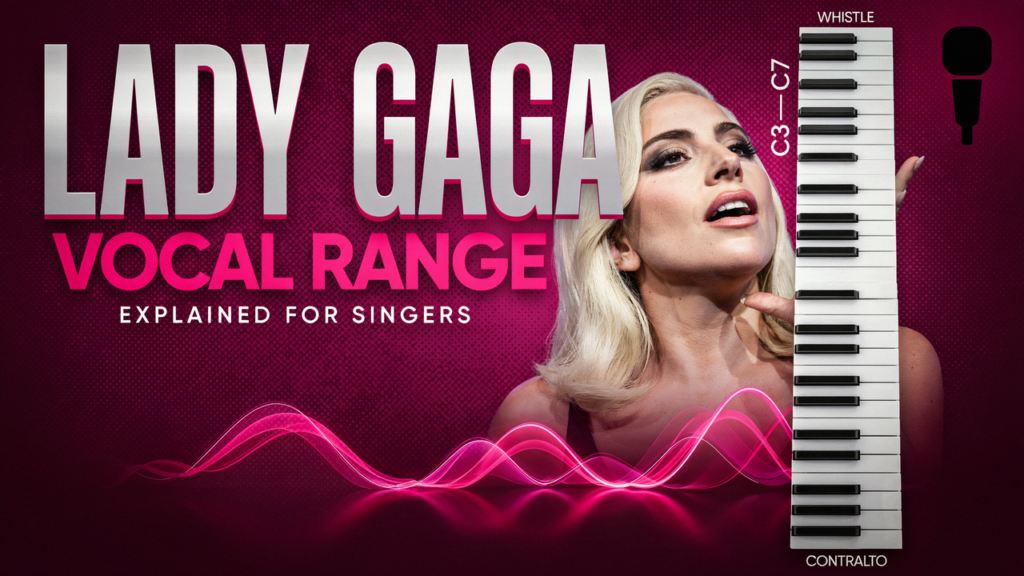
Lady Gaga’s vocal range is commonly estimated at approximately F♯2 to C6, spanning a little more than three and a half octaves. However, her most dependable melodic singing occupies a narrower area. She is strongest through her middle register and upper belt, while her lowest and highest documented notes appear less frequently.
Gaga is generally classified as a mezzo-soprano. Her voice combines a warm lower register, a substantial middle, powerful mixed belts, and a lighter head voice. She is not defined by range alone: breath control, resonance, stylistic versatility, and dramatic phrasing are equally important to her sound.
| Vocal characteristic | Approximate assessment |
|---|---|
| Reported overall range | F♯2–C6 |
| Approximate span | Over three and a half octaves |
| Strong belt and mix area | B4–G5 |
| Probable voice type | Mezzo-soprano |
| Comfortable musical center | Middle and upper-middle register |
| Known for | Belting, vibrato, tonal versatility and theatrical delivery |
What Is Lady Gaga’s Documented Vocal Range?
Published estimates of Lady Gaga’s range vary considerably. Conservative assessments place her near F2 or F♯2 at the bottom and G5 at the top of her prominent mixed or belted range. Broader compilations extend the upper limit to B5 or C6 when lighter head-voice notes are included.
A reasonable career-wide estimate is therefore F♯2–C6, with an important qualification: the two extremes do not represent the area in which Gaga sings most of her music.
Her practical range is closer to the central three octaves of that span. This is where she demonstrates the greatest consistency, projection, tonal variety, and control. The exceptional notes still matter, but they should not be confused with her everyday tessitura.
Singers can use a vocal range calculator to measure their own pitch span, but the resulting lowest and highest notes will not automatically reveal their comfortable singing range or voice type.
Why Do Lady Gaga’s Range Estimates Differ?
Range estimates depend on what an analyst accepts as a valid note. Some count only sustained lead vocals from official studio recordings. Others include live improvisations, background parts, vocal fry, brief exclamations, screams, and unusually light upper-register sounds.
A note may also be difficult to identify when it is:
- Brief or heavily distorted
- Buried beneath instrumental production
- Layered with background vocals
- Produced during a live improvisation
- Spoken, growled, or closer to vocal fry than conventional singing
- Transposed in a different live arrangement
This explains why Gaga has been credited with ranges including F2–G5, A2–B5, and F♯2–C6. These figures are not necessarily mutually exclusive. They often describe different registers or apply different evidence standards.
Lady Gaga’s Lowest Notes
Gaga’s lower register is unusually full for a mainstream pop singer. She can produce dark, speech-like notes without losing the recognizable core of her tone. Rare notes around F2 or F♯2 represent the bottom of her reported output, although her more reliable low singing is generally higher.
Her low notes benefit from relaxed vocal weight and strong resonance. She does not need to make every pitch loud to make it sound substantial. Jazz performances, piano-led arrangements, and quieter verses often reveal this part of her voice more clearly than densely produced dance-pop recordings.
The depth of her tone sometimes leads listeners to call her a contralto. However, having several strong low notes does not determine classification. The difference between a mezzo and a lower female voice involves tessitura, timbre, vocal weight, and register transitions, as explained in mezzo-soprano versus contralto.
Lady Gaga’s Highest Notes and Belting Range
Gaga’s upper register is most famous for its power. She regularly carries a substantial sound into the fifth octave through a chest-dominant mix. Her most convincing belts generally sit below the rare B5 or C6 notes attributed to her.
“Shallow” is a familiar example. Its climactic vocal section depends on resonance, vowel modification, breath management, and emotional intensity. The effect is powerful, but the notes remain organized around a clear melodic line rather than becoming uncontrolled shouting.
“Speechless” and “The Edge of Glory” also highlight her ability to sustain high-energy phrases. “Do What U Want” demonstrates the weight and density of her upper-middle register, while “LoveGame” covers a comparatively wide song range and reaches into a bright upper placement.
Her approach differs from the sharper, highly ornamented power singing associated with Christina Aguilera’s vocal range. Both singers can deliver forceful upper notes, but Gaga often prioritizes broad theatrical phrasing and sustained dramatic development.
Is Lady Gaga a Mezzo-Soprano or Contralto?
Lady Gaga is most realistically described as a mezzo-soprano, not a contralto.
Her dark color and low notes create some contralto-like qualities, but her voice functions comfortably through a higher central area than a true contralto would normally favor. She also has a developed upper mix and head voice that allow her to perform repertoire across pop, rock, jazz, country-influenced music, and musical theatre.
The term “alto” is also sometimes applied to her, but alto usually describes a lower choral part rather than a complete solo voice classification. A mezzo-soprano voice is assessed through more than pitch extremes. Gaga’s tonal weight, tessitura, passaggio behavior, and powerful middle register all support that category.
Her voice can be compared with Miley Cyrus’s range, which also features a low, smoky color and considerable upper power. The singers have different timbres and phrasing habits, but both demonstrate why a dark female voice should not automatically be labeled contralto.
Songs That Showcase Lady Gaga’s Vocal Ability
Different songs reveal different areas of Gaga’s instrument.
“Bad Romance” moves approximately from E3 to C5 in its primary melody. Its challenge comes less from extreme notes and more from rhythmic precision, tonal contrast, repeated hooks, and energetic delivery.
“Paparazzi” extends higher, reaching into an upper-middle area where Gaga combines brightness with a controlled pop tone. “Million Reasons” exposes her breath control because the arrangement leaves less production behind which the voice can hide.
“Always Remember Us This Way” showcases sustained belts, gradual dynamic growth, and her ability to retain emotional clarity at high intensity. “I’ll Never Love Again” displays a broader, more theatrical approach with long phrases and controlled changes in vocal weight.
Her jazz recordings with Tony Bennett reveal another side of her musicianship. Instead of depending on pop production, she uses timing, diction, vibrato, tonal shading, and interaction with the arrangement. This versatility distinguishes her from singers whose technique is closely tied to one genre. Kelly Clarkson’s vocal range offers a useful comparison for another pop vocalist with a strong belt and the ability to move convincingly between stylistic settings.
How Lady Gaga Produces Her Powerful Sound
Gaga’s power is not simply the result of pushing more air. Her strongest notes combine several coordinated elements:
- Firm but controlled vocal-fold closure
- Focused resonance that helps the sound project
- Vowel modification as pitches rise
- A chest-dominant mix rather than pure chest voice at every height
- Stable breath pressure
- Deliberate vibrato and dynamic shaping
She also uses different tonal textures for different characters and songs. Her voice may sound clean and rounded in jazz, raw in rock-influenced performances, conversational in acoustic material, or deliberately processed in electronic pop.
Occasional rasp adds drama, but it should not be copied by squeezing the throat. Pain, burning, or lingering hoarseness indicates that a singer should stop and reset rather than force the effect.
Studio Range Versus Live Singing
Studio recordings allow multiple takes, vocal layering, editing, and carefully planned keys. Live performances provide different evidence because the singer must manage the complete song in real time.
Gaga’s live work is significant because she has repeatedly performed demanding material with minimal instrumental support. Piano performances make pitch, breath, vibrato, and register changes easier to hear. Large theatrical performances demonstrate stamina and projection, although movement and dramatic choices may affect individual notes.
Her arrangements can also change between performances. A song may be lowered, raised, shortened, or rephrased, so one live version should not be treated as the only measurement of her ability.
Does Lady Gaga Use Whistle Register?
Lady Gaga has produced very high sounds, but there is not enough consistent evidence to describe whistle register as a central part of her technique. Most of her recognizable high singing comes from belt, mixed voice, or head voice.
A C6 head-voice note is not automatically a whistle note. Whistle register has a distinct coordination and sound quality, and pitch height alone cannot confirm it. Gaga’s reputation as a vocalist rests much more on her connected registers and powerful mix than on ultra-high effects.
Frequently Asked Questions
How many octaves can Lady Gaga sing?
Her reported F♯2–C6 range spans a little more than three and a half octaves. Her regularly used musical range is narrower than those absolute extremes.
What is Lady Gaga’s highest note?
C6 is a commonly reported upper extreme when lighter head-voice production is included. Her prominent mixed and belted notes generally sit lower, with G5 representing an especially demanding upper area.
What is Lady Gaga’s lowest note?
Notes around F2 or F♯2 are frequently cited as her lowest recorded sounds. Her more consistent melodic low register begins above those rare extremes.
What voice type is Lady Gaga?
She is best classified as a mezzo-soprano with a dark lower register, strong middle voice, powerful upper mix, and developed head voice.
Is Lady Gaga classically trained?
She received formal vocal and performance training and demonstrates techniques associated with theatrical and classical singing. However, performing classical repertoire does not make her an opera singer.
Is “Shallow” difficult to sing?
Yes. Its climax requires controlled breath pressure, register coordination, vowel shaping, stamina, and a strong mixed belt. Forcing the sound entirely from the throat can quickly create fatigue.
Lady Gaga’s range is impressive, but her musicianship makes it valuable. She combines more than three octaves of documented pitch with tonal versatility, reliable live singing, dramatic phrasing, and the ability to adapt her voice across several genres.

Harlow is a vocal analysis and singing tools writer at Voice Range Test. She focuses on vocal range testing, voice type analysis, pitch recognition, and singing education tools for singers, musicians, choir performers, and beginners.