
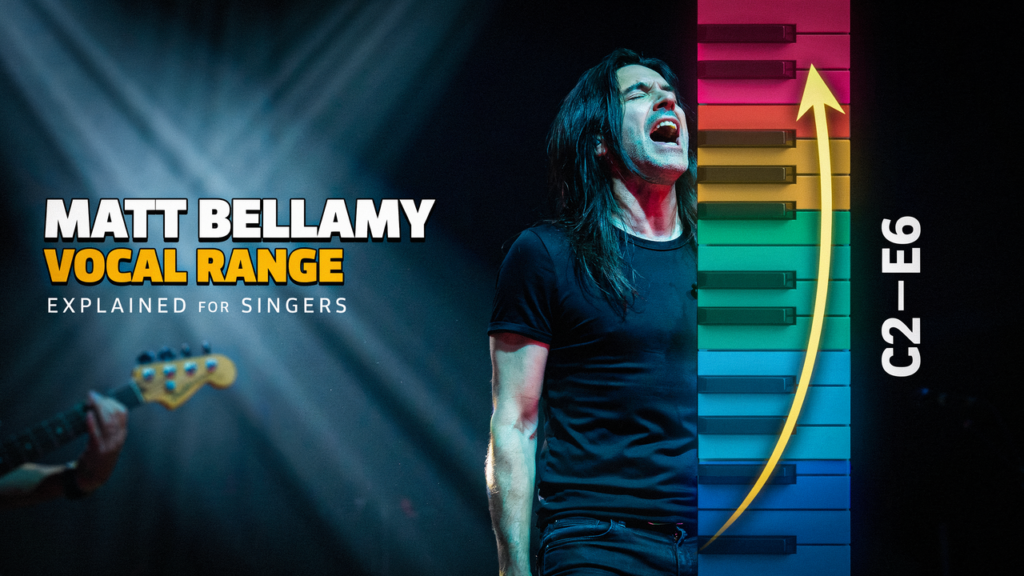
Matt Bellamy is known for one of the most recognizable voices in alternative rock. As the lead singer of Muse, he moves from restrained low phrases to dramatic belts, sustained falsetto and piercing high notes. His expressive delivery can make his range seem almost unlimited, but the complete picture depends on which recordings, live performances and vocal registers are included.
Bellamy’s commonly documented complete vocal range extends from approximately D2 to C♯6. This covers three octaves and eleven semitones, which is one semitone short of four full octaves. However, these endpoints should not be treated as equally comfortable or equally representative parts of his voice. His lowest and highest notes are exceptional extensions, while most Muse melodies sit within a much narrower area.
Matt Bellamy Vocal Range Summary
| Vocal characteristic | Approximate result |
|---|---|
| Commonly documented complete range | D2–C♯6 |
| Total span | 3 octaves and 11 semitones |
| More representative recorded range | Approximately C♯3–A5 |
| Highest modal or full-voice area | Around A4–B♭4 |
| Upper-register extension | Falsetto into the fifth octave and beyond |
| Likely voice type | Tenor |
| Signature qualities | Bright tone, vibrato, falsetto, dramatic dynamics |
The D2–C♯6 estimate includes rare notes, unusual sounds and live extensions. Bellamy does not regularly sing melodic lines across that entire span. A more useful analysis separates his complete demonstrated range from his repeatable singing range and tessitura.
What Is Matt Bellamy’s Lowest Note?
Bellamy has been credited with notes as low as D2, although these extreme lows are not the foundation of his singing style. Depending on the source and the performance being measured, some analyses use higher notes in the second or third octave as his practical lower boundary.
Low notes can also be difficult to classify when they appear as vocal fry, spoken sounds, layered studio parts or brief live improvisations. These sounds may demonstrate extension without proving that the singer can sustain the same pitch with a clear, projected tone.
Bellamy’s lower singing voice is easier to recognize in calmer passages, where his tone becomes darker and more restrained. Even then, he generally does not remain in a low baritone tessitura. His voice sounds most characteristic as it moves through the middle and upper portions of the tenor range.
For comparison, singers interested in a darker and heavier low register can examine Peter Steele’s vocal range. Steele’s voice occupies a very different tonal and stylistic space from Bellamy’s high, flexible delivery.
What Is Matt Bellamy’s Highest Note?
Bellamy’s highest widely cited extension is approximately C♯6, associated with live vocalization rather than a typical sustained lyric in a studio recording. Because live extremes can be brief, improvised or affected by recording quality, this note is best described as a documented or claimed extension rather than his everyday upper limit.
His studio work provides clearer examples of his usable high range. Songs such as “Showbiz,” “Micro Cuts,” “Hyper Music” and “We Are Fucking Fucked” contain notes around G♯5 or A5. Most of these extreme pitches use falsetto or another light upper-register production.
“Micro Cuts” is especially important because Bellamy sings much of the song in an elevated falsetto coordination. Its difficulty comes from more than the highest pitch. The singer must maintain control, tonal consistency and expressive intensity while staying in a high register for extended phrases.
Bellamy’s approach can be compared with the upper-register flexibility heard across Thom Yorke’s vocal range. Both singers use light high notes expressively, although their tone, vibrato and phrasing remain distinct.
Matt Bellamy’s Range in Famous Muse Songs
| Song | Approximate vocal span or notable area | Main vocal feature |
|---|---|---|
| “Showbiz” | Approximately C♯3–G♯5 | Wide span and climactic falsetto |
| “Micro Cuts” | Approximately D4–A♭5 | Sustained high falsetto singing |
| “Hyper Music” | Approximately G3–A5 | High falsetto and demanding modal notes |
| “Plug In Baby” | Approximately C♯3–F♯5 | Low-to-high contrast |
| “Feeling Good” | Approximately F3–F5 | Strong modal singing with upper extension |
| “Sing for Absolution” | Approximately G3–A4 | Sustained upper-middle tessitura |
These figures can change slightly according to the version being analyzed. Muse often performs songs in different keys, while Bellamy may change a phrase, replace a full-voice note with falsetto or allow another band member to support the highest section during a concert.
That distinction is important when comparing Bellamy with powerful rock tenors such as Chris Cornell. Two singers may reach similar written pitches while using different levels of vocal weight, resonance and intensity.
Does Matt Bellamy Sing in Falsetto?
Falsetto is one of Bellamy’s defining techniques. He uses it both as an extension of his range and as a deliberate color. In songs such as “Micro Cuts” and “Supermassive Black Hole,” the lighter coordination helps create an eerie, theatrical sound that would be difficult to reproduce with a heavy chest-dominant setup.
Not every high note is falsetto, however. Bellamy also uses a bright modal voice, lighter mixed coordination and narrowed vowels in the upper fourth octave. The exact boundary between mix, head voice and falsetto is not always obvious from a finished recording, especially when distortion, compression and layered vocals are present.
This register flexibility is one reason comparisons with Jeff Buckley’s vocal range are useful. Both singers could move between intimate phrases and soaring upper-register sounds without making every high note resemble a traditional rock belt.
Is Matt Bellamy a Tenor?
Matt Bellamy is generally classified as a tenor. His bright timbre, upper-middle tessitura and ability to sing high rock melodies support that description.
Calling him a tenor does not mean every note he produces belongs to a classical tenor technique. Contemporary singers use microphones, amplification, distortion, breathiness and falsetto in ways that do not fit neatly into an operatic classification system. You can read more about the basic characteristics in this guide to what a tenor is.
Bellamy is sometimes described as a high tenor or as having countertenor-like qualities. The second description should be used carefully. His extensive falsetto can resemble the pitch area associated with countertenors, but reaching those notes does not automatically establish a classical countertenor voice type.
For another example of an agile contemporary tenor with an extended upper register, compare Bellamy with Brendon Urie’s vocal range.
Vocal Range vs Tessitura
Bellamy’s complete range tells us the lowest and highest pitches attributed to him. His tessitura describes the area where he spends substantial time singing.
Much of his recognizable work sits in the upper-middle part of the male voice. Muse songs frequently require repeated fourth-octave notes, rapid register changes, sustained phrases and dramatic shifts in volume. This can make a song exhausting even when its highest note does not look exceptional on paper.
A singer who can touch A5 once may still struggle with “Plug In Baby” or “Sing for Absolution” because the surrounding phrases demand stamina and coordination. Use a vocal scale finder to identify pitches you can repeat comfortably instead of judging your voice by one extreme note.
Why Is Matt Bellamy Difficult to Imitate?
Bellamy’s difficulty comes from the combination of range, tessitura and style. His performances may require:
- Repeated upper-fourth-octave singing
- Smooth transitions into falsetto
- Controlled vibrato on sustained notes
- Fast changes in dynamics
- Clear phrasing over dense rock instrumentation
- Emotional intensity without excessive throat pressure
Trying to reproduce his sound by forcing chest voice upward is risky and usually inaccurate. Singers should lower the key when necessary, develop a stable mix and practice high passages at moderate volume before adding distortion or theatrical intensity.
Frequently Asked Questions
How many octaves can Matt Bellamy sing?
His commonly documented D2–C♯6 range covers three octaves and eleven semitones—just under four octaves.
What is Matt Bellamy’s highest note?
C♯6 is frequently cited as his highest live extension. His clearer studio high points are generally found around G♯5 and A5, primarily in falsetto.
What is Matt Bellamy’s lowest note?
D2 is often listed as his lowest demonstrated pitch, but higher notes provide a more reliable picture of his practical melodic low range.
Is Matt Bellamy a tenor?
Yes. He is generally described as a tenor because of his timbre, tessitura and strength in the upper-middle register.
Does Matt Bellamy use falsetto?
Yes. Falsetto is central to his style and is responsible for many of the extremely high notes associated with his voice.
Which Muse song best demonstrates his range?
“Showbiz” provides a strong low-to-high demonstration, while “Micro Cuts” is one of the clearest showcases of his sustained upper-register control.
Matt Bellamy’s complete vocal range is impressive, but his musical identity comes from how he uses it. His bright tenor tone, rapid register changes, expressive vibrato and fearless falsetto create the dramatic sound associated with Muse. The extreme D2 and C♯6 endpoints are noteworthy, yet his control through the upper-middle register is what makes his singing truly distinctive.

Harlow is a vocal analysis and singing tools writer at Voice Range Test. She focuses on vocal range testing, voice type analysis, pitch recognition, and singing education tools for singers, musicians, choir performers, and beginners.