
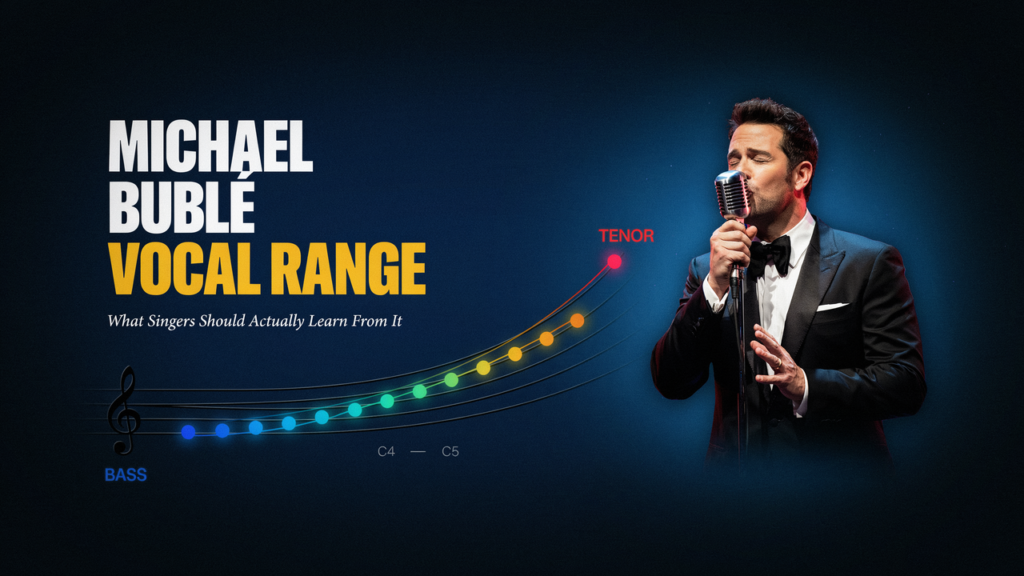
Michael Bublé is often described as a baritone in popular discussion, but his exact complete vocal range is not established by the sources reviewed here. Claims such as D-sharp2–C6 should not be treated as verified solo limits without identifiable recordings and clear vocal attribution.
Published song ranges also require care. A score can show a different octave placement from a recording, and different editions may disagree. For learning Bublé’s music, the actual melody, key, and repeated phrase demands are more useful than a headline total.
What Does D-sharp2–C6 Represent?
The interval contains 45 semitones: three octaves plus nine semitones. This confirms the calculation only. It does not verify that both endpoints were produced by Bublé, that they were sustained, or that they describe his comfortable range.
A high sound in a finished track may belong to a harmony, another performer, an instrument, or a production layer. None of those possibilities should be asserted as the explanation without checking the specific passage.
Similarly, a low pitch sounding plausible for a baritone is not evidence that it occurred. Both ends of a range claim need the same standard of documentation.
“Everything”: Written Range and Sounding Range
The Musicnotes “Everything” edition, product MN0073857, lists A3–F-sharp5 for the voice part in D major. This is a specific published arrangement, not a measurement of Bublé’s full voice.
That written span is 21 semitones: one octave plus a major sixth. If a vocal line is performed an octave below its written placement, its sounding notes move down 12 semitones while its width and pitch classes remain unchanged.
Do not silently turn A3–F-sharp5 into A2–F-sharp4 and then call the latter a verified recording measurement. Confirm the score convention and the actual performance before making that attribution. Different editions also need to be assessed separately.
Is Michael Bublé a Baritone or Tenor?
Baritone is a useful informal description of the vocal character commonly associated with his work. This article does not establish a formal lyric-baritone Fach or a measured comfortable tessitura.
The baritone voice guide explains why an upper extension does not automatically make a singer a tenor. Classification also concerns sustained repertoire, tonal weight, and register behavior.
Comparisons with Johnny Cash should not treat all low-sounding male voices as equivalent. Similar labels can cover very different repertoire and delivery.
Why Crooning Can Be Demanding
A conversational impression can hide precise musical work. Quiet entrances, connected vowels, intentional phrase endings, and accurate timing all require attention. A song does not become easy simply because it lacks an extreme high note.
When learning a phrase, check whether the rhythm remains stable before adding expressive delays. Singing behind the beat deliberately differs from losing track of the accompaniment.
Use an online metronome to establish the underlying pulse. Then compare your phrase against the backing track, listening for where it reconnects with important beats.
Choosing a Key for a Bublé Cover
Start with the exact arrangement. Identify the opening, the most demanding repeated passage, and any key changes. Testing only the first verse may miss the section that determines whether the song fits.
Sing at a comfortable volume with the actual words. If lowering the key improves the top, recheck whether the low phrases remain clear. If raising it clarifies the bottom, confirm that the upper phrases still work.
An octave displacement is not the same as a small key change. Specify which adjustment you intend so an accompanist can support the melody correctly.
Smooth Phrasing Without Imitating Vocal Weight
Practice one short line on a comfortable vowel, then restore the consonants while keeping the melody connected. Record the ending: it should remain deliberate rather than fading because the phrase was too long.
Do not manufacture a darker sound by pressing the voice downward. Clear words and controlled timing matter more than reproducing another singer’s natural tone.
Comparisons with Luther Vandross can focus on connected phrases and dynamics. Comparisons with John Legend can raise similar questions about how melody and accompaniment interact. Neither requires an unsupported ranking by octave count.
How to Check a Claimed Extreme Note
Keep the song, release, timestamp, and vocal part with the claim. Listen at the original speed, compare the pitch with a reference, and check whether it is repeated elsewhere.
A detector can follow a harmonic or an instrument. A surprising reading is a reason to inspect the evidence, not immediately expand the artist’s published range.
Frequently Asked Questions
Does Michael Bublé sing C6?
This review does not verify C6 as his solo maximum. A specific attributed vocal passage is needed.
Is D-sharp2 his lowest note?
It is not certified here as an absolute boundary. Plausibility and database repetition are not sufficient proof.
Does the “Everything” score show his real octave?
It shows the publisher’s listed voice range. Check notation conventions and the recording before treating written pitches as sounding ones.
Can a tenor sing his songs?
Yes, with a suitable arrangement and key. The complete phrases should fit the singer, not merely the highest note.

Harlow is a vocal analysis and singing tools writer at Voice Range Test. She focuses on vocal range testing, voice type analysis, pitch recognition, and singing education tools for singers, musicians, choir performers, and beginners.