
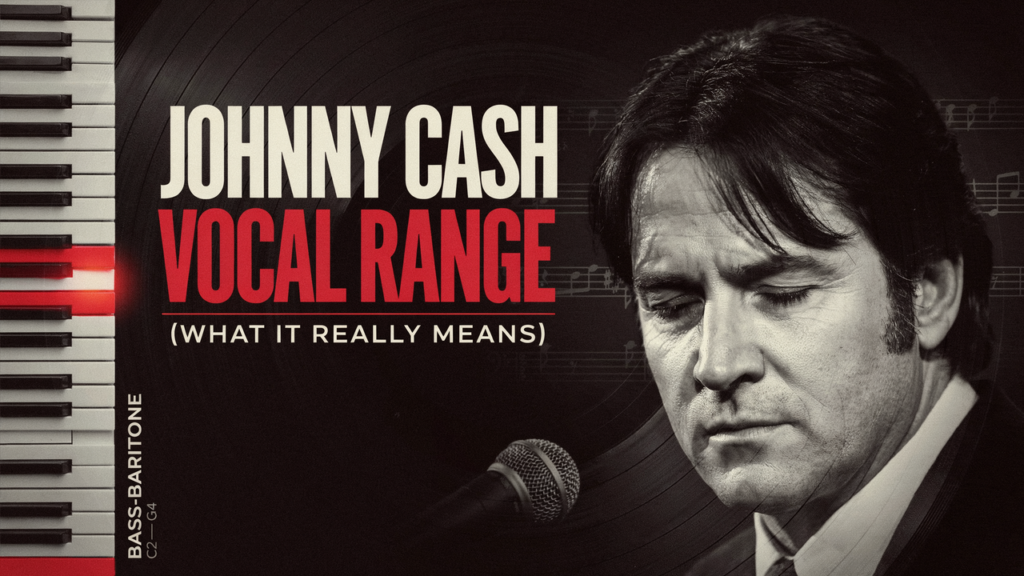
Johnny Cash is associated with a deep singing voice, but his exact career-wide vocal range is not established by the primary source reviewed here. E2–B3 should not be treated as a verified practical range, nor should a much wider fan-compiled total be accepted without identifiable recordings for its endpoints.
The useful distinction is between his recognizable vocal sound, the notes required by a particular song, and every pitch he may have produced across his career. Those are different questions, and none can be answered reliably from a voice-type label alone.
Johnny Cash’s Range: What Can Be Said Reliably?
Cash’s official biography identifies “I Walk the Line,” “Big River,” and “Folsom Prison Blues” among his early recordings and describes a career spanning studio work and major live performances. It does not publish a measured lowest-to-highest note span.
These recordings provide starting points for studying his music. The biography is evidence for the repertoire and career context, not for specific pitches or vocal-register claims. A precise range analysis would need to identify and check the actual performances.
Was Johnny Cash a Bass or a Baritone?
Bass-baritone is a familiar descriptive label for Cash’s deep sound, but this article uses it as an informal description rather than a certified operatic classification. Pop and country singers are not necessarily assessed using the same standards as unamplified classical singers.
The distinction between baritone and bass voices involves tessitura, tone, transitions, and musical function. A low note by itself cannot tell you whether someone has the sustained capabilities required by a particular bass role.
A dark sound also need not be the lowest pitch in a comparison. Pitch is the fundamental note; timbre is its perceived color. Two singers can produce the same note with very different brightness, resonance, articulation, and volume.
This is why an artist comparison such as Peter Steele’s vocal range should use documented notes and matching criteria rather than deciding whose voice merely sounds deeper.
Why E2–B3 Is Not a Confirmed Career Boundary
E2–B3 spans 19 semitones: one octave plus a perfect fifth. That arithmetic is straightforward, but it does not demonstrate that these were Cash’s regular limits. Establishing a practical range would require a defined sample of repertoire and evidence of repeated musical use.
A singer can also perform outside the range of their best-known songs. Conversely, a note found somewhere in a recording does not prove it belonged to the singer’s comfortable working range. The words “practical,” “recorded,” and “possible” should not be used interchangeably.
Claims about unusually low sounds in “After Taxes” or very high sounds in compilations need the exact recording and timestamp before a pitch can be certified. Humming, speech-like inflections, low irregular pulses, backing vocals, and brief effects need to be identified rather than silently counted as ordinary melodic notes.
How to Listen to Cash’s Songs Without Chasing Extremes
Use one identified release of “I Walk the Line,” “Big River,” or “Folsom Prison Blues.” Focus on the lead melody and write down the section you are comparing. A later live performance may differ from an earlier studio release, so avoid merging versions without noting the change.
Listen for where the melody repeatedly sits, how phrases begin, and how the words fit the beat. Those observations are more useful for learning a cover than finding the lowest sound in the whole track. When measuring notes, keep instrumental parts and backing voices separate from the lead.
Do not infer a medical cause from a change in tone between recordings. Different keys, arrangements, microphones, performance choices, and recording conditions can all affect what you hear. A late-career performance does not define the limits of an entire earlier career.
The distinction between range and delivery also matters when reading about Bob Dylan’s vocal range: expressive phrasing is not reducible to an octave count.
How to Find a Comfortable Key for a Johnny Cash Cover
Begin with the melody, not an attempt to make your voice artificially dark. Speak the words naturally, then sing a short phrase at an easy volume. If the low notes become indistinct or require pressing, raise the key and check the higher phrases too.
For a hypothetical arrangement requiring E2–B3, transposing up three semitones changes the requirement to G2–D4. The width remains 19 semitones. This is an illustration of transposition, not a verified range for a named Cash recording.
A higher key may clarify the low notes while making the chorus harder. Test both ends and the longest repeated phrases before deciding. If neither end fits comfortably, a different arrangement or song may suit your present voice better.
Use the pitch detector while singing alone, then compare the result with a keyboard or other reference. Do not play the original recording into the microphone and assume the reading belongs to your voice.
Low sounds can produce unstable readings, and software may display an octave error. Keep the recording, repeat the note gently, and exclude ambiguous attempts from a claimed reliable range. A quiet but clear note is useful; an impressive-looking number produced by strain is not.
What to Practice Instead of Forcing a Deeper Voice
Choose a short phrase in a comfortable key. First make the words understandable, then align the entrances with the accompaniment. Finally, shape the phrase so its ending remains audible and deliberate. Change one element at a time so you can hear whether it helps.
Avoid pushing the larynx downward, tightening the throat, or adding roughness to imitate a recording. Work with your own sound. If singing produces pain, new hoarseness, or a loss of comfortable notes, stop and seek appropriate help if symptoms persist.
A broader plan for improving singing can help you assess pitch, timing, and phrasing separately. These skills remain valuable even if your voice sits in a different register from Cash’s.
Frequently Asked Questions
How many octaves could Johnny Cash sing?
This article does not certify a full-career octave total. A trustworthy number requires documented low and high endpoints, with a clear explanation of whether non-melodic sounds were included.
Was E2 his lowest note?
E2 is not established here as an absolute lowest note. A frequently repeated estimate is not enough to prove a boundary, and a low sound in one recording needs its own analysis.
Does a deep tone prove a bass voice?
No. Timbre and pitch are related aspects of a voice but are not the same measurement. Formal classification requires more information than one recording or low note.
Can a tenor or a higher voice sing Johnny Cash songs?
Yes, in an appropriate arrangement and key. Choose a version that keeps both the low passages and repeated upper phrases comfortable, rather than forcing the original pitch placement.

Harlow is a vocal analysis and singing tools writer at Voice Range Test. She focuses on vocal range testing, voice type analysis, pitch recognition, and singing education tools for singers, musicians, choir performers, and beginners.