
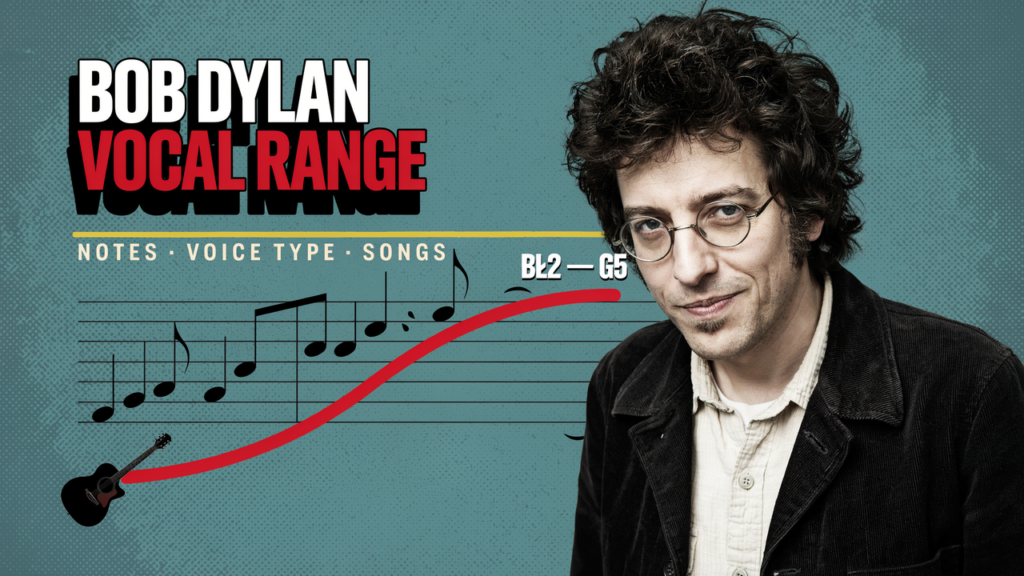
Bob Dylan’s vocal range is often reported around C2 to D5, but that number should be treated as a broad catalog estimate rather than a clean, official range test. His practical singing range is more useful to describe as a baritone-centered range around the low-middle and middle register, where his phrasing, diction, and storytelling usually sit.
Dylan is not famous because he displays the widest or smoothest voice. His vocal importance comes from phrasing, character, timing, lyric emphasis, and the way his voice changed across decades of recordings and live performances.
Bob Dylan Vocal Range at a Glance
| Category | Best practical assessment |
|---|---|
| Broad reported range | About C2-D5 |
| Approximate span | Three octaves plus two semitones |
| More usable song area | Often around A2-E4, depending on song and period |
| Likely voice type | Baritone |
| Core strength | Lyric phrasing, timing, tone color, and interpretation |
| Major limitation | His voice changed greatly across eras, keys, and live versions |
The C2-D5 figure is interesting, but it can be misleading if it combines isolated, rough, spoken, or unusual sounds from different decades. A range chart should not be confused with the notes Dylan regularly used with comfort and control.
What Are Bob Dylan’s Lowest and Highest Notes?
C2 is commonly cited as Dylan’s low endpoint, while D5 appears in some broad range databases as a high endpoint. Both should be qualified because Dylan’s delivery often moves between singing, speech-like phrasing, scoops, rough tone, and character sounds.
A useful vocal analysis asks whether the note is clearly sung, sustained, intentional, and part of the lead vocal. A brief or rough pitch can show vocal color, but it is not always part of a singer’s reliable performance range.
- Broad catalog range: about C2-D5, including unusual or isolated moments.
- Practical singing range: often closer to A2-E4 in many well-known melodies.
- Voice type clue: his tessitura and tone point more strongly to baritone than tenor.
Is Bob Dylan a Baritone?
Yes, Dylan is best described as a baritone. His comfortable center, darker lower-middle color, and frequent use of speech-like phrasing support that classification better than any single high note.
A baritone is not simply a singer who can sing low. Voice type also depends on tessitura, vocal weight, resonance, and where the voice works most naturally. The guide to what a baritone is explains this in more detail, and the tenor vs baritone comparison shows why one high note does not automatically make someone a tenor.
Dylan’s early voice could sound bright and nasal, especially in 1960s folk and rock recordings. Brightness, however, is a tone color. It does not cancel the baritone-centered placement of much of his catalog.
Why Dylan’s Range Is Hard to Measure
Bob Dylan is a difficult singer to analyze with a simple lowest-note and highest-note method. He changes keys, alters phrasing, bends pitches, speaks through melodies, and reshapes songs live.
That means two listeners can hear the same performance differently. One may mark a pitch as a sung note, while another may hear it as a speech-like inflection or slide. This is why range claims should be presented as estimates rather than final facts.
For Dylan, tessitura is more meaningful than extremes. His identity is clearer in the area where he spends most phrases than in the rare endpoints of a long career.
Famous Songs and Vocal Demands
| Song | Vocal character | Main challenge |
|---|---|---|
| Lay Lady Lay | Warm, lower, smoother tone | Maintaining relaxed low resonance |
| Like a Rolling Stone | Brighter, more projected delivery | Rhythmic drive and lyric attack |
| Tangled Up in Blue | Middle to upper-middle phrasing | Endurance and storytelling clarity |
| Knockin’ on Heaven’s Door | Compact melodic range | Restraint, tone, and phrasing |
| Mississippi | Lower, darker delivery | Speech-like musical control |
Many Dylan songs do not require extreme range, but that does not make them easy. The real difficulty is sounding conversational while staying rhythmically alive and lyrically clear.
How Bob Dylan’s Voice Changed Over Time
Dylan’s voice has moved through several recognizable phases. Early recordings often sound bright, nasal, direct, and folk-centered. Mid-1960s performances became sharper and more rock-oriented. Late 1960s and 1970s recordings sometimes reveal a warmer, smoother color. Later decades brought more roughness, darkness, and speech-centered delivery.
This evolution should not be reduced to one simple decline story. Age and long-term use matter, but Dylan also makes artistic choices. His later singing often prioritizes phrasing and character over sustained vocal polish.
The official Nobel Prize page recognized Dylan’s importance in literature for creating new poetic expressions within the American song tradition in its 2016 prize facts. That context matters because Dylan’s singing is inseparable from how he delivers language.
What Makes Dylan’s Singing Distinctive?
Speech-like phrasing: Dylan often bends melody around the natural rhythm of words.
Nasal resonance: His forward tone helps consonants and lyrics cut through.
Flexible timing: He may sit ahead of or behind the beat to highlight meaning.
Pitch slides and scoops: He often approaches notes indirectly, which creates a conversational feel.
Changing tone: Across his career, Dylan used bright, thin, warm, rough, dark, and gravelly colors.
This is why Dylan’s voice divides listeners. If you expect smooth bel canto tone, he may sound rough. If you listen for text, timing, and character, the choices become more intentional.
Can Bob Dylan Sing?
Yes, Bob Dylan can sing, but not in the narrow way people often mean when they ask the question. His strength is not clean vocal display. It is the ability to make a lyric feel spoken, sung, remembered, argued, or revealed.
That kind of singing depends on control over timing, emphasis, and character. It is less about proving a high note and more about making each line land.
Johnny Cash offers a useful comparison because he also used a low-centered voice and narrative authority, though Cash’s delivery was steadier and more resonant. John Lennon leaned more on rock urgency and bright upper-middle energy, while Jim Morrison used a darker, more theatrical baritone color.
Full Range vs. Usable Range
The broad C2-D5 estimate tells you what may appear somewhere in Dylan’s recorded output. It does not tell you what he regularly used in clear, comfortable singing.
For singers learning Dylan songs, the usable range matters more. Choose a key where the lyrics can stay clear and where the story feels natural. A lower key may fit one voice better; a brighter key may fit another. You can compare your own result with the vocal range calculator before choosing a song key.
Frequently Asked Questions
What is Bob Dylan’s vocal range?
Bob Dylan’s broad reported range is about C2-D5, but his practical singing range is narrower and often sits around the low-middle and middle baritone area.
Is Bob Dylan a baritone?
Yes. Dylan is generally best described as a baritone because of his tessitura, vocal weight, and comfortable lower-middle placement.
What is Bob Dylan’s lowest note?
C2 is commonly reported as a low endpoint, but it should be treated as a catalog estimate rather than a fully confirmed, regularly used singing note.
What is Bob Dylan’s highest note?
D5 appears in some broad estimates, but it is better understood as an isolated reported extreme than a normal part of his tessitura.
Why did Bob Dylan’s voice change?
His voice changed because of age, long-term use, changing musical style, and deliberate artistic choices in phrasing, tone, and delivery.

Harlow is a vocal analysis and singing tools writer at Voice Range Test. She focuses on vocal range testing, voice type analysis, pitch recognition, and singing education tools for singers, musicians, choir performers, and beginners.