
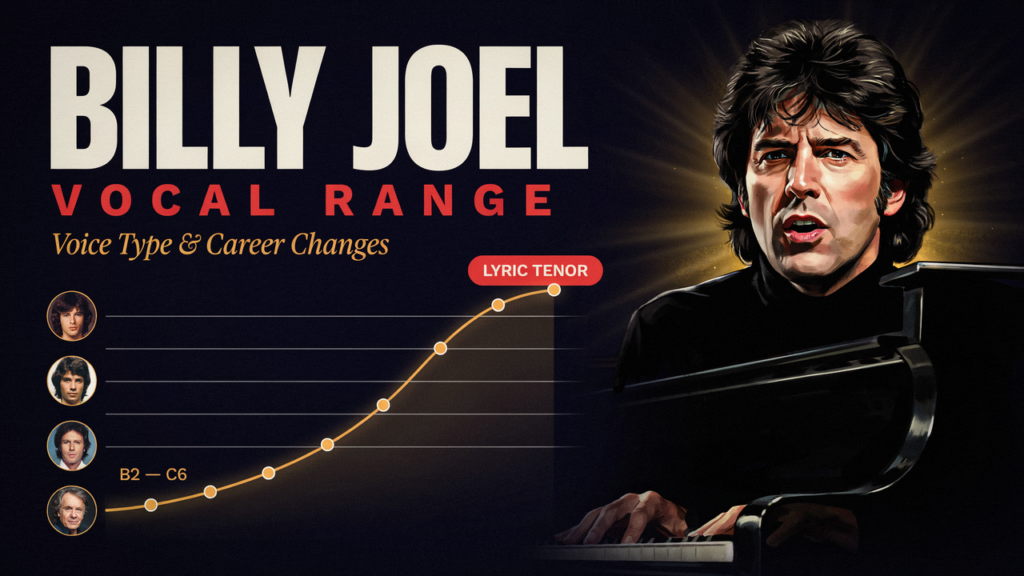
Billy Joel’s best-supported lead-vocal range is approximately A2 to C5, spanning two octaves and three semitones. His younger recordings also contain higher falsetto passages, most famously in “An Innocent Man,” but claims that his complete range extends to F♯6 are not supported by clear, consistently documented song evidence.
Joel’s voice does not fit neatly into one permanent label. His early recordings often display tenor-like brightness and upper extension, while his mature voice has developed a darker, heavier, more baritone-like tone. Describing him as a baritone with tenor extension, or informally as a baritenor, captures this flexibility better than judging him from one extreme note.
Billy Joel’s Vocal Range at a Glance
| Vocal detail | Best-supported assessment |
|---|---|
| Conservative lead-vocal range | Approximately A2–C5 |
| Conservative range span | Two octaves and three semitones |
| Strongest working area | Lower third through upper fourth octave |
| Higher extension | Falsetto above C5 in selected early recordings |
| Voice type | Baritone with tenor extension |
| Early-career character | Brighter, lighter and more tenor-like |
| Mature vocal character | Darker, heavier and more baritone-like |
| Signature strengths | Phrasing, storytelling, dynamics and tonal variety |
This conservative assessment focuses on recognizable lead singing rather than isolated studio effects, backing-vocal layers, or uncertain pitches. It also reflects a practical truth: Joel’s musical identity comes from how he shapes words and melodies, not from maximizing his octave count.
Billy Joel’s Lowest and Highest Notes
Billy Joel’s clearly usable lower range reaches approximately A2, although some analyses claim lower pitches around F2 or C2. Those more extreme estimates require caution because a low sound may be spoken, creaky, briefly touched, or difficult to separate from the recording.
Songs such as “Piano Man,” “Honesty,” and “New York State of Mind” demonstrate the warmth and conversational quality of his lower-middle register. His low notes rarely function as theatrical extremes. Instead, they support his storytelling and give the lyrics a direct, speech-like character.
C5 is a reasonable upper boundary for his strong lead singing across his classic catalog. He can extend above this area in lighter coordination, particularly through falsetto, but those notes should be classified separately from his full, repeatable upper voice.
| Vocal area | Song or context | Production | Evidence interpretation |
|---|---|---|---|
| A2–B♭2 | Lower passages in his classic repertoire | Full lower voice | Practical lower extension |
| B♭2–B♭4 | “Honesty” | Lead singing | Broad example of his usable range |
| A2–B4 | “Movin’ Out (Anthony’s Song)” | Chest and upper mixed production | Strong range contrast |
| Upper fourth octave | “Pressure” and “All for Leyna” | Forceful lead singing | Tenor-like intensity |
| Around C5 | Selected early recordings | High full or mixed singing | Reasonable core upper limit |
| Above C5 | “An Innocent Man” and related passages | Falsetto | Upper extension, not normal tessitura |
| F♯6 claim | Unclear | Unverified | Should not define his published range |
The wide range estimates found online often result from counting every audible sound without identifying the singer, register, or recording context. A layered harmony cannot automatically be assigned to the lead singer, and a brief falsetto peak does not establish a comfortable upper limit.
Does Billy Joel Have a Four-Octave Range?
A reliable four-octave range has not been demonstrated clearly enough to describe it as settled fact. Estimates such as F2–F♯6 or A2–A5 appear online, but they are rarely accompanied by an evidence trail showing the exact songs, timestamps, registers, and vocal context.
The more defensible A2–C5 range covers 27 semitones, equal to two octaves and three semitones. If an A5 falsetto extension is accepted, A2–A5 would equal exactly three octaves.
Neither calculation diminishes his ability. Many of Joel’s songs are difficult because they combine substantial range with demanding vowels, long phrases, rhythmic precision, sudden dynamic changes, and emotionally exposed delivery.
Range width also says little about how successfully a singer uses each note. Joel built distinctive songs around the most expressive areas of his voice rather than treating extreme pitches as the main attraction.
Is Billy Joel a Tenor or Baritone?
Billy Joel is most accurately described as a baritone with a strong upper extension, though his younger voice often displayed tenor-like qualities. The informal term “baritenor” can be useful when describing this overlap, but it is not a formal diagnosis.
Several characteristics support a baritone-leaning interpretation:
- His speaking and lower singing voices have substantial warmth.
- Many signature songs center comfortably in the middle male register.
- His tone becomes fuller and darker below the tenor’s characteristic high area.
- His mature voice carries more weight than it did on early records.
At the same time, Joel could sing bright, energetic phrases in the upper fourth octave and access higher notes through mixed voice or falsetto. This explains why some listeners identify him as a tenor.
The difference becomes clearer when comparing tenor and baritone voices. Voice type depends on tessitura, timbre, vocal weight, and register transitions—not merely the highest and lowest available notes.
Joel’s vocal development can also be compared with Elton John’s vocal range. Both are pianist-songwriters whose voices became lower and darker across long performing careers, affecting how their earlier material could be approached live.
Songs That Showcase Billy Joel’s Voice
“Honesty” is one of the clearest demonstrations of Joel’s controlled range. Its sustained phrases require breath management, even tone, and careful dynamic growth. The melody travels from a resonant lower register into an exposed upper area without depending on vocal effects.
“Movin’ Out (Anthony’s Song)” demonstrates rhythmic articulation and rapid movement between registers. Its famous emphatic phrases reveal how Joel could add bite and character without sacrificing the narrative.
“New York State of Mind” emphasizes mature phrasing, tonal warmth, and blues-influenced inflection. The song shows why vocal expression cannot be reduced to a range measurement.
“Pressure” places more sustained demand on the upper-middle voice. Its repeated intensity and urgent delivery make it challenging even without an exceptionally high final note.
“Piano Man” stays closer to Joel’s conversational center. Its difficulty comes from storytelling, breath pacing, repeated choruses, and maintaining interest through a familiar melody.
“All for Leyna” and “Sometimes a Fantasy” reveal a harder-edged side of his voice, with stronger attacks and more aggressive upper-register singing.
For another pianist-songwriter whose phrasing is central to his vocal identity, Donald Fagen’s vocal range offers a useful comparison. Fagen uses a narrower, more nasal tonal profile, while Joel moves more readily between conversational warmth and forceful rock singing.
The Falsetto in “An Innocent Man”
“An Innocent Man” is the most important recording for understanding Billy Joel’s upper extension. Its climactic falsetto phrases rise above the area where most of his catalog sits, creating a striking contrast with the fuller lead vocal below.
These notes count as part of his complete vocal range when falsetto is included. They should not, however, be used to claim that his entire voice functions comfortably at that height.
Falsetto typically uses a lighter vocal-fold coordination than chest-dominant or mixed singing. The result can reach higher pitches with less vocal weight. Joel uses that change intentionally as a stylistic reference to the high male vocals found in doo-wop and soul music.
The performance is impressive because the falsetto serves the song rather than existing as a detached vocal stunt. A comparison with George Michael’s vocal range shows another singer who used register contrast and tonal changes as expressive tools within carefully constructed pop arrangements.
How Billy Joel’s Voice Changed With Age
Billy Joel’s voice became noticeably darker and heavier over his long career. This kind of change can affect upper ease, resonance, vocal weight, and the keys in which older songs remain comfortable.
| Career period | Typical vocal impression | Practical effect |
|---|---|---|
| Early recordings | Light, bright and flexible | Easier access to energetic high phrases |
| Peak studio years | Balanced warmth and upper power | Wide range of ballads and rock material |
| Later performances | Darker and heavier | Stronger baritone color with reduced high ease |
| Mature concerts | More selective use of extremes | Transposition and altered phrasing may support consistency |
A lower concert key does not mean a singer has lost all upper ability. Transposition may help accommodate aging, fatigue, touring schedules, or changes in tone while preserving the shape and emotional effect of a song.
Joel’s mature voice often brings additional depth to narrative songs even when the original high notes are modified. This is similar to the way John Lennon’s vocal range is better understood through tone, phrasing, and emotional intensity than through endpoints alone.
Why His Songwriting Range Matters More
Billy Joel writes melodies that respond closely to the meaning of the lyrics. Verses may remain restrained and conversational before a chorus rises into a more urgent part of the voice. This makes the range itself part of the storytelling.
His strongest vocal qualities include:
- Clear diction that keeps the narrative understandable
- Changes in tone to represent different characters
- Controlled transitions between soft and forceful singing
- Rhythmic precision in lyric-heavy passages
- Soul, rock, doo-wop and theatrical influences
- The ability to make a familiar melody feel conversational
These skills explain why his songs can be difficult to imitate even when their written ranges appear manageable. A singer must reproduce the phrasing, dynamics, timing, and emotional progression—not merely reach the boundary notes.
A modern comparison can be found in John Legend’s vocal range, where piano-led arrangements likewise expose vocal control, phrasing, and register balance.
Frequently Asked Questions
What is Billy Joel’s vocal range?
Billy Joel’s best-supported lead-vocal range is approximately A2–C5, covering two octaves and three semitones. His younger recordings include additional falsetto extension above C5.
What is Billy Joel’s highest note?
C5 is a reasonable upper boundary for his strong lead singing. He reaches higher pitches in falsetto, particularly in “An Innocent Man,” but the exact absolute maximum is disputed.
What is Billy Joel’s lowest note?
A2 is a defensible practical low note. Lower boundaries such as F2 or C2 have been claimed, but they are not consistently supported by clearly identified lead-vocal evidence.
Is Billy Joel a tenor or baritone?
Billy Joel is best described as a baritone with tenor extension. His early voice was brighter and more tenor-like, while his mature voice developed greater baritone weight and darkness.
Does Billy Joel sing in falsetto?
Yes. “An Innocent Man” contains his most recognizable falsetto singing and demonstrates an upper extension beyond his normal full-voice range.
Did Billy Joel lose vocal range with age?
His upper range and tonal balance changed as his voice matured. Later performances sometimes use lower keys or adjusted phrases, while his lower and middle registers gained a darker, heavier quality.

Harlow is a vocal analysis and singing tools writer at Voice Range Test. She focuses on vocal range testing, voice type analysis, pitch recognition, and singing education tools for singers, musicians, choir performers, and beginners.