
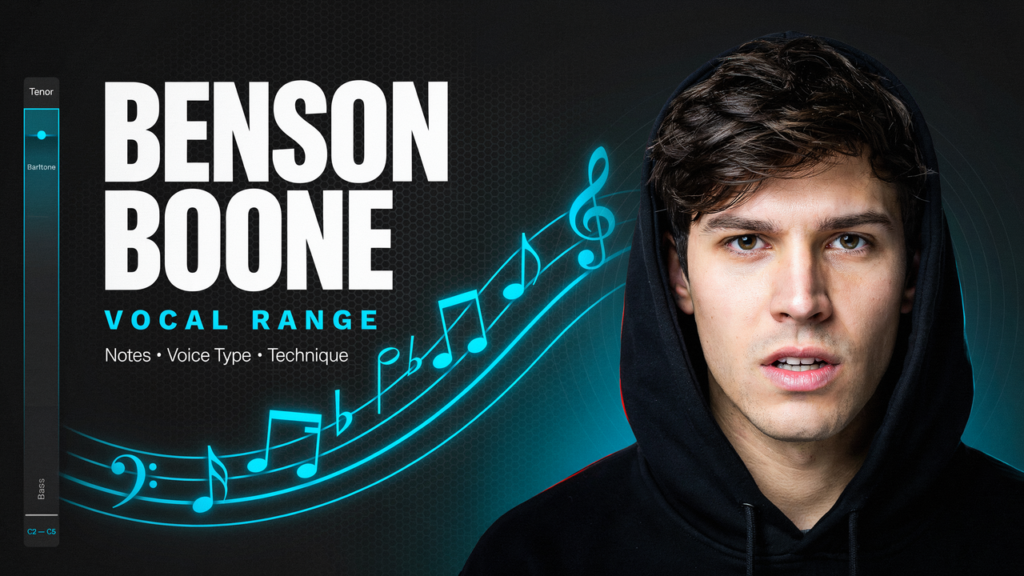
Benson Boone’s vocal range is best described as a conservative song-based estimate of about E3 to F5. That is not an official measurement from Boone or his team; it is a practical estimate from clearly audible lead-vocal moments in released songs and performances. His usable range may be wider, but wider online claims need song-specific evidence before they should be treated as fact.
In voice type terms, Boone fits best as a contemporary high tenor: bright upper-middle placement, strong mixed voice, flexible head voice and falsetto, and a dramatic ability to move from soft, intimate phrases into big pop-rock climaxes. The most famous example is the chorus of ‘Beautiful Things,’ where the difficulty comes from the repeated high-intensity phrases, not just one peak note.
Benson Boone Vocal Range at a Glance
| Category | Best current assessment |
|---|---|
| Estimated documented range | About E3-F5 in selected song evidence |
| Approximate span | Two octaves plus one semitone |
| Likely voice type | Contemporary high tenor |
| Strongest area | Upper-middle and high mixed register |
| Upper-register tools | Mix, head voice, falsetto and controlled rasp |
| Best-known high-note song | ‘Beautiful Things’ |
| Certainty level | Useful estimate, not an official full-range test |
This distinction matters. A singer’s complete physical range can include warm-up sounds, brief falsetto notes, vocal fry, background layers, or studio effects. A musically useful range is narrower: the notes a singer can repeat clearly, tune accurately, and use inside real songs. For readers checking their own notes, the vocal range calculator is more useful when you enter repeatable comfortable notes rather than one strained extreme.
What Is Benson Boone’s Highest Note?
The most defensible high note in Benson Boone’s released-song evidence is around F5, especially in the climactic sections of ‘Beautiful Things.’ Some online discussions list higher endpoints, but many of those claims do not clearly separate lead vocal, harmony, falsetto, software octave errors, or harmonics picked up by pitch trackers.
An F5 is already demanding for a male pop tenor when it is sung with intensity and repeated in a chorus. The note sits high enough that most singers cannot simply carry a heavy speaking-like chest setup into it. Boone’s sound has chest-like impact, but the coordination is better understood as a strong upper mix with resonance adjustment and reduced vocal weight.
If a source claims that Boone reaches F6 or C6, ask three questions before trusting it: which recording, which timestamp, and is the pitch the sung fundamental or a tracked overtone? Without that evidence, a huge range number can be more exciting than accurate.
What Is Benson Boone’s Lowest Note?
Around E3 is a reasonable lower endpoint for a conservative public-song estimate. Boone can sing with warmth in his lower-middle register, but his catalog is not built around extremely low singing. His artistic identity depends much more on upper-register release, emotional dynamics, and the contrast between quiet verses and explosive choruses.
That lower estimate should not be read as a hard biological limit. Pop recordings rarely reveal every note a singer can make. They reveal the range the song needs, the key chosen for the arrangement, and the sound the artist wants at that moment.
Is Benson Boone a Tenor?
Yes, Benson Boone is best described as a high contemporary tenor. His songs repeatedly place important phrases in a range where the voice needs brightness, lift, and flexibility. His timbre is not extremely heavy, and his upper register carries emotional intensity without sounding like a low voice being forced upward.
Still, voice type is not decided by one high note. It depends on tessitura, vocal weight, passaggio behavior, tone color, and where the singer can perform comfortably across a whole song. The guide to what a tenor is explains why range, tessitura, and vocal color all matter together.
It would be less accurate to call Boone a classical operatic tenor subtype from pop recordings alone. ‘Contemporary high tenor’ is safer because it describes how his voice functions in pop and pop-rock songs without pretending that commercial recordings provide a full classical fach assessment.
Why ‘Beautiful Things’ Sounds So High
The chorus of ‘Beautiful Things’ feels huge because Boone stacks several vocal challenges at the same time. The pitch is high, but the arrangement also demands volume, urgency, clean tuning, rasp, and quick emotional contrast. The official ‘Beautiful Things’ release became the song most listeners associate with his breakout vocal identity, and Boone was later listed among the Recording Academy’s 2025 Best New Artist nominees in a year when that song had made him widely visible according to the official GRAMMY nominees list.
Technically, the sound works because Boone lightens the vocal setup as the pitch rises. He keeps the emotional pressure in the performance, but he does not appear to drag a heavy chest voice all the way upward unchanged. That is why the chorus can sound intense without necessarily being pure shouting.
If you are trying to sing in a similar area, start with safe coordination before volume. The site’s guide on how to sing higher without straining is a better starting point than trying to copy the rasp or loudness first.
How Benson Boone Uses His Voice
Mixed voice is central to Boone’s high-note sound. It gives the upper notes power while preventing them from becoming too heavy. A good mix can sound bold to listeners even when the singer is making subtle adjustments internally.
Falsetto and head voice give him lighter colors. These are useful in exposed sections where emotional vulnerability matters more than volume. Boone often contrasts those lighter sounds with bigger choruses, which makes the climaxes feel larger.
Controlled rasp adds urgency. Rasp can be expressive, but it is not something beginners should force by squeezing the throat. If the roughness causes pain, loss of voice, or reduced control, the coordination is wrong.
Dynamic contrast is one of his strongest musical habits. He does not sing every phrase at maximum intensity. The softer lines make the high points feel earned, and that contrast is a major reason his choruses land emotionally.
Song Evidence and Vocal Features
| Song | What it shows | Why it matters |
|---|---|---|
| ‘Beautiful Things’ | Upper mixed climaxes around the F5 area | Shows Boone’s signature high-intensity chorus style |
| ‘Ghost Town’ | Soft-to-projected contrast | Shows emotional phrasing before the later arena-style sound |
| ‘In the Stars’ | Controlled middle and upper-middle singing | Shows breath pacing and sustained emotional delivery |
| ‘Slow It Down’ | Smoother upper-register transitions | Shows that his high range is not only about loud belts |
| ‘Death Wish Love’ | Lower-middle color around the E3 area | Helps define a conservative lower endpoint |
The table is not meant to prove every possible note Boone can sing. It is a practical map of the parts of his voice listeners are most likely to notice. For a broader reference point, compare these estimates with the site’s vocal range chart, which shows how notes relate to common voice categories.
Does Benson Boone Have a Four-Octave Range?
A confirmed four-octave range has not been established convincingly from public song evidence. Boone may be able to produce notes beyond E3-F5 in warmups, falsetto, or live moments, but a four-octave claim needs clear proof: identifiable recordings, correct octave labels, and confirmation that the notes are sung rather than tracked artifacts or backing layers.
This does not make his voice less impressive. Many excellent singers do not need four octaves to sound powerful. Boone’s standout quality is the way he makes upper notes feel emotionally urgent while keeping enough control for pop songwriting.
How He Compares With Similar Male Pop Tenors
Boone shares some high-tenor territory with Brendon Urie, especially in theatrical intensity and big upper-register moments. Urie, however, often uses a more overtly showman-like style with wider catalog evidence for extreme high singing.
Compared with Adam Lambert, Boone sounds less polished-theatrical and more raw-pop-rock. Lambert’s technique often feels highly controlled and resonant; Boone’s appeal is the feeling that the vocal is right on the edge emotionally, even when the coordination is still managed.
That is why voice type labels can only go so far. Two singers can both be contemporary tenors and still use very different tone colors, vowel shapes, stylistic choices, and performance habits.
How to Measure a Benson Boone-Style Range Safely
- Warm up gently for 5-10 minutes before testing your range.
- Find your lowest clear note, not your lowest croak or fry sound.
- Find your highest repeatable note without pain, shouting, or throat squeezing.
- Mark whether the high note is chest-dominant, mixed, head voice, or falsetto.
- Retest on another day; one good attempt is not the same as a reliable range.
For Boone-style songs, range is only part of the challenge. Breath control, vowel shaping, rhythm, and emotional pacing matter just as much. A singer who can hit one high note once may still struggle to sing the full chorus cleanly.
Frequently Asked Questions
What is Benson Boone’s vocal range?
Benson Boone’s conservative song-based vocal range is about E3-F5. His full physical range may be wider, but larger claims need clear song evidence before they should be treated as confirmed.
What is Benson Boone’s highest note?
Around F5 is the most defensible high-note estimate from his well-known released material, especially ‘Beautiful Things.’ Higher claims should be checked carefully for octave-labeling and source issues.
What is Benson Boone’s voice type?
He is best described as a contemporary high tenor. That label fits his bright upper-middle range, strong mix, flexible head voice, and song choices.
Does Benson Boone use falsetto?
Yes. Boone uses lighter upper-register colors, including head voice and falsetto, alongside stronger mixed notes. The contrast between those sounds is part of his style.
Can Benson Boone sing four octaves?
There is not enough public, song-specific evidence to confirm a four-octave vocal range. His documented usable range is better treated as about E3-F5 until stronger evidence is available.
Is ‘Beautiful Things’ hard to sing?
Yes. The song is difficult because of its high mixed phrases, repeated intensity, dynamic jumps, and controlled rasp. The challenge is not only the highest note.

Harlow is a vocal analysis and singing tools writer at Voice Range Test. She focuses on vocal range testing, voice type analysis, pitch recognition, and singing education tools for singers, musicians, choir performers, and beginners.