
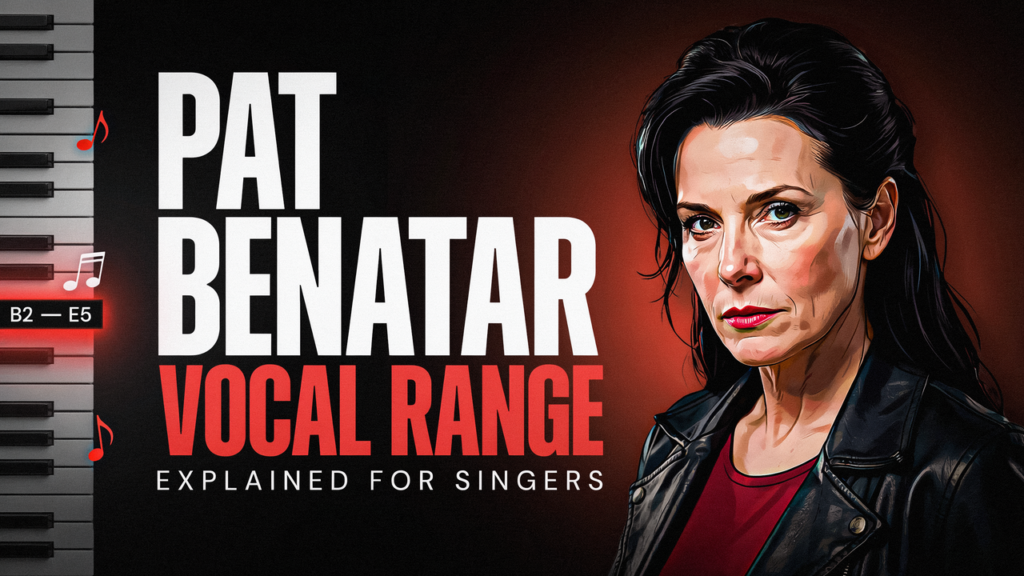
Pat Benatar’s documented song range is approximately E3 to B5, spanning two octaves and seven semitones. This estimate is based on pitches identified across a limited selection of her recordings, including a reported E3 in “Hit Me with Your Best Shot” and B5 in “All Fired Up.” Her complete lifetime range may be wider, but popular claims of a four- or five-octave range lack consistently identified song evidence.
Benatar’s reputation as an exceptional rock vocalist comes less from extreme notes than from the authority she brings to her upper range. Her bright resonance, controlled vibrato, clear diction, and powerful chest-dominant mix allow her to sound forceful without depending entirely on screams or rough vocal effects.
What Is Pat Benatar’s Vocal Range?
The most clearly documented sample of Pat Benatar’s vocal range is:
E3–B5: two octaves and seven semitones
This estimate represents 31 semitones. It is already a substantial recorded range, but it should not be confused with her comfortable tessitura or treated as an absolute lifetime measurement.
A singer’s total demonstrated range includes the lowest and highest pitches found across multiple recordings. Tessitura describes the area where most of the singing occurs and where the voice can sustain repeated phrases effectively. Benatar’s signature repertoire frequently concentrates on a strong middle and upper-middle register rather than constantly moving between E3 and B5.
| Note or range | Song | Vocal context | Evidence status |
|---|---|---|---|
| E3 | “Hit Me with Your Best Shot” | Lower end of the melody | Documented in a song-based analysis |
| E♭4–A♭5 | “Heartbreaker” | High rock melody with sustained upper phrases | Strongly supported song range |
| A3–F5 | “Treat Me Right” | Midrange and upper-register rock singing | Documented song range |
| B5 | “All Fired Up” | Brief upper extension | Reported highest cataloged pitch |
| Four or five octaves | No consistent endpoints identified | General publicity claim | Insufficiently supported |
The table shows why a singer’s widest reported range and the pitches used in individual hits are different measurements. A song may occupy little more than one octave while still being extremely demanding because of its tessitura, intensity, vowels, and sustained high notes.
Pat Benatar’s Lowest Documented Note
E3 is the lowest clearly cataloged note in the currently analyzed selection of Benatar’s songs. It appears in “Hit Me with Your Best Shot,” whose melody extends from approximately E3 to B4.
E3 is not unusually low for a female popular singer, but Benatar delivers her lower phrases with clarity and tonal substance. She does not rely on a breathy or artificially darkened sound to create depth. Instead, the lower register provides contrast before the melody returns to the brighter, more assertive part of her voice.
This is different from singers whose identities are built around a consistently dark lower register. Benatar’s strongest musical impression comes from the way her voice gains brilliance and urgency as it rises.
Pat Benatar’s Highest Documented Note
B5 is the highest pitch identified in the analyzed song sample, appearing in “All Fired Up.” Because it is an upper extension rather than the center of the song, B5 should not be interpreted as her everyday singing tessitura.
“Heartbreaker” offers a more representative example of her sustained upper-register ability. Its melody reaches approximately A♭5 and repeatedly demands an intense, focused rock sound. Singing a series of high phrases with stable pitch and clear words can reveal more about functional technique than touching a higher note momentarily.
Benatar’s upper-register coordination can be compared with P!nk’s powerful rock-oriented singing. Both vocalists can create considerable intensity, but range totals alone do not explain differences in tone, register balance, or stylistic delivery. Hayley Williams’ vocal range provides another useful comparison with a later generation of high-energy female rock singing.
Does Pat Benatar Have a Five-Octave Range?
Pat Benatar is sometimes credited with a four- or five-octave range, but these claims are not supported consistently by named lowest and highest notes from identifiable recordings.
A five-octave range beginning at E3 would need to extend to E8, far beyond the pitches documented in her familiar studio catalog. Alternatively, it would require a much lower starting note combined with an exceptionally high endpoint. Reliable evidence for either combination is difficult to establish.
This does not diminish Benatar’s vocal ability. Range size is only one measure of a singer. Her control, stamina, tonal focus, musical phrasing, and ability to maintain intensity in a difficult tessitura are more important to her recorded performances than an unsupported octave total.
Is Pat Benatar a Soprano or Mezzo-Soprano?
Pat Benatar is commonly described as a mezzo-soprano with a strong soprano extension, although some profiles simply classify her as a soprano. The disagreement exists because popular singers do not perform within the standardized framework used to assign operatic voice types.
The E3–B5 documented sample overlaps both mezzo-soprano and soprano territory. However, extreme notes alone cannot establish voice type. Classification also depends on tessitura, timbre, register transitions, vocal weight, and the area where the voice functions most comfortably.
Benatar’s warm middle register and substantial chest-dominant sound support a mezzo-soprano interpretation. Her bright, ringing upper range explains why listeners may hear soprano qualities. The most accurate description is therefore a powerful female rock voice with a mezzo-centered foundation and a developed upper extension.
How Classical Training Influenced Her Rock Voice
Benatar received vocal instruction when she was young and initially showed an interest in classical singing. That background likely helped establish habits involving breath management, diction, pitch accuracy, and coordinated resonance. It does not mean she completed conservatory training or worked professionally as an opera singer.
Her rock technique adapts those foundations to amplified music. She uses focused resonance to project through electric guitars, firm consonants to keep lyrics understandable, and controlled vibrato to finish sustained notes. Her sound can be aggressive, but it is usually more organized than a simple shout.
Listeners can hear a similar emphasis on controlled upper-register power in Kelly Clarkson’s vocal performances, although Clarkson’s contemporary pop phrasing differs from Benatar’s leaner rock delivery. For a contrasting male example, Steven Tyler’s range demonstrates a more effect-heavy approach involving rasp, cries, and high rock extensions.
What Makes Pat Benatar’s Voice Sound Powerful?
Benatar’s power results from several coordinated qualities:
- A bright resonance that helps the voice cut through a rock arrangement
- A firm, speech-connected middle register
- Controlled movement into a chest-dominant mix
- Stable breath pressure during long phrases
- Clear vowels and consonants
- Deliberate vibrato rather than constant wobble
- Dynamic contrast between restrained verses and forceful choruses
Power does not mean pushing maximum volume into every note. Benatar often preserves impact by shaping intensity across a phrase. Her quieter entrances make the climactic notes sound larger.
Singers studying this quality should not imitate the volume alone. Sustainable vocal power depends on coordination, resonance, and appropriate pitch selection. Pain, burning, or persistent hoarseness is a reason to stop rather than force a Benatar-style belt.
Songs That Best Demonstrate Her Voice
“Heartbreaker” is one of the clearest demonstrations of Benatar’s upper-range stamina, sharp attack, and rock projection. “Promises in the Dark” shows her ability to move from controlled, expressive lines into a forceful climax.
“Fire and Ice” highlights dynamic contrast and tonal precision, while “Love Is a Battlefield” uses a more rhythmically controlled delivery. “We Belong” reveals a softer side of her voice, including sustained phrasing and a less aggressive tonal approach.
“All Fired Up” is particularly relevant to range discussions because it contains her reported B5 upper extension. Readers analyzing these recordings can use a pitch detector to identify stable notes, but brief screams, harmonies, and instrumental frequencies should not be mistaken for lead-vocal pitches.
Frequently Asked Questions
How many octaves can Pat Benatar sing?
Her documented song sample covers two octaves and seven semitones, from E3 to B5. Her complete lifetime range may be wider, but four- and five-octave claims are not supported by consistently identified endpoints.
What is Pat Benatar’s highest note?
B5 is the highest note identified in the currently cataloged song sample, associated with “All Fired Up.” A♭5 in “Heartbreaker” is a more representative example of her sustained high rock singing.
What is Pat Benatar’s voice type?
Pat Benatar is commonly described as a mezzo-soprano with a strong upper extension, although some sources call her a soprano. Her range overlaps both categories, so no classification should be based on endpoints alone.
Was Pat Benatar an opera singer?
No. Benatar received vocal instruction and had an early interest in classical singing, but she built her professional career as a rock vocalist rather than an opera singer.
Why does Pat Benatar’s voice sound so powerful?
Her power comes from bright resonance, a strong speech-connected middle register, controlled breath use, clear articulation, and an efficient chest-dominant mix—not simply from singing loudly.

Harlow is a vocal analysis and singing tools writer at Voice Range Test. She focuses on vocal range testing, voice type analysis, pitch recognition, and singing education tools for singers, musicians, choir performers, and beginners.