
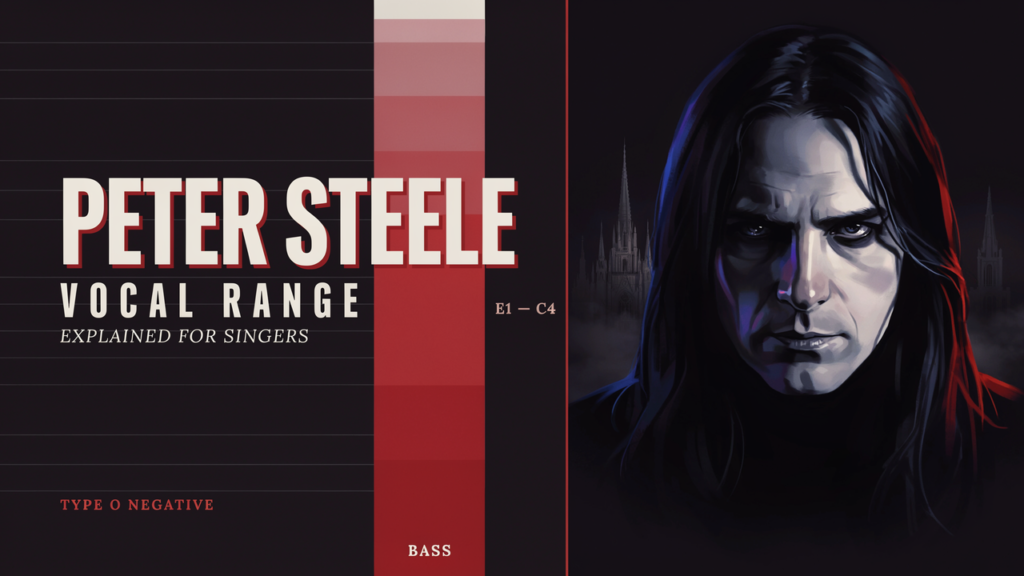
Peter Steele’s vocal range is commonly reported as F1 to G5, spanning approximately four octaves and two semitones. However, this figure includes very different forms of vocal production—from resonant low singing to distorted screams—and should not be interpreted as four octaves of equally comfortable melodic singing.
The Type O Negative frontman was best known for his cavernous lower register, dark tone and dramatic delivery. Although isolated notes helped build his reputation, Steele’s distinctive sound came primarily from his low tessitura, vocal weight and ability to shift between brooding clean passages and aggressive metal vocals.
What Was Peter Steele’s Vocal Range?
A defensible estimate of Peter Steele’s total recorded range is:
- Lowest reported note: F1
- Highest reported note: G5
- Total span: 50 semitones
- Range in octaves: Four octaves and two semitones
- Likely voice type: Bass-baritone
The F1 is often attributed to Type O Negative’s version of “Cinnamon Girl,” while notes near the top of the reported range appear in screams rather than conventional clean singing.
Some online range profiles extend Steele’s bottom limit to C1 or even A0. Those estimates should be treated cautiously. Extremely low sounds can involve vocal fry, subharmonics, layering, pitch processing or notes that are difficult to distinguish within a dense mix.
| Range boundary | Frequently cited example | Important context |
|---|---|---|
| F1 | “Cinnamon Girl” | Extremely low and potentially affected by vocal production or recording |
| D♯2 | “Haunted” | A clearer example of Steele’s sustained low singing |
| F♯5 | “Tripping a Blind Man” | Produced as an aggressive high vocal |
| G5 | “Zero Tolerance” | A scream rather than a sustained clean note |
This distinction matters because a singer’s total recorded range is not the same as the range they can use comfortably throughout a song.
What Was Peter Steele’s Lowest Note?
Peter Steele’s lowest commonly cited note is F1. That pitch is more than an octave below middle C and sits in a region reached by relatively few male singers with a conventional tone.
The note is associated with “Cinnamon Girl,” though its exact production is debated. It may contain elements of fry, subharmonic reinforcement or studio treatment. For that reason, the F1 is best described as a documented range boundary rather than proof that Steele regularly sang melodies at that pitch.
The D♯2 in “Haunted” provides a more representative example of his practical low register. It is sustained more clearly and aligns with the dark, weighty sound heard throughout Type O Negative’s catalog.
Listeners interested in comparable low voices can explore the vocal ranges of Johnny Cash, Josh Turner and bass vocalist Tim Foust.
What Was Peter Steele’s Highest Note?
Steele’s highest reported notes reach approximately G5, but these pitches came from screams and distorted vocal effects rather than his ordinary clean register.
A frequently cited F♯5 appears in “Tripping a Blind Man,” while a G5 has been associated with a high scream in “Zero Tolerance.” These performances demonstrate Steele’s willingness to use the entire voice as an expressive instrument, but they do not make him a conventional high-register singer.
His clean singing remained centered much lower. The contrast between that low foundation and sudden high screams helped make his extreme vocals sound especially dramatic.
This approach can be compared with metal singers such as Ozzy Osbourne and David Draiman, whose recorded extremes also need to be separated from their normal melodic tessitura.
How Many Octaves Could Peter Steele Sing?
Using F1 and G5 as the boundaries, Peter Steele’s recorded vocal range covered four octaves and two semitones.
Here is the calculation:
- F1 to F5 equals four octaves.
- F5 to G5 adds two semitones.
- The complete interval therefore contains 50 semitones.
If the disputed C1 claim were accepted, the result would be four octaves and seven semitones. An A0-to-G5 estimate would produce four octaves and ten semitones. Those larger totals depend on questionable low-frequency examples and are less useful when describing his functional singing voice.
Was Peter Steele a Bass or Bass-Baritone?
Peter Steele is most accurately described in practical popular-music terms as a bass-baritone. Some listeners classify him simply as a bass because of his unusually low notes and imposing vocal color.
A bass-baritone combines much of a bass singer’s depth with some of the flexibility and upper extension associated with a baritone. That description suits Steele because he could produce powerful low notes without spending every song at the absolute bottom of his range.
Formal classical voice categories are imperfect when applied to a gothic metal singer. Steele did not perform operatic repertoire under controlled acoustic conditions, and his recordings often used amplification, distortion and studio effects. “Bass-baritone” should therefore be understood as a practical tonal description, not a definitive classical Fach classification.
Clean Singing, Vocal Fry and Growls
Peter Steele used several vocal mechanisms that can sound deceptively similar on a recording.
His clean low singing featured a deep fundamental pitch, strong resonance and a dark vowel shape. Vocal fry created a rougher, creaking quality at the bottom of the voice. Growls and other distorted sounds added noise above the pitch, while possible subharmonics could make certain notes appear an octave lower.
Studio production added another layer. Type O Negative’s music frequently used reverb, doubling and dense instrumentation, all of which could make Steele’s voice sound even larger and deeper.
These effects do not diminish his ability. They simply explain why individual note claims should be evaluated according to how the sound was made.
Songs That Demonstrate Peter Steele’s Voice
Several songs provide a useful overview of Steele’s vocal qualities:
- “Black No. 1” showcases his theatrical low delivery, spoken inflections and dark clean tone.
- “Christian Woman” demonstrates his ability to move between restrained verses and more forceful singing.
- “Love You to Death” highlights his resonant lower register and romantic gothic style.
- “Wolf Moon” features controlled low singing within a dense arrangement.
- “Haunted” contains one of the clearer examples of his extreme lower register.
- “Everything Dies” reveals both vulnerability and weight in his clean voice.
- “Tripping a Blind Man” demonstrates his aggressive upper extension.
Together, these performances offer a better picture of Steele’s voice than any single lowest-note or highest-note clip.
Why His Tessitura Mattered More Than His Extremes
Peter Steele’s impact came from where his voice normally lived, not merely from touching F1 or G5.
Much of his memorable singing occupied a low, comfortable area where the lyrics remained understandable and the tone retained its weight. This tessitura allowed him to sustain Type O Negative’s somber atmosphere without relying constantly on extreme notes.
His phrasing was equally important. Steele could sound intimidating, sarcastic, mournful or unexpectedly tender while remaining recognizably himself. That expressive identity is why his voice continues to stand out among gothic and heavy metal vocalists.
Singers exploring their own lower register can use a deep voice test as a starting point. However, they should never force the larynx downward or imitate Steele’s growls through discomfort. Pain, burning or persistent hoarseness is a signal to stop.
Frequently Asked Questions
What was Peter Steele’s vocal range?
Peter Steele’s commonly reported recorded range was approximately F1 to G5, covering four octaves and two semitones.
What was Peter Steele’s lowest note?
His lowest widely cited note was F1 in “Cinnamon Girl.” Because the sound may involve fry, subharmonics or studio processing, D♯2 in “Haunted” may better represent his clear sustained low singing.
What was Peter Steele’s highest note?
His highest reported note was approximately G5. It was produced as a scream rather than as a clean, sustained melodic note.
Was Peter Steele a bass?
He is often called a bass, but bass-baritone is a more balanced description of his functional singing voice. Classical classifications cannot be applied perfectly to amplified metal vocals.
Did Peter Steele really have a four-octave range?
His total recorded extremes span slightly more than four octaves. His comfortable melodic range was narrower because the calculation combines clean notes, low effects and high screams.
Why did Peter Steele’s voice sound so deep?
His naturally low instrument, dark resonance, vowel choices, vocal fry and studio production all contributed to the effect. His height alone does not explain his voice.

Harlow is a vocal analysis and singing tools writer at Voice Range Test. She focuses on vocal range testing, voice type analysis, pitch recognition, and singing education tools for singers, musicians, choir performers, and beginners.