
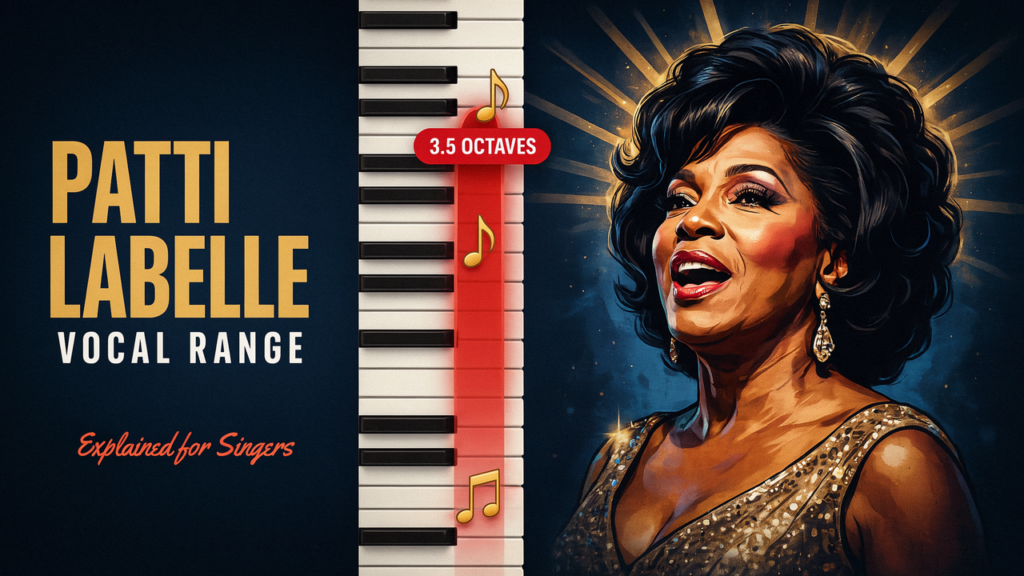
Patti LaBelle’s vocal range is commonly reported as approximately B♭2 to E6, covering three and a half octaves. Some vocal compilations extend the upper boundary to F6, but the exact endpoints depend on whether brief live exclamations, background notes, and other vocal effects are counted alongside clearly sung studio notes.
The size of the range is only part of LaBelle’s vocal identity. Her commanding upper register, penetrating belts, gospel-rooted phrasing, rapid dynamic changes, and instantly recognizable high “hollers” are more representative of her singing than any single range figure.
What Is Patti LaBelle’s Vocal Range?
The most frequently cited estimate for Patti LaBelle’s vocal range is:
B♭2–E6: three octaves and six semitones, or exactly three and a half octaves
This should be treated as a commonly reported range rather than a formally certified measurement. An artist’s complete discography may contain low background phrases, fleeting live notes, harmonized vocals, and improvised sounds that are difficult to classify consistently.
Some analyses give LaBelle a narrower range. A song-based database, for example, identifies F♯3–G5 from the limited recordings in its catalog. That does not necessarily contradict the wider estimate. It simply measures a smaller collection of clearly identified pitches rather than every known studio and live performance.
| Range boundary | Reported note | Context | Evidence status |
|---|---|---|---|
| Lower extreme | B♭2 | Reported in studio-range compilations | Commonly reported, recording-dependent |
| Upper sung extreme | E6 | High head-dominant or exclamatory production | Commonly reported |
| Extended upper claim | F6 | Included in some vocal compilations | Disputed and source-dependent |
| Catalog-based range | F♯3–G5 | Notes found in a limited song database | Documented within that catalog only |
These estimates describe demonstrated pitches, not LaBelle’s comfortable tessitura. A singer may touch an extreme note once without using that pitch regularly in complete musical phrases.
Patti LaBelle’s Lowest Notes
B♭2 is frequently identified as Patti LaBelle’s lowest recorded note, although documentation connecting that pitch to one universally accepted song is limited. It is therefore safer to call B♭2 a reported lower extreme rather than an unquestionable endpoint.
Her lower register is not the central feature of her public vocal image. LaBelle can bring warmth and depth into low phrases, but her most recognizable sound develops through the middle and upper portions of her voice.
This distinction is important when comparing LaBelle with a singer such as Tina Turner, whose lower, rough-edged tonal character plays a more prominent role in her signature sound. A low note establishes the bottom of a measured range; it does not automatically reveal where a singer sounds most comfortable or expressive.
Patti LaBelle’s Highest Notes
E6 is the most defensible commonly reported upper boundary for Patti LaBelle, while occasional analyses extend her range to F6. These pitches sit well above the range in which most of her melodies are written.
LaBelle’s extreme high sounds may involve different vocal coordinations. Some are recognizable sung pitches, while others occur during improvised cries, register flips, or gospel-style exclamations. A short sound that reaches a measurable frequency is not necessarily equivalent to a sustained, clearly articulated note.
Claims that LaBelle regularly reaches the seventh octave are considerably weaker. They often arise from interpreting very bright squeals or overtone-rich vocal effects as whistle-register notes. Without a clear recording, stable fundamental frequency, and identifiable register, such claims should not be presented as established fact.
Her upper-register intensity makes her a useful comparison with Jennifer Hudson’s powerful gospel-influenced voice and the high belts associated with Christina Aguilera. Their voices are not identical, but each demonstrates why tonal power and register choice matter alongside the highest pitch reached.
Is Patti LaBelle a Soprano?
Patti LaBelle is widely described as a soprano, frequently with the informal label “dramatic soprano.” The description reflects her strong upper extension, vocal weight, brilliant projection, and ability to carry considerable intensity into high phrases.
However, dramatic soprano is an operatic Fach classification based on more than range. It also considers tessitura, timbre, passaggio behavior, projection, and suitability for particular operatic roles. Because LaBelle is principally a soul, R&B, gospel, and pop singer, the term is best understood as a descriptive comparison—not a confirmed operatic classification.
Her voice is nevertheless more closely associated with soprano territory than with a consistently low female tessitura. Our guide to what defines a soprano explains why voice type cannot be determined from the highest and lowest notes alone.
What Makes Patti LaBelle’s Voice Distinctive?
LaBelle’s voice is recognizable because of how she uses her range, not merely because of its width.
Her defining characteristics include:
- Powerful, bright upper-register projection
- Sudden changes from restrained phrasing to explosive climaxes
- Gospel-influenced runs, cries, and improvised extensions
- Strong vibrato used for emotional emphasis
- Clear rhythmic articulation
- A penetrating belt that remains audible over dense arrangements
- Deliberate tonal changes from smooth to raspy or sharply accented
Her signature high cry—sometimes called the “Patti holler”—often functions as an expressive extension of a phrase. It may combine a pitched onset, a rapid register adjustment, and an exclamatory release. It should not automatically be categorized as whistle register.
Listeners can hear a different balance of power and control in Aretha Franklin’s vocal range. LaBelle often emphasizes abrupt, theatrical peaks, whereas Franklin frequently builds intensity through blues-inflected phrasing and sustained rhythmic authority. Gladys Knight’s vocal style provides another useful contrast, with greater emphasis on rounded tone and measured phrasing.
Songs That Demonstrate Patti LaBelle’s Voice
Several recordings reveal different parts of LaBelle’s vocal ability without requiring uncertain note claims.
“Lady Marmalade,” recorded with Labelle, demonstrates her assertive projection, rhythmic attack, and ability to lead a busy vocal arrangement. “If Only You Knew” begins with controlled, intimate phrasing before developing into a powerful emotional climax.
“You Are My Friend” highlights her gospel foundation, dynamic expansion, and improvisational delivery, especially in live performances. “Somebody Loves You Baby (You Know Who It Is)” demonstrates how she can build a polished R&B ballad toward a forceful upper-register conclusion.
“Down the Aisle (The Wedding Song),” recorded with the Bluebelles, is especially relevant to discussions of her early high-register singing. It contains a prominent high vocal passage near the ending, showing that her upper extension was already an important feature of her voice early in her career.
Range Versus Usable Singing Range
Patti LaBelle’s reported B♭2–E6 range does not mean every note within it has equal strength or appears regularly in her songs. Her usable singing range is the portion she can employ reliably with appropriate tone, control, and musical purpose.
Likewise, the highest sound in a live performance does not define her voice type. Range, tessitura, register, vocal weight, and stylistic choices answer different questions.
You can use the vocal range calculator to compare your own lowest and highest notes, but the result should be interpreted as a measured range—not a complete voice classification.
Frequently Asked Questions
How many octaves can Patti LaBelle sing?
Patti LaBelle is commonly credited with a three-and-a-half-octave range from B♭2 to E6. Some estimates extend the upper limit to F6, but those wider claims depend on which performances and vocal effects are included.
What is Patti LaBelle’s highest note?
E6 is her most commonly reported upper sung extreme. F6 also appears in some compilations, although the supporting evidence and classification of that sound are less consistent.
Does Patti LaBelle use whistle register?
There is no strong consensus that Patti LaBelle regularly uses a true whistle register. Some extreme sounds may resemble whistle notes, but they can also be interpreted as head-dominant cries, register flips, or exclamatory effects.
Is Patti LaBelle a soprano or mezzo-soprano?
She is generally described as a soprano because of her upper extension, vocal brilliance, and high tessitura. “Dramatic soprano” is frequently used descriptively, although it should not be treated as a formally established operatic Fach.
Has Patti LaBelle’s vocal range changed with age?
Her tone, weight, stamina, and approach to extreme notes have naturally varied across a career spanning several decades. However, vocal range cannot be compared fairly across eras without examining recordings made under similar conditions.

Harlow is a vocal analysis and singing tools writer at Voice Range Test. She focuses on vocal range testing, voice type analysis, pitch recognition, and singing education tools for singers, musicians, choir performers, and beginners.