
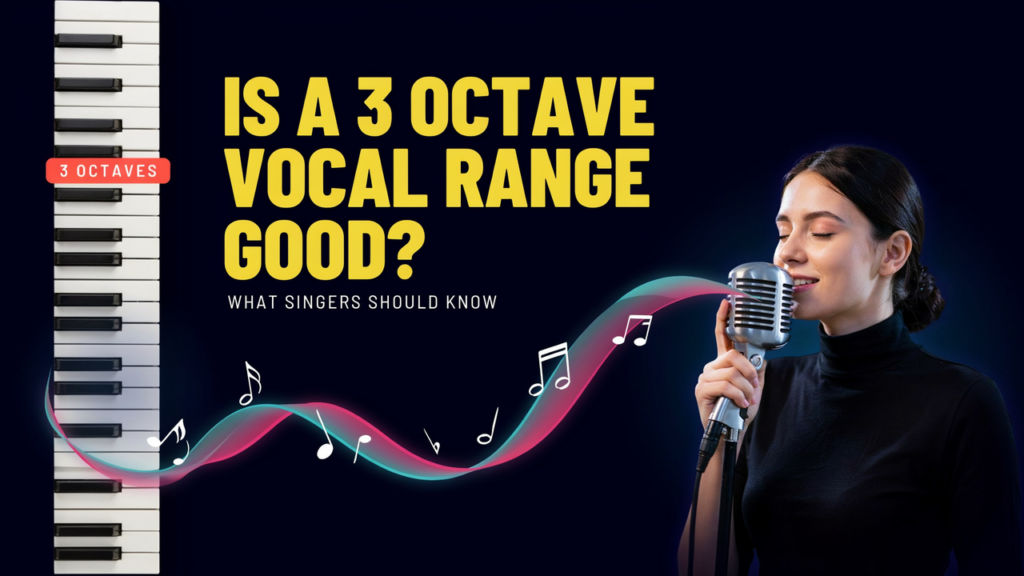
A 3 octave vocal range means the distance between a singer’s lowest and highest notes spans three complete octaves, or 36 semitones. Examples include C3–C6, A2–A5, and E3–E6. It is a wide range, but the number alone does not reveal how comfortably, consistently, or musically the singer can use those notes.
A singer may produce three octaves during a range test while having a smaller practical range for songs. Tone quality, pitch accuracy, register coordination, stamina, and tessitura are often more important than reaching an impressive boundary note once.
What Is a 3 Octave Vocal Range?
An octave is the musical interval between one note and the next note with the same letter name at twice its frequency. C3–C4 is one octave, C4–C5 is another, and C5–C6 is a third. Therefore, C3–C6 covers exactly three octaves.
In the standard 12-tone system, each octave contains 12 semitone intervals. Three octaves consequently equal:
- 36 semitones
- 3 complete octave intervals
- An 8:1 frequency ratio between the lowest and highest pitches
The range includes 37 chromatic pitch positions when both boundary notes are counted. This distinction explains why a three-octave interval has 36 semitone steps but 37 possible note positions.
If note names and octave numbers are unfamiliar, the guide to vocal range notes explains scientific pitch notation and how individual pitches are labeled.
Examples of Three-Octave Ranges
A three-octave span can begin on any note. It does not need to start and end on C.
| Lowest note | Highest note | Semitone span | Octave span |
|---|---|---|---|
| C2 | C5 | 36 | 3 octaves |
| A2 | A5 | 36 | 3 octaves |
| C3 | C6 | 36 | 3 octaves |
| E3 | E6 | 36 | 3 octaves |
These examples have the same width even though they occupy different pitch areas. A singer with A2–A5 and another with E3–E6 both cover three octaves, but their voices may suit different songs and vocal parts.
You can use a vocal range chart to visualize where your lowest and highest pitches sit relative to common singing ranges.
Does Every Sound Count as Part of Your Range?
A pitch should not automatically count merely because your voice produced a sound near it. For a meaningful singing-range measurement, a boundary note should be identifiable, reasonably steady, and repeatable without pain or severe strain.
Singers can measure range in several ways:
- Maximum range: Every identifiable pitch the voice can produce, including extreme register sounds
- Repeatable range: Notes that can be reproduced accurately across several attempts
- Usable singing range: Notes that can be sustained and incorporated into musical phrases with suitable tone and control
- Tessitura: The narrower area in which extended singing feels and sounds most comfortable
A singer might produce C3–C6 during one test but only sing comfortably and reliably from E3–A5. In that case, C3–C6 describes the maximum measured range, while the smaller interval better represents the usable range.
Heavy vocal fry, an uncontrolled squeak, a shouted high note, or a detector error should not be treated as proof of a reliable three-octave range. Falsetto and head voice can count when their pitches are controlled and relevant to the measurement, but the result should state which registers were included.
Is a 3 Octave Vocal Range Good?
Yes, three controlled and repeatable octaves provide substantial flexibility for most singers. However, “three octaves” is most impressive when the notes remain accurate, stable, and musically useful rather than existing only as isolated extremes.
There is no dependable universal percentage showing exactly how many people can sing three octaves. Results vary according to training, age, physiology, vocal condition, and—most importantly—the testing rules. A measurement that includes vocal fry and uncontrolled upper-register sounds cannot be compared fairly with one limited to comfortable sustained notes.
The separate guide answering whether a 3 octave range is good provides a more detailed evaluation. In practice, two well-controlled octaves may serve a singer better than three octaves containing weak or unreliable extremes.
How to Test a Three-Octave Range Accurately
Use the same conditions each time so your result reflects your voice rather than changes in equipment or testing technique.
- Warm up gently. Begin with comfortable humming, lip trills, or light scales instead of immediately testing extremes.
- Start near the middle of your voice. Sing a clear vowel such as “ah” at a moderate volume.
- Move downward gradually. Descend by semitones until the pitch becomes breathy, unstable, dominated by fry, or difficult to repeat.
- Confirm the lowest note. Repeat it two or three times without pressing the sound. Use the last consistently controlled pitch as your lower boundary.
- Return to the middle. Reset briefly before testing upward.
- Move upward gradually. Allow the voice to transition registers naturally. Do not shout or pull a heavy production upward merely to reach another note.
- Confirm the highest note. Count the highest pitch that you can reproduce clearly without pain, squeezing, or uncontrolled noise.
- Calculate the interval. Three complete octaves will place the upper note 36 semitones above the lower note.
The site’s vocal range calculator can help identify your boundary notes and calculate their exact distance. Test on more than one day before treating the result as a stable baseline.
What a Three-Octave Result Does Not Reveal
A three-octave measurement does not determine voice type. Voice classification also considers the part of the range used most comfortably, vocal timbre, weight, register transitions, and the demands of the repertoire.
For example, two singers may both produce C3–C6. One may feel strongest around the lower-middle portion, while the other may sing more freely in the upper portion. Their identical endpoints do not make their voices identical.
Range should also not be confused with tessitura. Vocal range records the distance between boundaries; tessitura concerns where the voice can remain comfortable and effective through sustained phrases.
A three-octave result also cannot measure:
- Tone quality
- Pitch accuracy
- Rhythmic control
- Dynamic control
- Vocal stamina
- Diction
- Style
- Musical expression
These abilities determine how effectively a singer uses the available pitches.
Making Three Octaves Useful in Real Songs
Instead of trying to make every note equally powerful, divide the measured range into practical zones:
- Core range: Notes that feel easy and dependable
- Developing range: Notes that work with preparation but need more coordination
- Extreme range: Occasional boundary notes that are not yet suitable for sustained phrases
Choose songs mainly around the core range. A song’s total span can appear manageable while its tessitura remains too high or too low. Look at where most of the melody sits, how long demanding notes are sustained, and how frequently they occur.
Track improvement by recording the lowest and highest repeatable notes under consistent conditions. Also record which notes can be used in scales, sustained vowels, and short song phrases. A new pitch becomes practically useful only when it can be repeated with stable intonation and suitable tone—not merely reached once.
Can You Develop a Wider Usable Range?
Training may make existing notes more coordinated and gradually increase the range available to some singers, but there is no guaranteed number of notes everyone can add. Progress depends on technique, practice consistency, vocal condition, and individual anatomy.
Work outward from comfortable pitches in small steps. Gentle glides, lip trills, and controlled scales can help coordinate transitions without turning every session into an extreme-note test. The guide on how to extend vocal range provides a gradual practice approach.
Stop if singing causes pain, burning, persistent tightness, or unusual hoarseness. Avoid demanding range work when your voice is ill, tired, or already hoarse. Persistent voice changes should be assessed by an appropriate medical or voice professional.
Frequently Asked Questions
How many semitones are in a 3 octave vocal range?
A three-octave vocal range spans 36 semitones. When both endpoints are included, the range contains 37 chromatic pitch positions.
Does falsetto count toward a three-octave range?
Falsetto can count as part of a singer’s total range when the notes are identifiable and controlled. It should be labeled separately if the goal is to compare chest-dominant, full-voice, or usable performance ranges.
Does a three-octave range determine voice type?
No. Voice type also depends on tessitura, timbre, vocal weight, register transitions, and repertoire. Extreme notes alone are insufficient for reliable classification.
Why does my vocal range change between tests?
Warm-up, fatigue, illness, hydration, recent voice use, microphone quality, background noise, and testing technique can change the result. Compare several tests performed under similar conditions.
Must all three octaves sound equally strong?
No. Most singers have stronger and weaker areas across their range. What matters is identifying which notes are comfortable, which are developing, and which are only occasional extremes.
Is it safe to test my highest and lowest notes every day?
Frequent gentle monitoring may be acceptable, but repeatedly forcing extreme notes is unnecessary. Test with moderate volume, stop when control disappears, and never continue through pain or persistent strain.

Harlow is a vocal analysis and singing tools writer at Voice Range Test. She focuses on vocal range testing, voice type analysis, pitch recognition, and singing education tools for singers, musicians, choir performers, and beginners.