
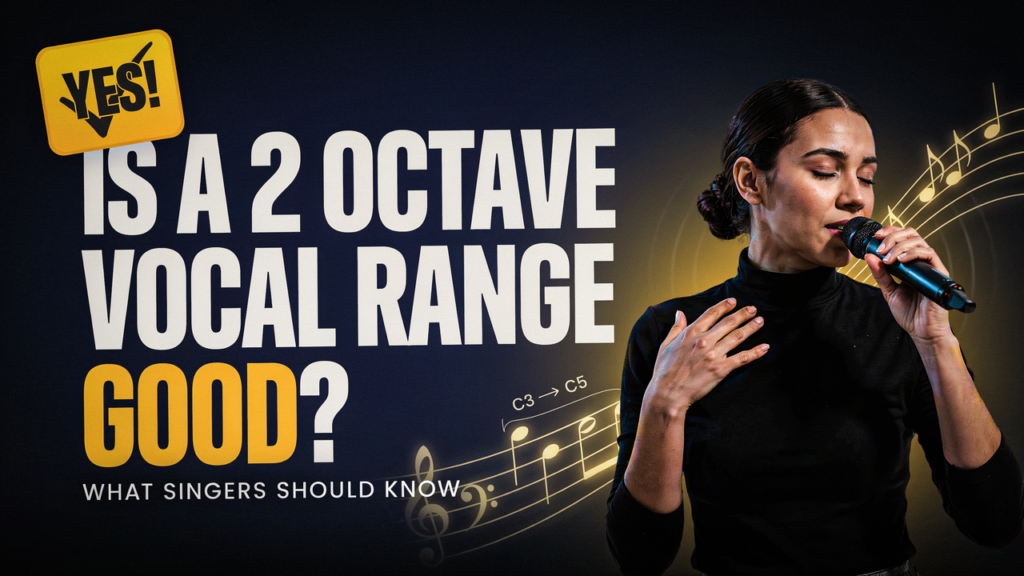
A two-octave vocal range spans 24 semitones between its lowest and highest notes. Examples include E2–E4, C3–C5, and A3–A5. Two controlled octaves can provide a practical foundation for singing, but the position, comfort, and consistency of those notes matter more than the number alone.
Someone with a two-octave range is not automatically limited or assigned to a particular voice type. The same interval can sit in a low, middle, or high part of the pitch spectrum, producing very different results for repertoire and vocal classification.
What Is a Two-Octave Vocal Range?
An octave is the interval between a pitch and the next pitch with the same note name at double its frequency. C3 to C4 is one octave, while C3 to C5 is two octaves.
Each octave contains 12 semitones, so two octaves equal 24 semitones. The calculation describes the distance between the lowest and highest notes—it does not mean that a singer has only 24 available pitches.
A two-octave range can be written in scientific pitch notation as:
- E2–E4
- A2–A4
- C3–C5
- F3–F5
- A3–A5
- C4–C6
These examples have the same width, but they occupy different pitch areas. That difference affects which songs and vocal parts are likely to feel comfortable.
The broader human vocal range varies considerably among individuals. Age, anatomy, training, health, vocal coordination, and the registers included in a test can all influence the measured result.
Two-Octave Vocal Range Examples
The following examples show how identical two-octave spans can sit in different parts of the musical spectrum:
| Example Range | Semitone Span | General Position | What It Demonstrates |
|---|---|---|---|
| E2–E4 | 24 | Lower | A two-octave span centered in a relatively low area |
| A2–A4 | 24 | Lower-middle | The range width remains two octaves despite higher boundaries |
| C3–C5 | 24 | Middle | A commonly referenced span for a higher male voice |
| F3–F5 | 24 | Middle-high | A range occupying a higher overall position |
| C4–C6 | 24 | High | A commonly referenced soprano area |
These are illustrative pitch spans, not automatic voice-type diagnoses. A vocal range chart can show where your notes overlap traditional categories, but overlap alone does not settle your classification.
For example, reaching C5 does not necessarily make someone a tenor. The note might be produced briefly in falsetto while the singer’s comfortable repertoire lies much lower. Similarly, a singer who reaches C6 is not automatically a soprano.
Is a Two-Octave Vocal Range Good?
Yes, two octaves can be a good and musically useful singing range, particularly when the notes are controlled, comfortable, and repeatable. However, there is no universal octave count that separates a good voice from a bad one.
A strong two-octave range should allow you to:
- Match pitches accurately
- Sustain notes without excessive effort
- Maintain an intentional tone
- Change volume without losing control
- Move between registers smoothly
- Repeat the notes on different days
- Use much of the range within actual songs
Two singers can both measure two octaves and have very different abilities. One may have stable tone and reliable transitions across the entire span. The other may include weak vocal fry at the bottom and an inconsistent falsetto note at the top.
The narrower question of whether a two-octave range is good therefore depends on how the range was measured and how much of it can be used musically.
Range Width vs Range Placement
Range width tells you the distance between your lowest and highest notes. Range placement tells you where those notes sit.
Consider two singers:
- Singer A: E2–E4
- Singer B: C4–C6
Both have two octaves, but their voices occupy very different pitch areas. They are unlikely to choose the same song keys or perform the same vocal parts comfortably.
This is why comparing octave totals without listing the boundary notes provides incomplete information. “Two octaves” answers how wide the range is; “E2–E4” identifies both its width and position.
The location of your reliable notes can help with repertoire selection. A song may span only one octave but still be uncomfortable if its entire melody sits near the top or bottom of your range. Transposing the song can move it into a more suitable area without changing the melody’s interval span.
Total Range, Usable Range, and Tessitura
A vocal-range test can describe several related but different measurements:
| Term | Meaning | Practical Importance |
|---|---|---|
| Total range | Lowest to highest identifiable pitch you can produce | Shows the full boundaries of the voice |
| Usable range | Notes you can repeat with reasonable control | Better reflects what you can sing reliably |
| Comfortable range | Notes that respond without significant effort | Useful for everyday practice |
| Tessitura | Area where the voice functions most comfortably across phrases | Important for choosing songs and vocal parts |
A total range might include vocal fry, chest voice, head voice, falsetto, and whistle register. These registers can legitimately contribute recognizable pitches, but they should be identified rather than treated as interchangeable.
For example, a singer might measure G2–G4 overall but have a reliable singing range of B2–E4. The total span is two octaves, while the usable portion is smaller. That is not a failed result; it is a more accurate description of the voice.
Does a Two-Octave Range Determine Voice Type?
No. Your highest and lowest notes provide useful clues, but voice type also involves tessitura, timbre, vocal weight, register transitions, and the area where sustained singing feels most natural.
Traditional classifications include soprano, mezzo-soprano, contralto, tenor, baritone, and bass. Their reference ranges overlap, so one set of boundary notes may appear in more than one category.
You can use your range to begin exploring how to find your voice type, but avoid choosing a classification solely because you reached one impressive extreme. A qualified teacher may provide a more complete assessment by listening to how your voice behaves throughout the range.
How to Measure a Two-Octave Range Accurately
Use consistent conditions so the result reflects recognizable pitches rather than accidental sounds.
- Warm up in your middle range. Start with gentle humming, lip trills, or comfortable scales.
- Choose a clear vowel. An “ah” or “oo” can help you maintain a consistent sound while testing.
- Move downward by semitones. Record the last note that remains identifiable and repeatable without forcing.
- Return to the middle and move upward. Do not push chest voice higher simply to increase the total.
- Identify the register. Note whether an extreme uses vocal fry, chest voice, head voice, falsetto, or whistle register.
- Sustain each boundary note briefly. A pitch that appears only during a fast slide is weaker evidence than one you can hold steadily.
- Repeat the test. Check whether the notes remain available during several attempts and on another day.
- Calculate the interval. A span of exactly 24 semitones is two octaves.
A pitch detector can recognize whether you reached a note, but it cannot judge comfort, tone quality, or technique. Use the site’s pitch accuracy test to check intonation while evaluating musical control separately.
How Useful Are Two Octaves for Singing?
Two octaves can support a substantial amount of singing, but repertoire suitability depends on more than a song’s total span.
A song works well for your voice when:
- Its lowest and highest notes fit your usable range
- Most of the melody lies near your comfortable tessitura
- Repeated high notes remain sustainable
- Register changes suit your coordination
- The key allows you to communicate the song without strain
Even a narrow song can feel difficult when its tessitura remains high for long phrases. Conversely, a song with a wider span may feel manageable if only a few notes approach your boundaries.
If a song nearly fits, changing its key may be more practical than trying to gain new notes immediately. The goal is to position the melody where your voice can deliver consistent pitch, tone, and expression.
Can You Expand a Two-Octave Vocal Range?
A two-octave range may expand as coordination improves, but progress is individual and cannot be guaranteed in a fixed number of notes. Often, the first improvement is not a new extreme—it is better control over notes that were already possible but unreliable.
Useful progress may include:
- Smoother register transitions
- More stable boundary notes
- Reduced unnecessary tension
- Better vowel consistency
- Greater dynamic control
- A wider comfortable tessitura
- Increased endurance in songs
If the upper edge is limiting your repertoire, use a gradual approach to developing the upper vocal range. Lower-range work should also focus on coordination rather than pushing the larynx downward; these lower-range development principles provide a safer starting point.
Track your lowest repeatable note, highest repeatable note, register used, and comfortable song range under similar testing conditions. Retesting every few weeks is more meaningful than checking several times per day.
Stop if singing produces pain, burning, worsening tightness, unusual hoarseness, or sudden loss of normally easy notes. Persistent or unexplained voice changes should be assessed by an appropriate medical voice professional.
Frequently Asked Questions
How many semitones are in a two-octave vocal range?
A two-octave range spans 24 semitones. C3–C5 and A2–A4 are both examples.
Does falsetto count toward a two-octave range?
Yes, controlled falsetto notes can count toward the total range. Labeling the register helps distinguish the complete measured span from the range you can use consistently in songs.
Can a beginner sing two octaves?
Yes. Some beginners can produce pitches across two octaves before receiving formal training. Their control, tone, and register transitions may still require development.
Does a two-octave range reveal my voice type?
No. It provides useful pitch boundaries, but voice type also depends on tessitura, timbre, vocal weight, passaggi, and repertoire comfort.
Can a professional singer work within two octaves?
Yes. Professional performance depends on musical control, interpretation, consistency, and suitability for the repertoire—not on reaching an arbitrary octave total.
Is a usable two-octave range better than a larger unstable range?
For practical singing, yes. Notes that remain accurate, repeatable, and expressive are more valuable than additional extremes that cannot be controlled.

Harlow is a vocal analysis and singing tools writer at Voice Range Test. She focuses on vocal range testing, voice type analysis, pitch recognition, and singing education tools for singers, musicians, choir performers, and beginners.