
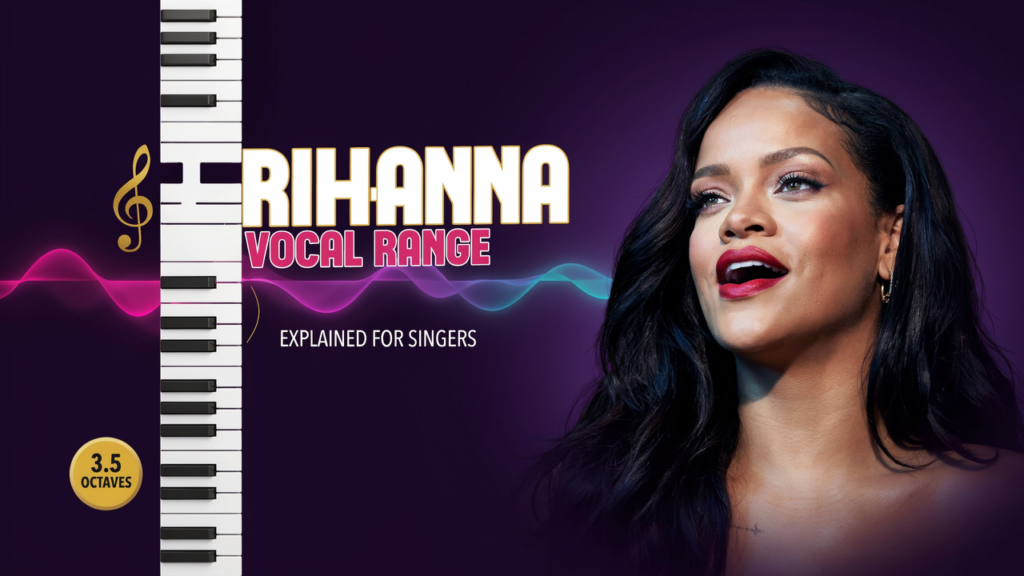
Rihanna’s vocal range is best understood as two things: her full note span (the lowest to highest pitches she can produce) and her usable tessitura (the range where she sings most consistently in her songs). Her signature style blends chest-dominant verses, a light pop mix in choruses, and an intentionally breathy tone.
Rihanna is a great singer to study because she proves something important: you don’t need constant high belts to sound iconic. You need control, phrasing, and a sound that fits the song.
If you want to follow note names as we talk about range, get familiar with vocal range notes so octaves and pitch labels don’t feel confusing.
What Rihanna’s Voice Actually Sounds Like (And Why)
Her “range” is less extreme than her impact
Rihanna isn’t famous because she’s hitting whistle notes every chorus.
She’s famous because she knows how to:
- place her voice in a comfortable zone
- keep the tone consistent
- use rhythm and attitude like instruments
This is why so many people can sing Rihanna songs… and still not sound like Rihanna. The magic is in the choices.
She’s a master of pop phrasing
If you’ve ever tried to sing one of her verses and felt like it sounded “flat” or “empty,” it’s usually not a pitch issue.
It’s a phrasing issue.
Rihanna’s delivery is built on:
- micro-dynamics (small changes in volume)
- breath timing
- consonant placement
- a controlled, intentional softness
That’s vocal skill, even when the notes are simple.
You can use this pitch memory exercise as a warm-up before singing.
Range vs Tessitura: The Key to Understanding Rihanna
Why “highest note” doesn’t tell you much
Most people searching “Rihanna vocal range” want:
- lowest note
- highest note
- octave count
That’s fair, but it’s not the most useful info for singers.
Rihanna’s songs are written so she can live in a strong, repeatable zone. That’s her tessitura.
Think of it like shoes:
- your highest note is a pair of heels you can wear for 30 seconds
- your tessitura is the sneakers you can wear all day
If you want the concept that makes this click immediately, read tessitura explained.
Where Rihanna usually lives
In many of her biggest hits, Rihanna spends most of the song in:
- comfortable chest voice for verses
- a light mix for choruses
- occasional head voice touches for contrast
That balance is why her songs are singable and still powerful.
What Voice Type Is Rihanna?
Alto vs mezzo: what’s the practical answer?
People often debate whether Rihanna is an alto or mezzo-soprano.
The truth: pop doesn’t behave like classical voice categories. But her voice tends to read as lower-leaning because she often chooses:
- chest-heavy placement
- darker vowels
- relaxed, speech-like tone
That can sound “alto-ish,” even if the notes aren’t extremely low.
If you want a practical reference, compare her approach with the typical zones in female vocal ranges.
The more useful label: “chest-forward pop mezzo”
If I had to coach this in one phrase, I’d call Rihanna a chest-forward pop mezzo.
That means:
- she gets her power from tone and phrasing
- she doesn’t rely on huge belts
- she’s comfortable in the midrange
- she uses head voice selectively
The Rihanna Sound: Breathy, But Not Weak
Breathy tone is a style choice (with tradeoffs)
A lot of singers try to imitate Rihanna by adding more air.
That’s where the trouble starts.
Breathiness can be beautiful, but it has costs:
- pitch gets less stable
- stamina drops
- the vocal folds dry out faster
- you can go flat without noticing
Rihanna’s breathy tone works because it’s controlled. It’s not a leak. It’s a filter.
How to tell if your breathiness is controlled
Controlled breathiness feels like:
- the tone is still “centered”
- you can sing louder instantly
- you can sing cleaner instantly
Uncontrolled breathiness feels like:
- you’re constantly running out of air
- pitch drifts downward
- your throat feels dry after 2 minutes
If you want to build this kind of control, you’ll benefit from breath support for singers even if you don’t think you’re a “power singer.”
Rihanna’s Register Use (What She Does Most)
Verses: chest voice and speech-level singing
Rihanna’s verses often sit in a speaking-like range.
This makes the delivery feel intimate and conversational. It’s one reason her music feels personal.
To sing this well, you need:
- clean pitch
- steady airflow
- crisp consonants
Choruses: light mix instead of heavy belt
In many choruses, Rihanna doesn’t “belt up.” She shifts into a lighter mix.
This is one of the biggest differences between Rihanna and classic belters. The goal isn’t to overpower the track—it’s to sit inside it.
Head voice: used for contrast, not constant climax
Rihanna does use head voice, but usually as a color.
This is a smart strategy for pop because it:
- reduces fatigue
- creates emotional lift
- adds variety without forcing volume
Step-by-Step: How to Sing Rihanna Songs Without Going Flat
Rihanna’s songs are deceptively hard because they’re exposed. When you sing softly, every small pitch issue becomes obvious.
Here’s how to train it.
Step 1: Get pitch stable at low volume
Many singers can sing on pitch when they’re loud.
The real skill is singing on pitch when you’re quiet.
Practice a simple 3-note pattern at low volume on “OO”:
- keep the tone steady
- don’t let it fade out
- don’t let it get breathier as you go higher
If pitch is your weak spot, spend time on how to improve pitch accuracy before you chase style.
Step 2: Add “edge” without adding air
Rihanna’s tone often has a slight bite or edge, but not because she’s blowing more air.
Try this:
- say “nah” with a little attitude
- keep it medium-soft
- feel the sound forward in the mouth, not in the throat
This creates pop presence without forcing.
Step 3: Control the end of phrases
Most Rihanna lines are rhythmic and phrase-driven.
A common mistake is letting the last word collapse into air. That’s how singers go flat.
Instead, aim for:
- steady airflow
- clear consonants
- a controlled release
Step 4: Learn the “mix lift” for choruses
When Rihanna goes higher, she often lightens rather than pushes.
If your chorus notes feel heavy, you’re likely trying to keep chest voice too long.
If you’re stuck at a ceiling, the cleanest fix is how to extend your upper vocal range without turning it into a shout.
A 10-Minute Rihanna Practice Routine
This is designed for consistency, not heroics.
Your routine (do this 4–5 days a week)
- 2 minutes: soft “OO” slides (mid to slightly higher)
- 3 minutes: low-volume 3-note patterns for pitch stability
- 3 minutes: verse practice with crisp consonants
- 2 minutes: chorus practice with lighter mix (no pushing)
This routine trains the real Rihanna skills: stability, control, and ease.
If you want to see what notes you’re actually hitting, use a pitch detector so you’re not guessing.
The One Table That Makes Rihanna’s Style Easy to Diagnose
Rihanna’s singing is mostly about choosing the right coordination for the moment.
| Song Section | Rihanna’s Common Approach | What You Should Feel | Biggest Trap |
|---|---|---|---|
| Verse | chest-dominant, speech-like | easy, grounded | too breathy |
| Pre-chorus | slightly lifted mix | lighter, focused | pushing volume |
| Chorus | light mix, rhythmic power | energized, not heavy | belting too hard |
| Ad-libs | selective head voice color | free, floaty | going sharp/flat |
If your chorus feels harder than your verse, that’s normal—but it shouldn’t feel like you’re fighting your throat.
Signs you’re doing it right
- Your voice feels normal when you speak afterward.
- You can repeat the chorus without tightening.
- Your pitch stays stable even at lower volume.
- You can switch from breathy to clean instantly.
Red flags (stop and reset)
- scratchy throat or dryness
- hoarseness that lasts into the next day
- feeling like you must push to be heard
- pitch sliding downward as you run out of air
Pop singing should feel controlled. If it hurts, something’s off.
Common Mistakes When Singing Rihanna Songs
Mistake 1: Adding breathiness by leaking air
This is the fastest way to go flat.
Breathy tone should still have a centered pitch. If the tone collapses, you’re not doing “Rihanna style”—you’re just under-supporting.
Mistake 2: Over-darkening the vowels
Many singers try to sound “cool” by making everything darker.
That often causes:
- muffled tone
- sluggish diction
- pitch instability
Rihanna’s tone is relaxed, but it’s still clear.
Mistake 3: Treating choruses like belt anthems
Rihanna choruses often don’t need heavy belting.
If you belt them like a power singer, you’ll fatigue quickly and lose the vibe.
Mistake 4: Ignoring rhythm and consonants
Rihanna’s phrasing is rhythmic. If you sing everything legato, you’ll miss the style.
Pop delivery is often about how you place consonants, not just the notes.
Mistake 5: Practicing through hoarseness
If your voice gets hoarse, stop.
Rihanna’s sound should not require pain. If you’re getting scratchy, reduce volume, reduce breathiness, and rebuild clean tone first.
How to Make Rihanna Songs Easier Immediately
Choose songs that match your tessitura
If you’re a beginner, start with songs that sit in your comfortable middle voice.
If you try to sing the highest choruses first, you’ll learn bad habits.
To map your range quickly, use a vocal range calculator and compare it to a vocal range chart so you can see where your comfort zone sits.
Don’t copy the exact tone at first
Tone comes last.
First, you need:
- pitch stability
- smooth phrasing
- consistent vowels
Once those are stable, you can add breathiness and stylistic edge safely.
The Takeaway: What Rihanna Teaches Singers
Rihanna’s vocal range matters, but her real strength is how she uses it.
She shows singers how to:
- stay in a comfortable tessitura
- sound emotional without oversinging
- control breathiness without losing pitch
- deliver pop phrasing with confidence
If you train those skills, you’ll sound better in Rihanna songs—and in almost any modern pop style.
FAQs
1) What is Rihanna’s vocal range?
Rihanna’s range is usually described by her lowest and highest confirmed notes across recordings and performances. But her most important feature is her tessitura: she lives in a comfortable midrange and uses light mix and head voice selectively. For singers, that’s more useful than a single octave number.
2) Is Rihanna an alto or mezzo-soprano?
In pop terms, she often reads as a lower-leaning mezzo because of her chest-forward tone and midrange comfort. Pop voice types are flexible, so the label isn’t absolute. The practical takeaway is that she sings most comfortably in the midrange rather than constant high belting.
3) Why does Rihanna sound breathy?
Breathiness is part of her stylistic identity and helps create intimacy in her delivery. But it’s controlled breathiness, not a total air leak. If you try to copy it by adding too much air, you’ll usually go flat and lose stamina.
4) Are Rihanna songs hard to sing?
They can be, especially because the vocals are exposed and pitch issues show up quickly. Many songs require stable pitch at low volume and clean phrasing. The difficulty is often control, not range.
5) Does Rihanna belt?
She can belt, but she often uses a lighter mix rather than heavy belting. That’s why her choruses can sound strong without being shouted. Many singers make the mistake of over-belting her songs.
6) How do I sing Rihanna songs without going flat?
Keep breathiness controlled and maintain steady airflow through phrases. Practice low-volume pitch stability and don’t let the ends of phrases collapse. If your pitch drifts, reduce air and focus the sound more forward.
7) Is it safe to imitate Rihanna’s tone?
Yes, as long as you don’t force breathiness or push volume to create style. Your voice should feel normal after practice, with no pain or lasting hoarseness. If you feel dryness or scratchiness, back off and rebuild clean tone first.