
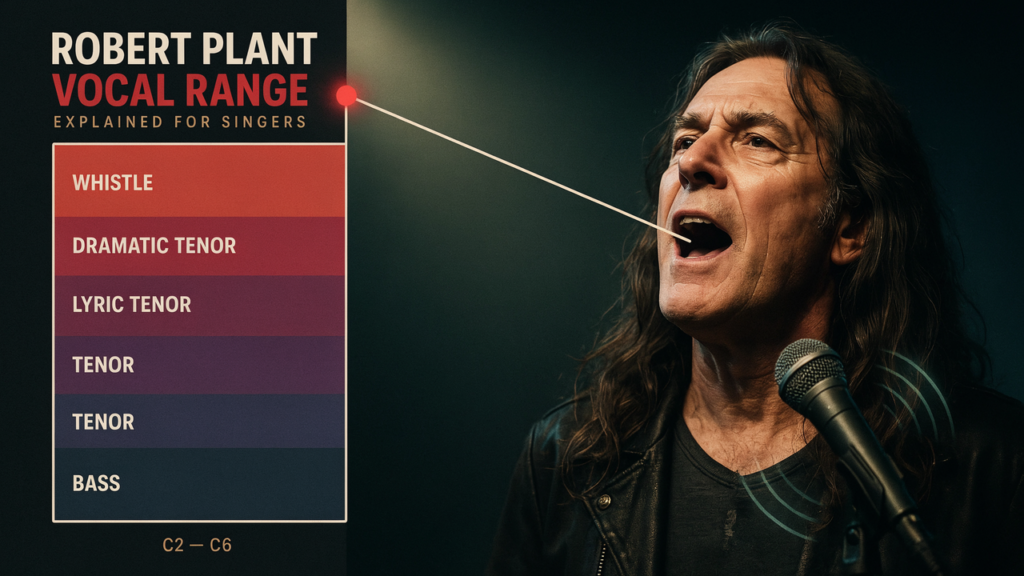
Robert Plant’s career-spanning vocal range is commonly estimated at approximately G2 to C♯6, covering three octaves and six semitones. However, the highest pitches come from early Led Zeppelin live improvisations involving wails, screams, or head-dominant production—not ordinary clean singing.
A more practical description is that Plant possessed a wide tenor-oriented voice with a demanding upper-middle tessitura, strong head and mixed coordination, blues-derived phrasing, and an extended range of pitched cries and distorted effects.
What Is Robert Plant’s Vocal Range?
The frequently cited G2–C♯6 measurement combines Plant’s low melodic singing with his most extreme early live sounds.
| Range category | Approximate notes |
|---|---|
| Lowest commonly reported note | G2 |
| Alternative later-career low | F♯2 |
| Core melodic range | Approximately G2–A5 |
| Extended live high | C6–C♯6 |
| Broad reported span | G2–C♯6 |
| Total broad span | 42 semitones |
| Octave span | 3 octaves and 6 semitones |
| Practical voice category | High rock tenor |
The G2–C♯6 figure should not imply that Plant regularly sang every note in this span with the same register, volume, or reliability. It combines material recorded across decades, including Led Zeppelin studio tracks, live improvisations, solo releases, and lower-placed later-career performances.
Robert Plant’s Lowest and Highest Notes
Plant’s extreme notes need an evidence-status system because his highest sounds are often distorted or produced during spontaneous live sections.
| Note | Song or performance | Vocal context | Evidence status |
|---|---|---|---|
| F♯2–G2 | Later solo and collaborative material | Low melodic singing | Supported lower extension |
| E5 | “Rock and Roll” and similar material | High melodic singing and ad-libs | Strongly representative |
| G5 | “The Lemon Song” and live blues improvisations | Head-dominant or mixed wail | Commonly reported |
| A5 | “Immigrant Song” studio cry | High pitched wail | Strongly associated |
| B5–C6 | Early live improvisations | Head voice, falsetto, or scream-like production | Performance-dependent |
| C♯6 | “You Shook Me,” reported 1969 performance | Brief extreme live sound | Commonly reported but source-dependent |
The C♯6 should be presented as an extended live extreme, not Plant’s highest repeatable clean belt. His A5 in the studio version of “Immigrant Song” is a more recognizable and reproducible piece of recording evidence, although it is still a specialized high wail rather than a conventional chest-voice note.
How Many Octaves Could Robert Plant Sing?
A range from G2 to C♯6 contains 42 semitones, equal to three octaves and six semitones.
If the lower boundary is expanded to F♯2, the span becomes 43 semitones, or three octaves and seven semitones. Neither measurement should automatically be called four octaves.
A full four-octave range beginning on G2 would need to reach G6. There is insufficient evidence that Plant demonstrated that span in clearly pitched musical performances.
His range was impressive, but his tessitura mattered more. Many Led Zeppelin songs keep the voice high for repeated phrases, making them difficult even when they never approach C6. Touching one extreme note is different from sustaining an entire song in the upper register.
What Note Does Robert Plant Sing in “Immigrant Song”?
The signature opening cry in the studio recording of “Immigrant Song” is commonly identified as reaching approximately A5.
Some live versions rise higher or include additional improvised sounds. Those performances should be measured individually rather than used to assign one universal note to every version.
The cry has a focused pitch, but its vocal quality is not equivalent to a clean, sustained classical note. Plant uses a light, head-dominant coordination with an intense tone that can sound larger because of resonance, distortion, and the surrounding arrangement.
Singers should not attempt to reproduce it by pulling heavy chest voice upward or forcing more volume. The pitch is only one component; register choice and coordination determine whether the sound is manageable.
Clean Singing vs Wails, Falsetto and Screams
Plant’s vocal range contains several different types of production:
- Clean chest and middle-register singing
- Chest-head mix
- Head-dominant high notes
- Falsetto
- Blues wails
- Pitched screams
- Distorted ad-libs
- Spoken or semi-spoken effects
A stable high note in “Rock and Roll” does not demonstrate the same coordination as an improvised scream during “Dazed and Confused.” Both may have a measurable pitch, but they should be labeled separately.
Plant often blended categories. His upper sounds could retain a clear pitch while also containing rasp, distortion, and strong harmonics. This makes simple “chest voice versus falsetto” descriptions inadequate.
Steven Tyler’s vocal range presents a similar challenge because Tyler also combines high melodic notes with cries, rasp, and scream-like effects. Axl Rose’s range extends across several contrasting vocal qualities that should not be treated as one uniform register.
Was Robert Plant a Tenor or Baritone?
Robert Plant is best described as a high rock tenor, particularly when evaluating his early Led Zeppelin tessitura.
Evidence for a tenor-oriented classification includes:
- Frequent singing in the upper fourth octave
- Sustained high placement across complete songs
- Regular movement into the fifth octave
- A bright, cutting resonance over loud guitars
- Flexible head-dominant and mixed production
- A relatively light upper-register quality in his prime
Some listeners hear baritone qualities in his later work because his voice became darker, lower, and heavier with age. His lower collaborations with Alison Krauss also emphasize warmth and restraint rather than the extreme highs of early Zeppelin.
That evolution does not prove he was originally a baritone. Contemporary voice labels describe how the voice functions in repertoire, and Plant’s classic Led Zeppelin material consistently demonstrates tenor behavior. Readers can compare the general characteristics using the guide to what a tenor is.
Robert Plant’s Tessitura in Led Zeppelin Songs
Plant’s upper-middle tessitura is the main reason many Led Zeppelin songs are challenging.
“Rock and Roll” repeatedly demands high, energetic phrases. “Black Dog” combines exposed vocal lines, rhythmic precision, and high placement. “Whole Lotta Love” uses blues phrasing, cries, and dynamic contrasts. “Stairway to Heaven” begins in a moderate range before moving toward more intense upper-register singing.
| Song | Primary vocal challenge |
|---|---|
| “Immigrant Song” | High head-dominant cry and sustained intensity |
| “Rock and Roll” | Repeated high melodic phrases |
| “Black Dog” | Exposed vocals, rhythmic accuracy, and upper placement |
| “Whole Lotta Love” | Blues wails, distortion, and register contrast |
| “Stairway to Heaven” | Gradual movement from soft mids to high rock singing |
| “Since I’ve Been Loving You” | Dynamic control and improvised blues phrasing |
| “Dazed and Confused” | Live improvisation and extended vocal effects |
| “The Rain Song” | Delicate phrasing and controlled emotional build |
Plant’s range alone does not explain these demands. The difficulty lies in repeatedly singing high while preserving pitch, expression, diction, and stamina.
What Made Robert Plant’s Voice Distinctive?
Plant combined blues vocabulary with an unusually high rock tessitura. His vocal identity included bent pitches, slides, cries, dynamic changes, rasp, call-and-response phrasing, and spontaneous ad-libs.
His tone could move from intimate and breathy to piercing within one song. Vowel modification helped make high phrases more manageable, while bright resonance allowed the voice to cut through Jimmy Page’s guitars and John Bonham’s drums.
Chris Cornell’s vocal range offers a useful comparison. Cornell also sang in a demanding upper register, but his tone generally carried more low and middle-register weight. Geddy Lee’s voice was similarly high but cleaner and less rooted in blues wailing.
How Robert Plant’s Voice Changed
Plant’s early Led Zeppelin period contained his lightest and most extreme upper-register singing. Performances from approximately 1969–1971 are frequently cited for wide-ranging improvisations and unusually high cries.
During the middle and later Zeppelin years, his tone became rougher and his approach changed. He often modified melodies, selected different register strategies, or emphasized power and phrasing over the highest original notes.
His solo career revealed a broader musical identity. Songs such as “Big Log” use a smoother and more controlled range. Later collaborations with Alison Krauss feature lower keys, blended harmonies, subtle dynamics, and mature tonal color.
This should not be reduced to saying Plant simply “lost” his voice. The instrument, repertoire, vocal choices, and artistic priorities all changed. His later work demonstrates adaptation rather than an attempt to reproduce his 21-year-old sound indefinitely.
Can You Safely Sing Like Robert Plant?
Plant’s most extreme sounds should not be copied through throat pressure or uncontrolled shouting.
Begin with the clean melody in a comfortable key. Develop stable pitch, breath management, and smooth register transitions before adding any rasp or distortion. Transposing a Led Zeppelin song downward is sensible if the original key forces the voice.
Stop if singing produces pain, burning, sudden hoarseness, loss of normally easy notes, or persistent tightness. Distortion training is best undertaken with a qualified teacher familiar with contemporary rock techniques.
Comparing results with the voice type test can provide a starting point, but one automated result cannot determine whether Plant’s original keys are suitable for a particular singer.
Frequently Asked Questions
What was Robert Plant’s vocal range?
Robert Plant’s broad career-spanning range is commonly estimated at G2–C♯6. The highest notes are brief live extremes rather than his regular clean-singing range.
What was Robert Plant’s highest note?
C♯6 is commonly reported from an early live “You Shook Me” performance. Because it is a brief, scream-like live extreme, it should be classified separately from his repeatable melodic highs.
What is the high note in “Immigrant Song”?
The famous studio cry is commonly identified as reaching approximately A5. Live versions vary and may contain higher improvisations.
Was Robert Plant a tenor?
Yes. Plant’s early repertoire, bright upper resonance, and consistently high tessitura support describing him as a high rock tenor.
Did Robert Plant use falsetto?
Yes, but not exclusively. He also used head-dominant production, mixed coordination, blues wails, and pitched distortion.
Why did Robert Plant’s voice change?
Age, extensive performance demands, repertoire, artistic choices, and changes in vocal strategy all contributed. Specific medical explanations should not be asserted without reliable documentation.

Harlow is a vocal analysis and singing tools writer at Voice Range Test. She focuses on vocal range testing, voice type analysis, pitch recognition, and singing education tools for singers, musicians, choir performers, and beginners.