
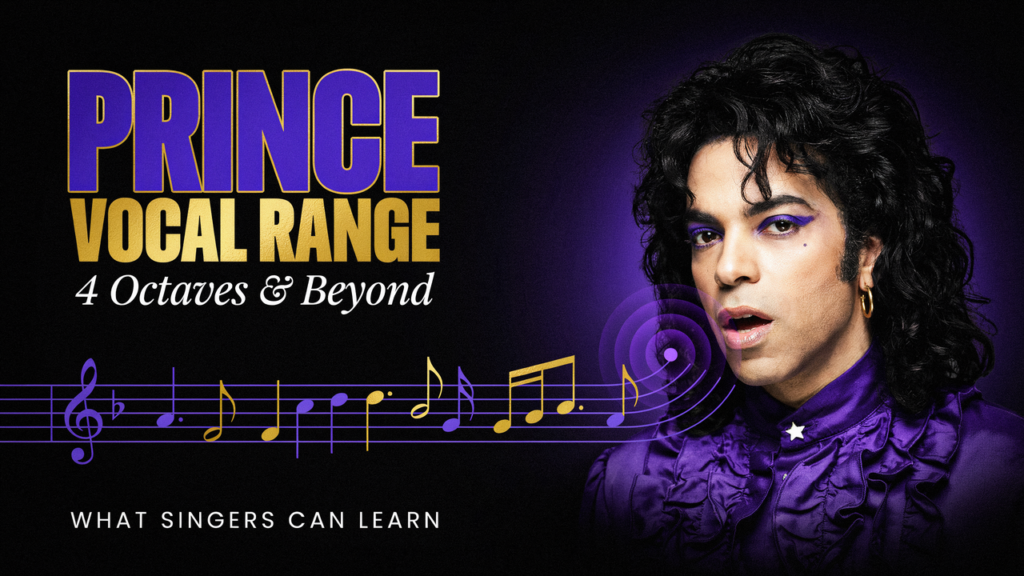
Prince’s vocal range is most commonly reported as approximately E2 to B6, spanning four octaves and seven semitones. A more conservative catalog of clearly identifiable song pitches places his range around E2 to A♯5, while fan-led analyses claim wider extremes extending from A1 to C7.
The difference comes from what each analysis counts. Prince used chest voice, falsetto, vocal fry, screams, layered studio vocals, and whistle-like effects. His repeatable musical range was narrower than every sound he produced, but his ability to move between registers made his voice exceptionally versatile.
What Was Prince’s Vocal Range?
Prince’s commonly cited E2–B6 range covers 55 semitones, equivalent to four octaves and seven semitones. That estimate includes upper-register pitches rather than representing a range sung entirely in chest voice.
A useful way to interpret the available evidence is:
| Range category | Approximate notes | Octave span | Evidence status |
|---|---|---|---|
| Conservatively cataloged song range | E2–A♯5 | 3 octaves, 6 semitones | Supported by identifiable song pitches |
| Commonly reported full range | E2–B6 | 4 octaves, 7 semitones | Widely cited but source-dependent |
| Wider fan-documented extremes | A1–C7 | 5 octaves, 3 semitones | Depends on counting fry, effects, and unusual sounds |
| Primary singing area | Approximately middle-low through upper-middle register | Not a fixed boundary | More representative of regular musical use |
These ranges should not be treated as interchangeable. A brief extreme, a studio layer, and a sustained lead-vocal note provide different kinds of evidence.
Prince’s Lowest and Highest Notes
The lowest note regularly used in conservative estimates is E2. This pitch has been associated with “Beautiful, Loved and Blessed,” although Prince’s catalog contains other moments of unusually low production.
Claims extending below E2 include C2 and A1. Those pitches may involve vocal fry, a brief effect, or a sound whose status as a clearly sustained sung note is debatable. They demonstrate Prince’s ability to produce very low frequencies, but they do not establish an A1 tessitura.
The highest boundary is even more disputed. A♯5 provides a conservative high point associated with “Adore,” while B6 appears in the frequently cited E2–B6 estimate. Some analyses extend the range to C7 or C♯7 and connect the extreme upper area with “God” or other high vocal effects.
Such sixth- and seventh-octave pitches require careful classification. They may be extremely light falsetto, whistle-like phonation, screams, or short studio sounds. Calling all of them conventional sung notes would exaggerate how Prince normally used his voice.
How Many Octaves Could Prince Sing?
Prince could sing more than four octaves if the commonly reported E2–B6 boundaries are accepted. The exact calculation is four octaves and seven semitones—not five complete octaves.
The conservative E2–A♯5 span covers three octaves and six semitones. The much wider A1–C7 claim covers five octaves and three semitones, but that figure depends on including disputed extremes.
Prince therefore had a demonstrably broad range regardless of which defensible boundaries are selected. However, the difference between “more than four octaves” and “more than five octaves” is primarily a difference in evidence standards.
Readers can see how his reported span compares with other unusually broad voices in the guide to the widest vocal ranges.
Was Prince a Tenor or Baritone?
Prince is usually described as a tenor with an unusually developed falsetto and a warm lower extension. His ability to sing low notes sometimes leads listeners to call him a baritone, but isolated low pitches do not determine voice type.
Voice classification also considers tessitura, vocal weight, timbre, register transitions, and the area in which a singer can sustain complete phrases. Prince regularly used a bright, flexible upper register and moved into falsetto as an essential part of his style. Those characteristics make tenor the more practical contemporary classification.
This should not be confused with assigning Prince a formal operatic Fach. His music used amplified contemporary techniques, deliberate tonal effects, and studio production that do not map neatly onto classical categories. The guide to tenor voices explains the broader classification without implying that every tenor has the same tone or upper limit.
Chest Voice, Falsetto and Vocal Effects
Prince’s real vocal strength was not simply reaching distant notes. It was changing registers rapidly while preserving rhythm, expression, and character.
His lower and middle register could sound intimate, dark, conversational, or forceful. In songs such as “Purple Rain,” the lower phrases help create contrast before the performance expands into more intense upper singing.
Falsetto was one of his defining tools rather than an occasional effect. Prince used it for softness, sensuality, tension, theatricality, and rhythmic emphasis. “Kiss,” “Adore,” and “Do Me, Baby” demonstrate different ways of using a lighter upper-register sound.
Prince also employed screams, rasp, breathiness, and speech-like production. These colors can create the impression of an even larger range, but they should be classified separately when identifying precise sung boundaries.
His register flexibility invites comparison with Stevie Wonder’s vocal range, while the prominence of high male falsetto provides a useful connection to Justin Timberlake’s vocal profile.
Songs That Demonstrate Prince’s Range
No single song captures every part of Prince’s voice, but several recordings reveal different aspects of his range:
- “Beautiful, Loved and Blessed” is associated with the conservatively documented E2 lower boundary.
- “Adore” demonstrates sustained upper-register singing and is associated with an A♯5 high.
- “Purple Rain” highlights the movement from controlled, relatively low phrases to emotionally intense upper singing.
- “International Lover” contrasts deeper production with falsetto and dramatic vocal effects.
- “Kiss” shows how Prince could build an entire performance around an agile, rhythmically precise falsetto.
- “Damn U” displays transitions between a lighter high register and a warmer lower sound.
- “God” is often mentioned in discussions of his extreme upper effects, although the exact highest-note classification remains disputed.
This combination of low notes, upper-register agility, and expressive contrast distinguishes Prince from singers whose reputations rest mainly on belting or isolated high notes. Similar versatility across style and color appears in David Bowie’s vocal range, though the two singers used their registers differently.
Prince’s Usable Range Mattered More Than His Extremes
Prince’s most important ability was making register changes serve the song. A five-octave claim may attract attention, but it reveals less about his musicianship than his control of tone, dynamics, articulation, and phrasing.
His falsetto could sound delicate in one phrase and sharply rhythmic in another. His middle register could move from speech-like intimacy to a cutting rock sound. His lower notes supplied color and contrast without defining his entire voice.
That versatility also explains why Prince’s songs can be difficult to reproduce. A singer may reach the written notes yet struggle with the quick shifts in vocal weight, tone, timing, and intensity. George Michael’s vocal range offers another example of how phrasing and register control can matter as much as total span, while Adam Lambert’s range provides a contrasting approach to powerful upper-register singing.
To examine your own likely classification separately from your extreme notes, try the voice type test.
Frequently Asked Questions
What was Prince’s vocal range?
Prince’s range is commonly reported as E2–B6, spanning four octaves and seven semitones. A conservative song-based estimate is approximately E2–A♯5.
Did Prince have a five-octave vocal range?
Possibly, if disputed extreme sounds below E2 and above B6 are included. The better-supported commonly reported range is slightly less than five octaves.
What was Prince’s lowest note?
E2 is a conservative documented low associated with identifiable song material. Claims of C2 or A1 exist, but they may involve fry or brief vocal effects.
What was Prince’s highest note?
B6 is frequently cited as Prince’s upper boundary. Claims of C7 or C♯7 also circulate, but the precise recordings and vocal-production categories are disputed.
Was Prince a tenor?
Prince is most reasonably described as a contemporary tenor with a warm lower extension and highly developed falsetto. His lowest isolated notes do not automatically make him a baritone.
Did Prince use whistle register?
Prince produced very high whistle-like and falsetto-based effects, but labeling every extreme pitch as traditional whistle register is not sufficiently supported. Falsetto is the clearer description for much of his familiar upper-register singing.

Harlow is a vocal analysis and singing tools writer at Voice Range Test. She focuses on vocal range testing, voice type analysis, pitch recognition, and singing education tools for singers, musicians, choir performers, and beginners.