
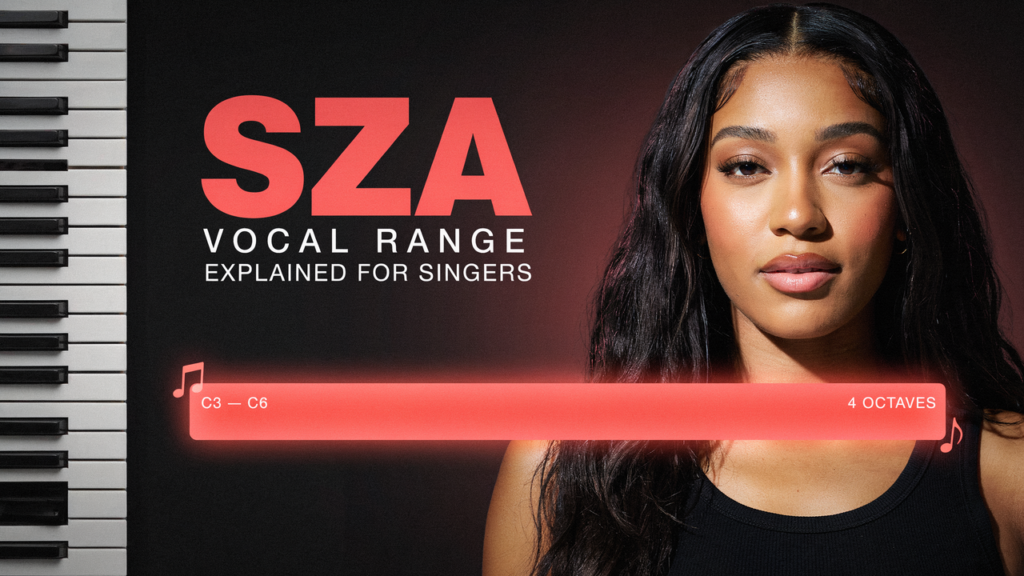
SZA’s vocal range is the span of notes she can sing from her lowest usable tones to her highest sustained pitches, including chest voice, mix, and lighter head-voice colors. Most listeners notice her range because she combines soft dynamics, breathy tone, and expressive runs—often making moderate notes sound emotionally huge.
If you want the singer-friendly takeaway: SZA isn’t just “high” or “low.” She’s a master of tessitura control, register blending, and soft singing that still stays on pitch.
If you want to compare your voice to hers accurately, start with a vocal range calculator so you’re working with real notes, not vibes.
What Makes SZA’s Range Feel So Wide?
Some singers have a big range on paper but don’t use it musically.
SZA is the opposite: even when she’s not singing extreme notes, she creates the illusion of wide range by moving between colors—chest, mix, airy head voice, and vocal fry.
Her style is like a painter who doesn’t just use more colors… she uses more brush strokes.
The three ingredients behind her “range effect”
- She shifts registers smoothly, so you hear contrast.
- She sings softly but stays expressive, so you lean in.
- She uses runs and pitch slides, which makes the voice feel more flexible.
A lot of singers try to copy her breathy tone first. That’s usually the wrong order. You want the coordination first, then the style.
If you’re unsure where your voice sits, try the range finder tool.
Voice Type: Is SZA an Alto, Mezzo-Soprano, or Soprano?
In pop and R&B, voice types aren’t as strict as classical categories.
SZA is often described as alto-leaning mezzo-soprano. That means she has:
- warmth and depth in the lower middle voice
- a comfortable mid-range tessitura
- access to lighter higher notes when she shifts coordination
If you’re learning voice categories, it helps to start with the broad map in female vocal ranges and then refine from there.
Why people argue about her voice type
Because SZA uses a lot of breathy head voice and light mix.
To many ears, that reads as “soprano.” But voice type is not defined by your lightest high notes. It’s defined by where you can sing consistently with tone, stability, and ease.
Range vs Tessitura: The Part That Actually Matters
Range is the total span of notes you can reach.
Tessitura is the part you can live in without fatigue.
SZA’s music often sits in a mid-range sweet spot where she can deliver lyrics with intimacy and control. That’s why she sounds effortless even when the melody is tricky.
If you want a clean explanation of this concept, what tessitura means is one of the most useful things you can learn as a singer.
A practical example
Think of your voice like a house.
- Your range is the entire house.
- Your tessitura is the room you can comfortably hang out in for hours.
SZA’s songs are written for that “main room,” and then she decorates it with higher colors and lower accents.
How SZA Uses Registers (Without Making It Obvious)
SZA’s sound is built on register management.
If you don’t understand registers, her singing can feel mysterious. Once you do, it becomes trainable.
Chest voice (low and grounded)
She uses chest voice for:
- warmth
- intimacy
- conversational tone
But she doesn’t “push down” for low notes. The low tones stay relaxed.
Mix (the core of her power)
Her mix is rarely a loud belt.
It’s more like a firm speaking voice that can rise in pitch without turning into shouting.
Head voice (the airy shimmer)
This is where her signature softness lives.
But here’s the key: soft does not mean unsupported. If you try to sing airy without support, you’ll go flat and get tired fast.
Vocal fry (used as texture, not technique)
SZA uses fry for emotional punctuation.
It’s like adding gravel to a line of dialogue—not a full-time setting.
SZA’s Vocal Range: The Singer-Friendly Way to Think About It
Because recordings vary and studio choices can exaggerate extremes, the smartest way to study her range is by function:
- What does she do in her low range?
- What does she do in her mid range?
- What does she do in her high range?
That’s how you actually learn to sing her songs.
If you’re unsure how to read note names like C4 or F5, vocal range notes makes the whole system simple.
A range-by-function table (more useful than one number)
| Zone | What it feels like | What SZA uses it for |
|---|---|---|
| Low range | warm, intimate | grounded lyrics, mood |
| Mid range | stable, speech-like | most melodies and phrasing |
| Upper mid | brighter, emotional | climactic phrases |
| High light | airy, floating | color, softness, contrast |
This is the reason many singers struggle with SZA songs: they try to “belt” the upper mid when the style needs a lighter mix.
Step-by-Step: How to Sing SZA Songs Without Straining
If you want to sing SZA well, you need two skills:
- soft singing that stays stable
- smooth register shifts
Below is a training approach I’d give a student in a lesson.
Step 1: Measure your range and pick keys that fit you
Don’t guess.
Use a voice type test as a starting point, then verify with your own range measurements.
If a song sits too high for your current coordination, you’ll squeeze. If it sits too low, you’ll darken and swallow the sound.
Step 2: Build pitch stability at low volume
This is where SZA’s style exposes weaknesses.
A lot of singers can sing in tune when loud, but drift when soft.
To fix that, do a daily check with a pitch accuracy test at a quiet volume.
Your goal is to stay accurate without pushing.
Step 3: Learn “supported softness”
Soft singing is not weak singing.
Supported softness feels like:
- steady breath pressure
- open throat
- minimal jaw tension
- the sound stays forward
Imagine a laser pointer, not a flashlight.
Same energy, more focus.
Step 4: Train clean register transitions
SZA shifts registers often.
If you “flip” suddenly, it sounds like a crack. If you avoid shifting, you push.
You want a smooth change, like shifting gears in a car without jerking.
Step 5: Add runs only after the notes are stable
Runs are not random.
They’re controlled note choices with timing.
If the base pitch is unstable, runs become messy and your throat tightens trying to “save it.”
A 12-Minute Practice Routine for SZA-Style Singing
This is a simple routine you can do 4–6 days per week.
If your voice feels sore, scratchy, or hoarse, stop and rest. Progress should feel gradual and recoverable.
Numbered routine
- Lip trill slides (2 minutes) from mid range up and down
- “NG” hum (2 minutes) to wake up head voice gently
- 5-tone scales on “NEH” (3 minutes) for forward resonance
- Octave patterns on “NOO” (3 minutes) for smooth register shifts
- One chorus practice (2 minutes) at 70% volume, focusing on pitch
If you want more range-building drills, use vocal exercises to increase range and keep them gentle.
The One Bullet List: What to Focus on When Covering SZA
If you only remember one checklist, make it this:
- Stay accurate at low volume
- Keep vowels small and focused as you go higher
- Let the register shift happen instead of fighting it
- Don’t overdo breathiness (it can tire your voice)
- Use emotion through phrasing, not just high notes
- Choose a key that matches your tessitura
- Practice runs slowly like scales, not like decoration
Quick Self-Check: Are You Singing This Style Safely?
This takes about 60 seconds.
Green flags
- your high notes feel lighter, not heavier
- you can sing softly without going flat
- your throat feels neutral after practice
- your voice feels normal the next morning
Yellow flags
- you need extra air to “make it sound breathy”
- your jaw locks on higher notes
- your tongue pulls back
- you lose pitch when you go quiet
Red flags
- pain
- persistent hoarseness
- burning sensation in the throat
- losing notes you normally have
If you hit red flags, stop and reset. A healthy voice improves over weeks, not in one session.
Common Mistakes When Trying to Sing Like SZA
This is where most singers accidentally hurt themselves or plateau.
Mistake 1: Forcing breathiness
Breathy tone is a stylistic color.
If you force it, you leak too much air, and the vocal folds work harder to stay together. That’s fatigue territory.
Mistake 2: Belting the upper mid like a pop anthem
SZA’s climaxes are often emotional, not loud.
Many singers push volume to “match the intensity,” but the style needs controlled mix and resonance.
Mistake 3: Ignoring tessitura and singing everything in the original key
Your voice is not her voice.
Even if you have the notes, your comfort zone might be different. If the song lives above your tessitura, it will feel tense.
If you want a reference for where your voice sits, a vocal range chart makes it easy to see.
Mistake 4: Doing runs without rhythm
Runs are musical.
If they’re not locked to the beat, they sound messy and you’ll tense up trying to control them.
Mistake 5: Training high notes with max volume
Loud high notes build the wrong habit for this style.
Train high notes at medium volume first. Then add intensity later.
Realistic Expectations: What You Can Improve (And How Fast)
Most singers can improve their usable range by a few notes in a month if they practice consistently and safely.
The bigger improvement—especially for SZA-style singing—is not the range itself.
It’s the ability to:
- sing quietly and stay in tune
- blend registers without cracks
- control tone without throat tension
That’s a real skill set. And it’s learnable.
If you want a structured path for expanding range without forcing, follow extend your vocal range safely and track progress weekly, not daily.
FAQs
1) What is SZA’s vocal range?
SZA’s range is typically described as an alto-leaning mezzo-soprano range, with strong mid-range control and access to light higher notes. Exact note values vary depending on the song, recording, and what counts as sustained singing. The most useful takeaway is that she uses registers and tone colors to make her range feel bigger.
2) Is SZA an alto or mezzo-soprano?
Most singer-focused classifications place her closer to a mezzo-soprano with an alto-leaning tone. She often sounds warm and grounded in the lower middle voice, which makes people call her an alto. In pop, these labels overlap, so tessitura matters more than the name.
3) How many octaves can SZA sing?
Different sources report different octave counts because they measure differently. Some include quick ad-libs or very light tones, while others count only sustained notes. For singers, your goal shouldn’t be to match her octave number—it should be to build a stable, usable range.
4) Does SZA use head voice or falsetto?
She uses a lighter register that many listeners call falsetto, but in female voices it’s more accurate to think in terms of head voice coordination. The key is that she blends it smoothly with her mid voice. That’s why her transitions sound emotional instead of “flippy.”
5) Why does SZA sing so breathy?
Breathiness is a stylistic choice that creates intimacy and vulnerability. It also works well with close microphone technique and layered production. If you try to copy it, do it lightly—too much breathiness can fatigue your voice.
6) Can beginners sing SZA songs?
Yes, but choose songs and keys that sit in your comfortable range. Many beginners struggle because the melodies require pitch control at low volume. Start by practicing softly with stable pitch before adding runs and stylistic breathiness.
7) How can I sing SZA-style softly without going flat?
You need steady breath pressure and focused resonance, not extra air. Practice singing quiet notes while keeping the tone forward and the vowel slightly smaller. If you drift flat, reduce breathiness and aim for a clearer, more centered sound first.