
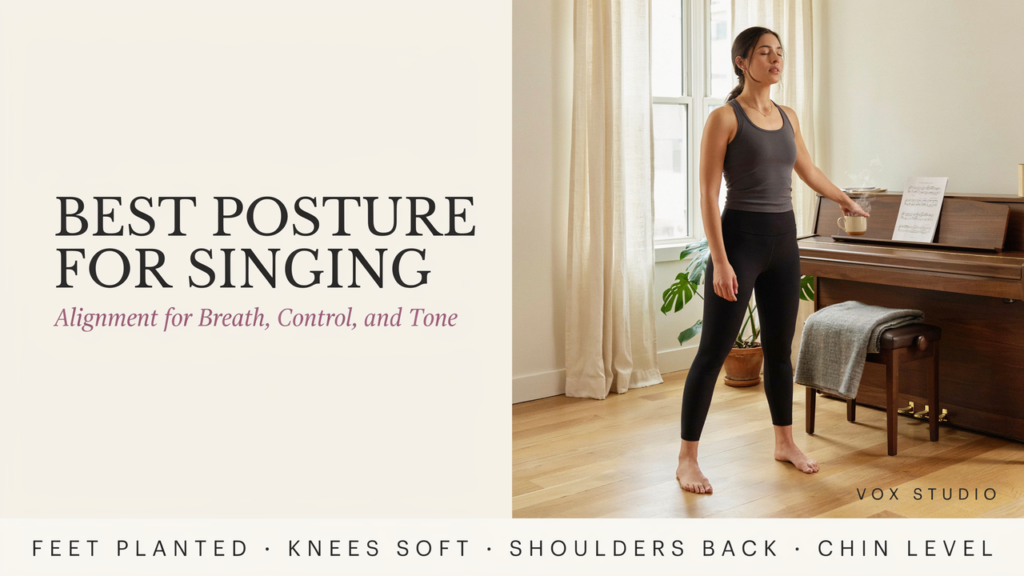
Good posture for singing isn’t about standing military-straight or looking “proper.” It’s about aligning your spine, ribs, and head so your diaphragm can move freely, your ribs can expand in all directions, and your breath supports your voice without tension. When that alignment clicks, everything gets easier: your tone improves, breath control stabilizes, and neck tension drops.
The reason is mechanical, not mysterious. Your diaphragm—the muscle that powers breathing—works best when there’s space for it to descend. Slouching, locked knees, or forward head posture collapse that space. Your body then compensates with accessory muscles in your neck and shoulders, creating tension that chokes your sound before it even starts. Fix the posture, and the tension often vanishes without any other intervention.
Even trained singers benefit from posture awareness. A 2025 study using motion-capture technology found that skilled singers maintained consistent voice output across different body positions—but that same research noted that posture adjustment has the greatest effect on singers with tension patterns or less-developed technique. If you’re struggling with neck tension, breath control, or tone quality, posture is one of the highest-leverage places to start.
The Foundation: Foot Position and Core Alignment
Posture starts from the ground. Your feet position controls everything above them.
Stand with your feet hip-width apart (roughly the distance between your hipbones). One foot can be slightly forward for comfort and stability, but both should feel grounded and weighted evenly—not on your heels, not on your toes. Your knees should be soft and slightly bent, not locked. When knees lock, your hips freeze, your ribcage can’t expand, and your diaphragm loses the space it needs.
Think of your legs like tiny springs, not rigid poles. Imagine a string attached to the top of your head, gently pulling you upward—not yanking, just creating length through your spine. That mental image helps most singers find the balance between tall and relaxed.
Your pelvis sits neutral, not tilted forward or back. There’s natural space between the bottom of your ribs and your waistline. This space is essential: when your pelvis tucks under or tilts forward excessively, your lower back flattens and your abdominal muscles can’t engage to support breathing.
The Spine: Keep Its Natural Curves
Your spine has natural curves—a gentle arch in your lower back (lumbar), a slight rounding in your mid-back (thoracic), and a gentle curve in your neck (cervical). Good posture preserves these curves; it doesn’t flatten them out.
The thoracic spine—your mid-back region—matters most for singing because it’s the anchor for your ribcage. When this area moves well and maintains healthy alignment, your ribs can expand in three directions: front, back, and sides. That complete three-dimensional expansion is what gives your diaphragm the room to descend fully. Without it, breathing becomes shallow and restricted.
If you spend hours slouched at a desk or looking down at your phone, your thoracic spine gets stiff and rounds forward. Your ribcage can’t expand properly, and you shift to shallow upper-chest breathing. Your neck and shoulders then recruit as backup breathing muscles, creating the tension that makes singing feel effortful. This is why posture work often needs to come before—or alongside—breath exercises.
To restore thoracic mobility, stand tall against a wall: your heels, hips, and shoulders should touch the wall. Your head should align with the wall too, though your natural neck curve means your head won’t touch. This position shows what neutral alignment feels like.
The Ribcage: Unlock Its Movement
Your ribcage needs freedom to expand and settle with each breath. Many singers keep their ribs chronically collapsed or overly lifted, limiting their breathing space.
Keep your shoulders relaxed and slightly back, not squeezed back. Raised shoulders feel like “good effort,” but they’re a tension trap—they choke your tone at the start and increase fatigue. When shoulders lift, your neck tightens, your ribs can’t expand, and breath gets shallow.
Your shoulders should sit directly above your hips when standing upright. There should be space between your ribs and your waistline—not exaggerated, just natural. Avoid collapsing your ribcage forward or sticking it out artificially.
When you breathe in, feel your ribs expand gently in all directions: front (your chest lifts slightly), back (your back ribs spread), and sides (your sides widen). This isn’t something you force; it’s what happens when your spine, ribs, and diaphragm are aligned and free to move.
The Head and Neck: Avoid Forward Posture
Forward head posture—where your head juts forward instead of stacking over your shoulders—is one of the most common postural problems singers develop. It comes from:
- Looking down at sheet music or lyrics
- Leaning toward a microphone
- Slouching during rehearsal
- Spending the day in a collapsed desk posture, then coming straight to sing
When your head moves forward, it places your entire neck and throat under tension. Your larynx and all the surrounding structures compress. Tension spreads down through your shoulders and chest, restricting breathing and creating resistance that your voice has to push against.
To find neutral head alignment: stack your head evenly over your spine with a gentle chin tuck (not an exaggerated tuck that feels strained). Soften your gaze forward with your eyes level to the horizon, not looking up or down. Feel the back of your neck lengthening toward the ceiling—this sensation means you’re creating space rather than compressing.
Imagine ears over shoulders, shoulders over hips. When that stacking is vertical, your neck airway stays open and unobstructed. This simple alignment change often reduces throat tension dramatically, even without other interventions.
Seated Posture
If you’re singing seated—at a piano, in rehearsal, or on stage—the same principles apply. Your spine should stay tall and maintain its natural curves. Avoid slouching into the chair or leaning forward. Your ribcage should stay open, not collapsed.
Sit toward the front of the chair, not sunk into the back. Your feet can be flat on the floor with knees at roughly a right angle. Keep the same tall-spine, relaxed-shoulders alignment as standing. The difference is your lower body stability comes from the chair rather than your legs, but your upper-body posture remains identical.
Many singers tighten and collapse forward when sitting, especially if focusing intently on music or a conductor. Periodically reset: straighten your spine, drop your shoulders, breathe into your ribs, and reset your head alignment.
What Locked Knees Actually Do
It’s worth understanding why knee position matters so much, since it’s easy to overlook. When you lock your knees:
- Your hip joints freeze
- Your pelvis can’t maintain neutral alignment
- Your abdominal muscles disengage
- Your ribcage collapses
- Your diaphragm loses the space it needs to descend
- Breathing becomes shallow and upper-chest dominated
- Your neck and shoulders compensate, creating tension
It happens without conscious effort—most singers lock knees when they’re nervous or concentrating hard. But the impact on breath and tone is immediate. Once you unlock them and soften your knees, that space returns. Your diaphragm can work, your ribs can expand, and your breath supports your voice without effort.
Posture and Breath Support
Posture and breath are inseparable. When your body is aligned, your breathing mechanics work efficiently. When you’re out of alignment, breathing becomes restricted.
Good breathing isn’t about taking bigger breaths or forcing air down into your belly—it’s about creating space and getting out of your own way. When your spine is tall, your ribs can move freely, and your head sits over your shoulders without tension, your diaphragm descends naturally on the inhale and rises naturally on the exhale. Airflow moves smoothly and steadily.
This is why breath-support exercises sometimes don’t work as well as they should—if your posture is collapsed, no amount of breathing drills will fully solve the problem. The foundation has to be right first. Start with posture. Then layer in breathing techniques for singing exercises, and you’ll feel the difference immediately. Once your posture and breath are solid, adding structured vocal exercises to increase range becomes much more effective.
How Posture Affects Tone and Resonance
Posture influences where your voice resonates. When your spine is tall, your throat is open, and your ribcage is free to move, sound travels upward without obstruction. The voice resonates in your pharynx (throat), mouth, and head cavities instead of getting stuck and muffled in your chest or throat.
This is why singers often notice their tone suddenly sounds clearer, richer, and more powerful after fixing posture—it’s not because the sound is “bigger,” but because it’s resonating more efficiently. Tension-free alignment allows overtones to flourish, giving your voice warmth and projection without extra effort.
Additionally, good posture reduces the effort required to produce tone. When you’re aligned, your vocal folds vibrate more freely, your breath flows with less resistance, and you need less muscular force to create the same volume. Over a long rehearsal or performance, that efficiency translates to less fatigue. This reduced effort is especially important when working on techniques like vibrato, which relies on relaxed, efficient phonation.
Checking Your Posture: Simple Tests
Use a mirror or video recording. Stand or sit in your singing position and check:
Vertical stacking: Are your ears over your shoulders, shoulders over hips? If your head juts forward or your shoulders cave in, that’s misalignment to address. Forward head posture particularly affects pitch accuracy and breath control, so fixing it has immediate payoff for improving pitch accuracy.
Spine curves: Does your back maintain its natural S-curve, or is it flat or overly arched? A flat or collapsed spine limits ribcage movement.
Ribcage: Are your ribs lifted and tense, or open and relaxed? Can you see space between your ribs and waistline?
Knees: Are they locked and rigid, or soft and slightly bent? Locked knees collapse your breathing space.
Shoulders: Are they raised toward your ears (tension), or relaxed and slightly back? Raised shoulders limit breath.
Neck: Is your head forward, or stacked over your spine? Forward head posture creates throat tension.
If you see misalignment in the mirror, reset one area at a time. Start with feet, then move to knees, pelvis, spine, ribcage, shoulders, and finally head. Do this before every practice session or performance. It takes 30 seconds and prevents a cascade of compensation patterns.
Building the Habit
Good posture doesn’t stick overnight. Your body has muscle memory from years of sitting at desks, looking at phones, or standing casually. Conscious posture awareness takes weeks to become automatic.
Practice standing or sitting in correct alignment for 2-3 minutes before every singing session. Walk around while maintaining it. Record yourself singing and watch the video—you’ll see patterns (head drifting forward, shoulders rising during high notes, ribcage collapsing) that you didn’t notice while singing.
Many singers find it helpful to place a mirror where they can see themselves during warm-ups or practice. When your brain sees the alignment, your body learns to replicate it. After several weeks, good posture starts feeling natural rather than effortful.
Posture and Tension Release
If you carry chronic neck or shoulder tension, posture is often where to start. Tension that feels “stuck” often disappears once postural alignment improves, because the muscles are no longer being pulled into compensation mode. A forward head posture or collapsed ribcage forces your neck and shoulders to work as backup breathing muscles, creating the exact tension you’re trying to eliminate.
You may also benefit from gentle stretching: neck rolls (slow and controlled, not full circles), shoulder shrugs and releases, and side-to-side spinal twists. But stretching is most effective once your posture baseline is correct—stretching a tense neck while your head is still forward is like trying to fix the symptom instead of the cause.
For more on how posture connects to overall vocal control techniques, which relies on relaxed mechanics, see that guide. Understanding how posture, breath, and vocal control interconnect helps you address tension at the source.
Posture Across Different Singing Styles
Classical and opera singers typically maintain more formal, upright posture to maximize resonance and projection. Pop and contemporary singers may use slightly more relaxed, forward-leaning postures during performance, but the alignment principles remain the same—spine tall, ribcage open, head over shoulders, knees soft.
The key is that alignment principles don’t change, only the stylistic expression. A pop singer can be relaxed and contemporary while still maintaining the postural mechanics that support breath and vocal freedom.
FAQ
Can bad posture actually damage my voice? Bad posture creates tension and restricts breathing, making vocal fatigue more likely and limiting your range and tone quality. Chronic tension can contribute to voice strain over time, though posture alone doesn’t cause permanent damage. The relationship is more: poor posture makes bad technique more likely, and bad technique practiced over years can eventually create injury. Fix posture early and you prevent this cascade.
How long until I feel a difference? Many singers notice improved breath support and reduced neck tension within the first practice session after correcting posture. More significant changes in tone quality and stamina show up after 2-3 weeks of consistent awareness. It’s one of the fastest-payoff technique improvements.
Does posture matter if I’m sitting down? Yes. The same alignment principles apply whether you’re standing or sitting. Spine tall, ribcage open, head over shoulders, knees relaxed (or at a right angle if seated). The primary difference is your lower-body stability comes from the chair, not your legs.
What if I have back pain or mobility issues? Posture awareness is still valuable, but work within your range of comfortable movement. A slightly less-upright posture that you can maintain comfortably is better than perfect posture that causes pain. If you have chronic back pain or mobility restrictions, physical therapy or a qualified vocal coach can help you adapt these principles to your body.
Should I always sing with perfect posture? Yes, during practice and performance. But during everyday life, perfect posture isn’t necessary or realistic. The goal is to build the habit of good postural alignment when you’re actively singing or warming up, so it becomes your default. Over time, better posture in general feels more natural, but the conscious focus applies mainly to singing contexts.
Does posture affect vocal range? Indirectly, yes. Good posture supports breath control and reduces tension, both of which make accessing your full range easier. You don’t gain actual range from posture alone, but you unlock more of the range you already have by removing mechanical restrictions. When working on how to extend your vocal range, posture is the foundation that makes range-expansion exercises effective.

Harlow is a vocal analysis and singing tools writer at Voice Range Test. She focuses on vocal range testing, voice type analysis, pitch recognition, and singing education tools for singers, musicians, choir performers, and beginners.