
If you’re searching for how to do whistle tones, you’re probably fascinated by those ultra-high, flute-like notes heard in some pop and R&B singing. Whistle tones sound impressive—but they’re also one of the most misunderstood and overhyped vocal effects.
This authority guide explains what whistle tones really are, who can (and can’t) produce them, how singers safely explore them, and why they’re not required for great singing.
Whistle tones are an advanced, optional vocal effect.
They happen only when the voice is already well coordinated, and they should never be forced.
If whistle tones don’t come naturally, that does not mean you’re lacking ability—or missing a skill you need.
Singers exploring advanced registers often benefit from understanding whether professional vocal coaching works.
What Are Whistle Tones in Singing?
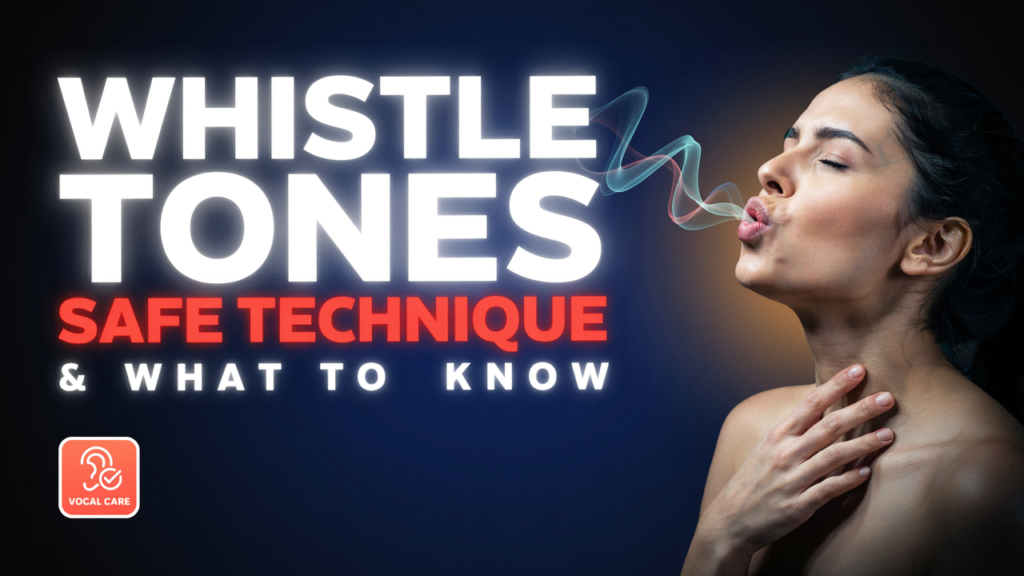
Whistle tones (also called the whistle register or flageolet) are extremely high pitches produced with a very small portion of the vocal folds vibrating. The sound is:
- Very thin
- Flute- or whistle-like
- Quiet compared to chest or head voice
- Hard to sustain
They are not the same as:
- Head voice
- Falsetto
- Vibrato
- “Just singing higher”
Whistle tones sit above head voice and falsetto.
How Whistle Tones Actually Work
In normal singing, most of the vocal folds vibrate together. In whistle tones:
- Only the very edges of the vocal folds vibrate
- Airflow is extremely precise
- Pressure must be minimal
- Any tension shuts the sound down immediately
This is why whistle tones:
- Feel unstable
- Can’t be pushed
- Often appear briefly, not consistently
They are a special configuration, not a stronger version of high notes.
Can Anyone Do Whistle Tones?
No—and that’s important to understand.
Whistle tones depend heavily on:
- Vocal fold anatomy
- Natural flexibility
- Neuromuscular coordination
Some singers can access them easily. Many never will—even with excellent technique. That’s normal.
Not being able to do whistle tones does not limit your vocal range, quality, or professional potential.
Reducing strain during experimentation is easier when supported by proper posture techniques for singing.
Why You Shouldn’t Chase Whistle Tones Early
Many singers try to learn whistle tones before their voice is ready. This often leads to:
- Throat tension
- Cracking or squeaking
- Breath pushing
- Fatigue or strain
Whistle tones are not a foundation skill. They sit at the very edge of vocal function and only work when everything else is already balanced.
What Needs to Be in Place Before Attempting Whistle Tones
Before even thinking about whistle tones, you should already have:
- A free, stable head voice
- Good breath control (no pushing)
- Low jaw, tongue, and neck tension
- Comfort singing high notes without strain
If high notes feel tight, whistle tones are not the next step.
Whistle Register vs Head Voice vs Falsetto
Understanding this prevents a lot of confusion.
- Head voice: Full, resonant high singing
- Falsetto: Light, airy, less closure
- Whistle register: Extremely small vibration area, flute-like
Trying to “push” head voice into whistle tones doesn’t work. They are functionally different.
How Whistle Tones Usually Appear (When They Do)
For singers who can access whistle tones, they usually:
- Appear accidentally at first
- Happen quietly, not loudly
- Occur on relaxed vowels
- Come and go unpredictably
They are discovered, not manufactured.
Safe Guidelines for Exploring Whistle Tones
This is not a step-by-step promise—because there is no guaranteed method—but these principles matter.
1. Never Push for Volume
Whistle tones are naturally soft. Loud attempts = strain.
2. Stay Well Within Comfort
The moment you feel throat effort, stop.
3. Avoid “Reaching Up”
Think light, not high. Reaching creates tension.
4. Keep Attempts Short
A few seconds at most. Whistle tones are not endurance sounds.
5. Stop at Any Discomfort
Pain, scratchiness, or fatigue means you’re pushing.
Why Voice Cracks Happen When Trying Whistle Tones
Cracks usually happen because:
- Air pressure is too high
- The larynx is tense
- The vocal folds can’t maintain the configuration
Cracking is a sign to back off, not push harder.
Are Whistle Tones Dangerous?
Whistle tones themselves are not inherently dangerous.
What is dangerous:
- Forcing them
- Practicing them excessively
- Using throat tension to “reach” them
Most vocal issues around whistle tones come from misuse, not the sound itself.
Do Whistle Tones Increase Vocal Range?
Not in any practical sense.
Whistle tones:
- Don’t expand usable singing range
- Aren’t used in most music
- Don’t improve tone or control elsewhere
They are a special effect, not a training tool.
Do You Need Whistle Tones to Be a Good Singer?
Absolutely not.
Many world-class singers:
- Never use whistle tones
- Have no access to them
- Build careers without them
Great singing depends on:
- Tone
- Control
- Expression
- Endurance
- Musicality
Whistle tones are optional decoration—nothing more.
Common Myths About Whistle Tones
“Everyone can learn whistle tones”
Anatomy matters a lot
“Whistle tones mean elite singing”
They’re not a measure of skill
“You should practice them to get better”
They don’t build core technique
When Whistle Tones Make Sense Artistically
In some styles, whistle tones are used:
- Sparingly
- As brief effects
- For stylistic color
They are never the backbone of a song—and shouldn’t be.
Key Takeaways
- Whistle tones are an advanced, optional effect
- Not everyone can produce them—and that’s normal
- They should never be forced
- They don’t define vocal ability
- Core technique matters far more
- Understanding extreme high notes starts with learning how the vocal cords function during advanced techniques.
- Many singers prepare for whistle tones by first working on safe vocal exercises to expand range.
- High-register discussions are clearer when compared against what a four-octave vocal range actually means.
- Managing comfort at the top of the range depends heavily on how tessitura affects vocal ease.
- Technique boundaries become clearer when contrasting whistle tones with how whistle voice is typically produced.

Harlow is a vocal analysis and singing tools writer at Voice Range Test. She focuses on vocal range testing, voice type analysis, pitch recognition, and singing education tools for singers, musicians, choir performers, and beginners.