
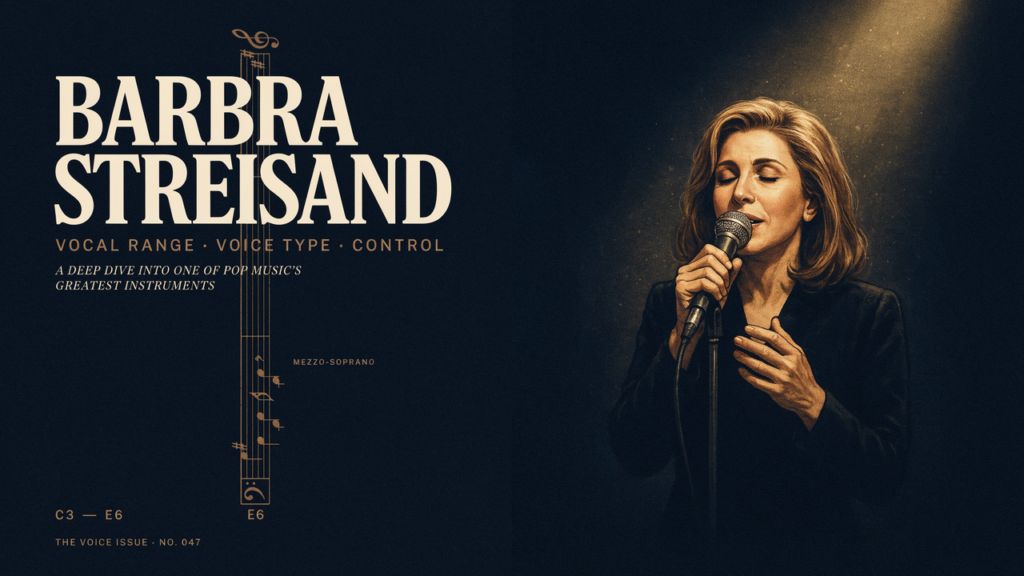
Barbra Streisand’s clearly traceable range across selected published songs is approximately D3 to A5, spanning two octaves and eight semitones. Broader vocal profiles commonly report a career range of around B2 to D6, or three octaves and two semitones, but those outer notes depend on which studio recordings, live performances, and vocal registers are counted.
Streisand is most reasonably described as a soprano with an unusually developed lower register, although mezzo-soprano is another common classification. Her importance as a singer comes from much more than extreme notes: precise breath control, seamless phrasing, clear diction, expressive dynamics, controlled vibrato, and a remarkable ability to interpret lyrics all define her sound.
Barbra Streisand’s Vocal Range at a Glance
| Vocal characteristic | Current assessment |
|---|---|
| Clearly traceable song range | Approximately D3–A5 |
| Selected-song span | 2 octaves and 8 semitones |
| Broader reported career range | Approximately B2–D6 |
| Broader reported span | 3 octaves and 2 semitones |
| Common voice classification | Soprano |
| Alternative classification | Mezzo-soprano |
| Functional center | Approximately G3–F5 |
| Signature strengths | Breath control, phrasing, diction and dynamic precision |
The D3–A5 estimate is the more conservative answer because both endpoints can be associated with published song material. The broader B2–D6 figure may reflect additional recordings, brief upper notes, early live performances, and different decisions about what counts as part of the range.
Neither measurement should be confused with tessitura. A singer’s total range includes outer pitches, while tessitura describes where the voice can remain comfortable and expressive through sustained musical passages.
What Are Barbra Streisand’s Lowest and Highest Notes?
D3 is a clearly documented lower pitch in published material for “No Matter What Happens.” The song also extends upward substantially, demonstrating that Streisand’s lower register is part of a connected singing voice rather than an isolated low effect.
A5 appears in “I Finally Found Someone,” providing a defensible upper endpoint in selected song data. This gives Streisand a traceable D3–A5 span of 32 semitones.
Broader vocal profiles place her lowest note around B2 or B♭2 and her highest between C6 and E6. These claims are plausible within a long career containing studio albums, concerts, film performances, and classical material, but not every endpoint is documented with the same precision.
A responsible summary therefore separates the evidence:
| Range claim | Evidence status | Best interpretation |
|---|---|---|
| D3–A5 | Supported by selected published songs | Conservative documented song range |
| B2–D6 | Commonly reported across vocal profiles | Broad career estimate |
| B♭2–C6 | Associated with some early live analyses | Performance-dependent estimate |
| B2–E6 | Reported by some secondary sources | Requires stronger note-level evidence |
An extreme note should ideally be connected to a named recording, identified register, and clear lead-vocal moment. A brief head-voice pitch does not reveal the same ability as a sustained phrase, just as a momentary low note does not establish the singer’s regular tessitura.
Is Barbra Streisand a Soprano or Mezzo-Soprano?
Barbra Streisand is commonly classified as a soprano, sometimes more specifically as a lyric soprano. Her brilliant upper register, ability to sustain high melodic lines, and tonal clarity support that interpretation.
The mezzo-soprano label persists because her voice also has warmth, weight, and unusual authority in its lower and middle registers. Unlike a stereotypically light soprano, Streisand can bring substantial chest resonance into dramatic phrases without losing clarity.
The most practical description is a soprano with a strong lower extension and a rich, mezzo-like middle voice. This recognizes her upper-register abilities without ignoring the tonal depth that distinguishes her from lighter sopranos.
Assigning a precise classical fach would be less reliable. Most of Streisand’s career has involved amplified musical theatre, popular music, jazz, and film songs rather than unamplified operatic repertoire. Formal fach classification considers passaggio, tessitura, projection, vocal weight, and performance demands—not only range endpoints.
The guide to what a soprano voice is provides additional context. A broader overview of female vocal ranges also shows why soprano and mezzo-soprano categories naturally overlap.
Songs That Showcase Streisand’s Range
“No Matter What Happens” demonstrates lower-register depth alongside expansive melodic movement. It is useful for hearing how she connects darker low notes to a brighter upper voice.
“I Finally Found Someone,” recorded with Bryan Adams, contains some of her strongest published upper-range evidence. Its climactic passages require projection, register balance, and the ability to retain lyric clarity as intensity increases.
“Don’t Rain on My Parade” showcases theatrical drive rather than merely extreme pitch. The performance requires sustained energy, accurate articulation, controlled breath pacing, and increasingly intense upper-middle phrases.
“People” reveals the quality of Streisand’s legato. She connects notes and words into long musical ideas while shaping the volume inside individual phrases.
“The Way We Were” is less about range display and more about control. Its exposed lines require stable pitch, gradual dynamic changes, careful vibrato, and restrained emotional delivery.
“Evergreen” demonstrates smooth register connection and sustained phrasing. Streisand allows the melody to expand naturally without treating every high point as a separate vocal stunt.
“Memory” highlights her ability to build dramatic intensity through tone, diction, and breath management. The climax feels large because it grows from carefully controlled earlier phrases.
What Makes Barbra Streisand’s Technique Distinctive?
Streisand’s most important skills operate throughout complete phrases rather than only on high notes.
| Vocal skill | How it affects her singing |
|---|---|
| Breath control | Supports long phrases and gradual changes in volume |
| Dynamic shading | Allows a note to grow or diminish without losing focus |
| Clear diction | Keeps lyrics intelligible without interrupting legato |
| Vowel shaping | Helps maintain resonance through higher passages |
| Controlled vibrato | Adds movement without obscuring pitch |
| Register connection | Creates continuity between lower, middle and upper notes |
| Interpretive timing | Gives important words additional emotional weight |
Her sustained notes rarely remain emotionally static. She may begin softly, allow the tone to expand, alter the vibrato, and then taper the sound while preserving pitch. This internal movement makes a single note feel connected to the dramatic meaning of the lyric.
Streisand is also highly attentive to consonants. In less skilled singing, clear diction can make a phrase sound fragmented. She generally preserves the word while allowing the vowel to carry the musical line.
Her approach to interpretation is closely connected to acting. Instead of applying the same vocal color to every lyric, she changes timing, intensity, and tone according to the character’s emotional state.
Did Barbra Streisand Have Formal Vocal Training?
Streisand is widely known for saying that she did not follow a conventional path of sustained formal voice training. However, the absence of extensive traditional lessons does not mean her singing lacked technique.
Her recordings reveal sophisticated control of breath, resonance, diction, phrasing, and dynamics. Some singers develop these abilities through a mixture of instinct, close listening, performance experience, self-correction, and occasional professional guidance.
Her experience should not be treated as proof that training is unnecessary for everyone. Streisand possessed unusual natural coordination and developed her approach over decades of demanding professional work.
How Did Streisand’s Voice Change Over Time?
Streisand’s early recordings display a particularly bright, flexible upper register and fearless theatrical projection. Her Broadway-era performances often combined rapid articulation with sustained high-intensity phrases.
During the 1970s and 1980s, her singing frequently became smoother and more pop-oriented. The voice retained its clarity, but subtle dynamics and conversational phrasing became increasingly central.
In later recordings, the upper range naturally became less dominant, while interpretive detail, warmth, and tonal shading remained prominent. A singer’s current range should not be assumed to equal every note available decades earlier.
Changes across such a long career also make one fixed range number incomplete. A note available in an early live performance may not belong to the singer’s later comfortable range, even when the underlying musicianship remains strong.
How Streisand Compares with Other Singers
Idina Menzel’s vocal range provides a useful musical-theatre comparison. Both singers are known for dramatic climaxes, but Menzel often uses a more contemporary belt-dominant sound, while Streisand emphasizes classical line, detailed diction, and dynamic shading.
Kristin Chenoweth represents a lighter, more agile soprano approach with an especially bright upper extension. Streisand’s voice generally carries more weight through the middle and lower registers.
Streisand and Ella Fitzgerald both demonstrate exceptional phrasing, though they apply it differently. Fitzgerald’s rhythmic freedom and improvisation define much of her jazz singing, while Streisand often shapes phrases around theatrical character and narrative development.
Linda Ronstadt’s vocal profile offers another comparison across popular and traditional styles. Ronstadt was known for tonal power and stylistic versatility, while Streisand’s signature lies particularly in sustained-line control and dramatic interpretation.
These comparisons describe different vocal priorities rather than ranking one singer above another.
Frequently Asked Questions
How many octaves could Barbra Streisand sing?
Her conservative D3–A5 published-song range spans two octaves and eight semitones. The broader B2–D6 estimate covers three octaves and two semitones.
What was Barbra Streisand’s lowest note?
D3 is a clearly traceable lower note in selected published material. B2 and B♭2 are also reported, particularly in broader career and live-performance analyses.
What was Barbra Streisand’s highest note?
A5 is supported by published song data. Notes between C6 and E6 are reported by broader vocal profiles but require more specific recording and register context.
Is Barbra Streisand a soprano?
Yes, soprano is the most common practical classification. Her strong lower register and substantial middle voice also explain why some listeners describe her as a mezzo-soprano.
What is Barbra Streisand’s best vocal register?
Her middle and upper-middle registers are especially important because they combine warmth, textual clarity, carrying power, and dynamic control. Her best singing cannot be reduced to one highest register.
Why is Barbra Streisand considered a great singer?
She is celebrated for breath control, phrasing, diction, tonal consistency, dynamic precision, register connection, and her ability to communicate a lyric as dramatic thought.

Harlow is a vocal analysis and singing tools writer at Voice Range Test. She focuses on vocal range testing, voice type analysis, pitch recognition, and singing education tools for singers, musicians, choir performers, and beginners.