
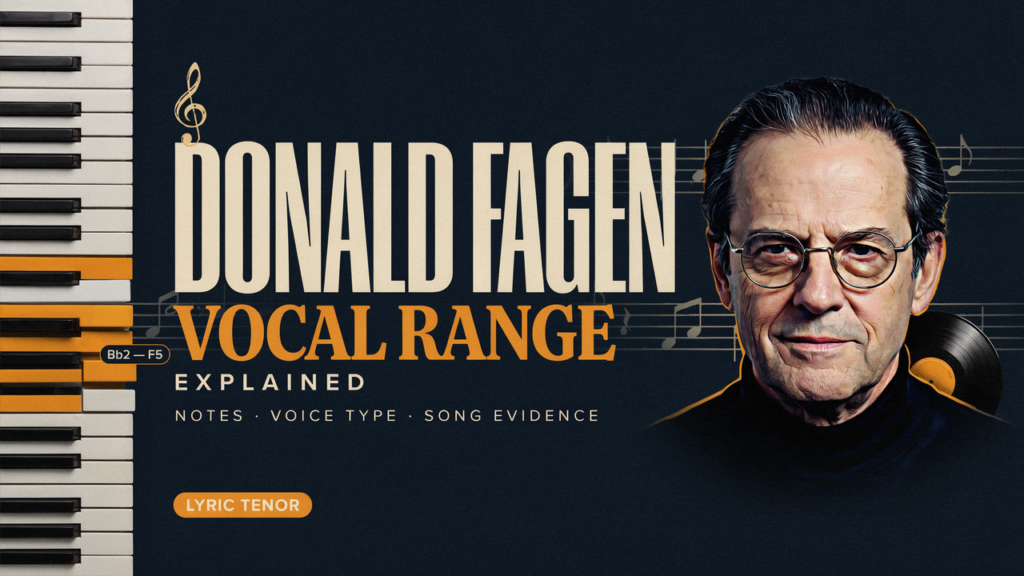
Donald Fagen’s exact vocal range has not been firmly established by a reliable public note-by-note analysis. His recordings show a midrange-centered male voice with both high-baritone and low-tenor qualities, plus a distinctive bright, nasal, rhythmically precise delivery.
That uncertainty is important. Fagen’s value as a singer is not based on the widest range or the highest note. His strength is phrasing inside complex harmony, clear articulation, conversational timing, and a tone that became inseparable from Steely Dan’s sound.
Donald Fagen Vocal Range at a Glance
| Category | Best practical assessment |
|---|---|
| Exact range | Not reliably documented in a traceable public source |
| Likely vocal area | Middle and upper-middle male range |
| Possible voice type | High baritone or low tenor in popular-music terms |
| Signature traits | Forward tone, precise rhythm, dry delivery, jazz phrasing |
| Main evidence issue | Steely Dan recordings include layers, backing vocals, and session singers |
The safest way to analyze Fagen is through usable tessitura and song evidence rather than a dramatic two-note range claim. If you need a refresher, tessitura explains why a singer’s working area can matter more than the outer extremes.
Why His Exact Range Is Hard to Confirm
Steely Dan recordings are beautifully produced, but that production makes vocal range analysis difficult. Many tracks include doubled vocals, harmony stacks, backing singers, and studio processing. Michael McDonald, David Palmer, Jim Hodder, Walter Becker, and session singers contributed vocals in different contexts.
Before counting a note as Fagen’s range, an analyst has to answer several questions:
- Is the sound definitely Donald Fagen’s lead vocal?
- Is it sung, spoken, doubled, or harmonized?
- Is it a sustained musical note or a passing inflection?
- Does the note appear in a studio track, live performance, or overdub?
- Is the pitch coming from a voice, instrument, or harmony blend?
Without that context, a precise octave number can create more confidence than the evidence deserves.
Is Donald Fagen a Tenor or Baritone?
Fagen is best described cautiously as a high baritone or low tenor in a popular-music context. His voice has a speech-like lower-middle area and a pointed upper-middle brightness, which is why listeners disagree.
A formal classical label is hard to assign from recordings alone. Voice type depends on vocal weight, tessitura, passaggio behavior, tone, and sustainable repertoire, not only pitch extremes. The tenor vs baritone guide explains why the boundary can be blurry for amplified popular singers.
Fagen’s forward and slightly nasal tone can also make the voice seem higher than the pitch range alone suggests. Tone color is not the same thing as voice type.
Song Evidence
| Song | What it shows | Why it matters |
|---|---|---|
| Deacon Blues | Sustained midrange phrasing | Shows control and narrative delivery |
| Peg | Bright, rhythmically locked lead vocal | Shows upper-middle clarity inside a dense groove |
| Hey Nineteen | Relaxed conversational delivery | Shows speech-like phrasing and lower-middle ease |
| I.G.Y. | Polished solo-era upper-middle singing | Shows cleaner, more open Fagen lead tone |
| New Frontier | Agile articulation and jazz-pop phrasing | Shows rhythmic precision rather than vocal display |
| The Nightfly | Narrative singing and controlled tone | Shows characteristic tessitura and style |
These songs reveal more about Fagen’s voice than an unsupported range number. They show how he phrases through complex chord changes, syncopation, and lyric-heavy melodies.
You can inspect individual notes with the pitch detector, but use judgment. Instruments, backing vocals, and harmonies can confuse automated pitch detection.
What Makes Donald Fagen’s Voice Distinctive?
Fagen’s voice is instantly recognizable because of its combination of musical precision and conversational dryness.
- Forward tone: a bright, focused quality often described as nasal.
- Clear consonants: lyrics remain sharp even in complex arrangements.
- Rhythmic placement: he sits tightly inside grooves and syncopations.
- Speech-like phrasing: lines often sound narrated as much as sung.
- Jazz influence: melodic turns interact closely with the harmony.
- Restrained vibrato: he usually favors character and timing over lush sustained tone.
This is why Fagen can be effective without sounding like a conventional powerhouse. His voice serves the writing, the groove, and the arrangement.
How He Compares With Similar Singers
Fagen can be compared with Billy Joel and Elton John because all three are keyboard-centered singer-songwriters whose voices changed across long careers. Joel and John often use broader emotional belting, while Fagen is more dry, clipped, and jazz-influenced.
He also shares some rhythmic and harmonic sophistication with Stevie Wonder, though Wonder’s voice is more elastic, soulful, and technically expansive. Fagen’s appeal is narrower but highly identifiable.
Range vs. Usable Voice
A singer’s total range can include isolated studio notes, backing parts, or brief inflections. Fagen’s usable voice is better understood through the notes and colors he repeats across full songs.
That usable range appears centered in the middle and upper-middle voice, where he can keep lyrics intelligible and rhythm precise. The exact lowest and highest notes matter less than how consistently he works in that area.
For singers covering Steely Dan material, the challenge is often not extreme range. It is matching the timing, diction, groove, and harmonic awareness without sounding stiff.
How Fagen’s Voice Changed Over Time
Early Steely Dan recordings often present a leaner, brighter Fagen sound. Solo-era tracks such as material from The Nightfly can sound more polished and assured. Later performances may feel rougher, heavier, or more economical.
These shifts can reflect age, touring demands, key choices, studio methods, and artistic preference. They do not prove one simple story of loss. Many singers adjust phrasing, keys, and intensity over long careers.
That long-career lens also helps when comparing Fagen with Paul McCartney, whose practical live voice also changed as repertoire, age, and performance context changed.
Best Songs for Hearing Donald Fagen’s Voice
- “Deacon Blues” for phrasing and control
- “Peg” for rhythmic accuracy and bright lead tone
- “Hey Nineteen” for conversational lower-middle delivery
- “I.G.Y.” for polished solo-era singing
- “New Frontier” for agile articulation
- “The Nightfly” for narrative vocal character
- “Aja” for singing inside a harmonically complex arrangement
Taken together, these tracks provide a stronger vocal profile than any single pitch range claim.
Frequently Asked Questions
What is Donald Fagen’s vocal range?
There is no reliable public note-by-note source that firmly establishes his exact lowest and highest notes. His recordings show a flexible midrange male voice.
Is Donald Fagen a tenor or baritone?
He is best described cautiously as high baritone or low tenor territory in popular-music terms.
Why does Donald Fagen’s voice sound nasal?
His tone has a forward, focused quality with clear consonants and speech-like phrasing. “Nasal” describes color, not voice type.
Did Donald Fagen sing every Steely Dan song?
No. He became the group’s most recognizable lead singer, but other vocalists also sang lead or backing parts on different tracks.
Are Steely Dan songs hard to sing?
Often, yes. The difficulty is less about extreme range and more about rhythmic precision, harmony, diction, and phrasing.

Harlow is a vocal analysis and singing tools writer at Voice Range Test. She focuses on vocal range testing, voice type analysis, pitch recognition, and singing education tools for singers, musicians, choir performers, and beginners.