
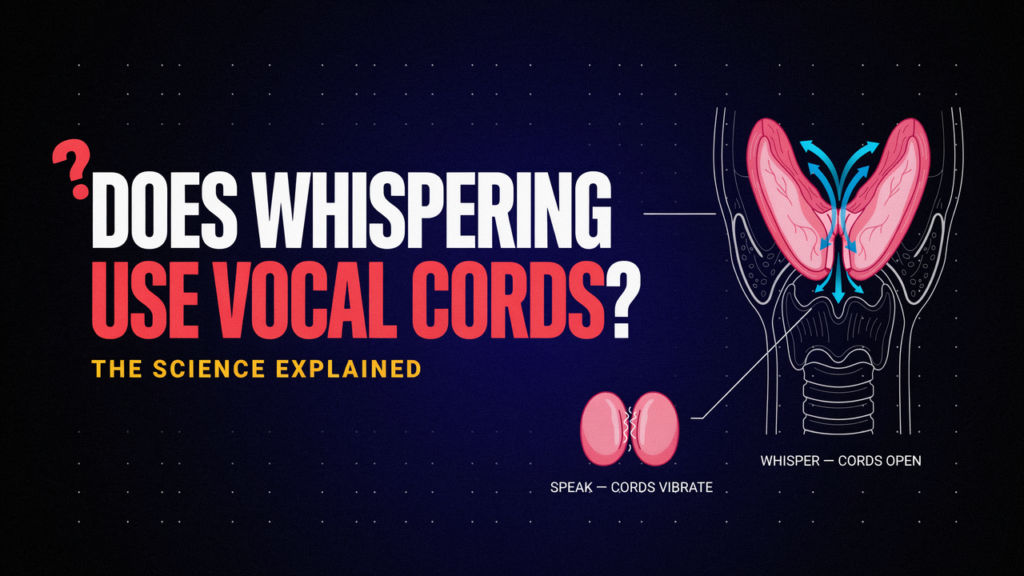
Yes, whispering uses the vocal folds and surrounding structures inside the larynx, but usually not in the same way as ordinary speech. During normal voiced speech, the vocal folds vibrate rapidly and regularly. During a typical voiceless whisper, they are positioned to create a narrow opening through which air produces turbulent noise, usually without regular vocal-fold vibration.
This means whispering is not the same as giving your voice complete rest. It still requires airflow, laryngeal positioning, and articulation. A gentle, brief whisper may feel easy for some people, but a loud or forced whisper can involve considerable effort.
What Do the Vocal Folds Do During a Whisper?
The vocal folds—commonly called vocal cords—are two flexible structures inside the larynx. During quiet breathing, they remain separated so air can move freely through the glottis, the space between them.
During ordinary voiced speech, laryngeal muscles bring the folds toward the center. Air pressure from the lungs then helps initiate rapid, repeating vibration. That vibration generates the sound source that the throat, mouth, tongue, and lips shape into speech.
During a typical whisper, the larynx uses a different configuration. Much of the glottis may be narrowed while a small opening remains, often toward the back. Air rushing through this opening becomes turbulent and creates the soft, noisy source associated with whispering.
The vocal folds therefore remain actively positioned even when they are not vibrating regularly. Saying that whispering “does not use the vocal cords” is inaccurate.
For a complete explanation of normal phonation, see how vocal cords work.
Whispering vs. Normal Speech
Whispering and speaking use the same respiratory tract, larynx, vocal tract, and articulators, but they create sound differently.
| Voice Activity | Vocal-Fold Behavior | Primary Sound Source |
|---|---|---|
| Quiet breathing | Folds remain open | No intended voice sound |
| Normal speech | Folds usually vibrate for voiced sounds | Periodic vocal-fold vibration |
| Gentle whisper | Narrow glottal configuration, usually without regular vibration | Turbulent airflow |
| Forced whisper | Stronger airflow and possible constriction | More intense turbulent airflow |
| Complete voice rest | No intentional speaking or whispering | No intentional voice production |
Whispering still requires the tongue, lips, jaw, and soft palate to form recognizable words. The difference lies primarily in the sound source generated at the larynx.
Listeners can often understand whispered speech because the vocal tract continues to shape airflow into distinct consonants and vowels. However, the clear musical pitch associated with regular vocal-fold vibration is usually absent.
Gentle and Forced Whispering Are Different
Not every whisper uses the same degree of effort. This distinction explains why simple claims such as “whispering is always harmful” or “whispering always rests the voice” are unreliable.
A gentle whisper uses low intensity and does not attempt to reach someone across a room. It may feel relatively easy when used briefly.
A forced whisper—sometimes called a stage whisper—attempts to create greater loudness without returning to ordinary voicing. The speaker may push more air, tighten structures around the larynx, exaggerate articulation, or compress the throat to make the words carry.
Warning signs that your whisper is becoming effortful include:
- Tightness in the throat or neck
- Rapidly running out of breath
- Dryness or irritation
- Strong abdominal pushing
- Raised shoulders during inhalation
- Increasing the whisper to compete with noise
- Discomfort after speaking
If you must force a whisper to be heard, amplification, text messaging, writing, or moving closer to the listener may be more appropriate.
Is Whispering Bad for Your Voice?
Whispering is not automatically damaging in every person or situation. Research has found that laryngeal behavior during whispering varies among individuals. Some people show greater constriction, while others use a less effortful pattern.
The concern is that many people do not whisper gently. They try to project the whisper, squeeze the throat, or use excessive airflow. This can feel tiring and may be unhelpful when the larynx is already irritated.
The practical question is therefore not simply whether you are whispering. Ask:
- Am I pushing air?
- Does my throat feel tight?
- Am I trying to whisper loudly?
- Does the voice feel worse afterward?
- Am I supposed to be following complete voice rest?
Pain, burning, increasing hoarseness, or loss of vocal control are reasons to stop. Do not continue whispering because you assume the absence of normal vibration makes it harmless.
General work on releasing vocal tension may help you recognize excessive effort, but exercises should not be used to self-treat an unexplained or persistent voice problem.
Does Whispering Count as Voice Rest?
Whispering does not count as complete voice rest. It uses the larynx and requires active coordination even when periodic vocal-fold vibration is absent.
Voice rest can mean different things depending on why it was recommended:
- Relative voice rest reduces the amount and intensity of voice use.
- Complete voice rest generally means avoiding intentional vocalization, including speaking, singing, humming, and whispering.
If a clinician prescribed voice rest after surgery, injury, or another diagnosed condition, follow the exact instructions provided. Do not assume that whispering is permitted. Postoperative guidance can vary according to the procedure and individual case.
When complete rest is required, use text messages, writing, gesture, or text-to-speech tools rather than whispering. Avoid repeatedly testing whether your voice has returned unless your clinician has instructed you to do so.
Whispering When You Have Laryngitis or Hoarseness
Hoarseness can occur when the vocal folds are swollen, irritated, unable to close normally, or affected by another condition. Trying to whisper loudly through an irritated larynx may add effort rather than provide meaningful rest.
If you have temporary hoarseness during a respiratory illness, reduce unnecessary talking and avoid singing, yelling, or speaking over noise. Communicate quietly and briefly when necessary, provided doing so is comfortable. Do not force either speech or whispering.
Supportive habits may include:
- Drinking adequate water
- Allowing time for sleep and recovery
- Avoiding smoke and other irritants
- Using amplification when speech is necessary
- Limiting prolonged conversations
- Avoiding repeated throat clearing
- Following medical guidance for the underlying illness
Water supports systemic hydration, but it does not directly wash the vocal folds. Food and liquid normally travel toward the esophagus rather than over the folds.
Safer Communication When Your Voice Is Tired
If your voice feels mildly tired after ordinary use, begin by reducing vocal demand. Move to a quieter environment instead of trying to communicate over background noise.
Use short phrases and a comfortable volume. Avoid an artificially low pitch, exaggerated breathiness, or pressed speech. Efficient speaking should feel easier than a projected whisper.
Helpful alternatives include:
- Sending a text or written note
- Using a text-to-speech app
- Moving closer to the listener
- Turning off music or other noise
- Using a microphone for necessary public speaking
- Scheduling quiet breaks
- Postponing nonessential conversations
Breathing should remain coordinated rather than forced. The guide to breathing techniques for singing can help explain airflow management, but breathing exercises are not a treatment for active laryngeal illness.
After temporary fatigue has resolved, return to voice use gradually. A gentle vocal warm-up generator can help organize comfortable preparation for healthy singers, but do not warm up through pain or significant hoarseness.
Can Whispering Train or Improve the Voice?
Whispering is not a substitute for normal vocal technique. Because ordinary whispering usually lacks regular vocal-fold vibration, it cannot train pitch coordination in the same way as voiced exercises.
Repeated whisper practice also does not strengthen the vocal folds. For singers, useful training generally involves coordinated breathing, efficient phonation, resonance, pitch accuracy, and gradual workload progression.
If you want to develop your voice, use comfortable voiced exercises suited to your current ability. Broader guidance on improving your singing can help you build technique without treating whispering as a shortcut.
When Hoarseness Needs Medical Attention
Temporary hoarseness often accompanies a cold or unusual voice use, but persistent or severe symptoms should not be managed through online advice alone.
Arrange an evaluation with an appropriate healthcare professional if hoarseness lasts longer than three weeks, particularly when you have not had a cold or flu.
Seek prompt medical attention if you experience:
- Difficulty breathing
- Difficulty swallowing
- Coughing up blood
- A lump in the neck
- Pain while speaking or swallowing
- Complete voice loss lasting more than a few days
- A sudden voice change after intense vocal use
Professional singers, teachers, broadcasters, and other occupational voice users may benefit from evaluation by an ear, nose, and throat physician, preferably a laryngologist, and a voice-specialized speech-language pathologist.
Frequently Asked Questions
Does whispering make the vocal cords vibrate?
Ordinary voiceless whispering usually does not involve regular vocal-fold vibration. The folds are still actively positioned to create a narrowed opening that produces turbulent airflow.
Does whispering use your voice box?
Yes. Whispering uses the larynx, airflow, vocal tract, and articulators even though its sound source differs from normal voiced speech.
Is whispering worse than talking?
Not universally. A gentle whisper may be comfortable for some people, while a forced whisper can involve substantial airflow and constriction. Comfortable, quiet speech may sometimes be easier than projected whispering.
Can I whisper when I lose my voice?
It is usually better to reduce communication and avoid forcing either whispering or speech. Follow professional guidance when voice loss is severe, persistent, or accompanied by other symptoms.
Is whispering allowed during voice rest?
Not during complete voice rest unless your clinician specifically permits it. Relative voice-rest instructions vary, so confirm what activities are allowed.
Can singers practice songs by whispering?
Whispering may help review lyrics or rhythm, but it does not reproduce normal vocal-fold vibration or train sung pitch effectively. Silent mental rehearsal is often a better rest-day option.

Harlow is a vocal analysis and singing tools writer at Voice Range Test. She focuses on vocal range testing, voice type analysis, pitch recognition, and singing education tools for singers, musicians, choir performers, and beginners.